9/11 attacks compelled NYC Emergency Management to evolve. Here's how the agency has changed.

After the Sept. 11, 2001 terror attacks, New York City faced a difficult question: how can more lives be saved in future mass emergencies?
A quarter-century later, the city says it's far better equipped to handle such a tragedy.
The collapse of 7 World Trade Center on 9/11
All day every day, New York City Emergency Management scans the five boroughs, listening to police radios and watching traffic feeds.
"This is kind of the city's eyes and ears," Commissioner Christina Farrell said.
From the department's headquarters, Farrell and her team use those tools to decide what resources are needed and where. It's a building that's very existence serves as a stark reminder of the importance of emergency management. She showed CBS News New York images of the structure before and after the towers collapsed.
"People literally ran for their lives. They went over to the Police Academy on 23rd Street and that was where operations ran for a couple days. And that building, [7] World Trade, collapsed at about 5 p.m.," Farrell said.
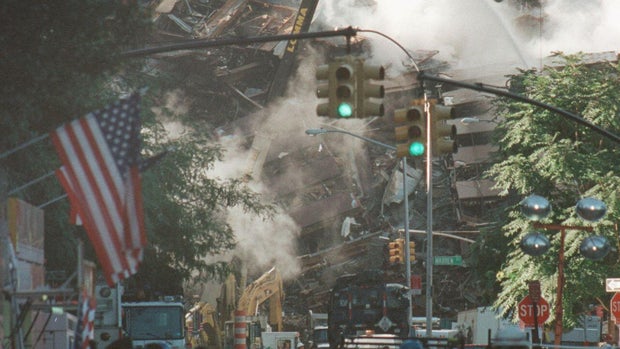
Farrell said all of the Emergency Management office employees survived, but some died later from 9/11-related illnesses.
In November 2001, New Yorkers voted overwhelmingly to elevate the office to an official charter agency. The city built the new headquarters and opened it in 2006.
"For the whole city, the whole city government, there's definitely before 9/11 and after 9/11, but for our agency, I think it's hard to overstate how much it shaped our legacy," Farrell said.
NYC Emergency Management's evolution following tragedy
These days, Emergency Management works with city agencies to form plans on how to continue operations in the event of a disaster. It also manages messages the public gets warning about severe weather, and it helps coordinate how police, firefighters and other agencies work together in emergencies to save more lives.
"I remember the smell, and if you can envision or picture the smell of burning flesh and burning metal, that was something that never left me," retired NYPD Lt. Darrin Porcher said.
Porcher said City Hall realized after 9/11 it had to strengthen relationships and communications between various city agencies.
"That relationship has now made us a more safer city. We have 8.5 million residents that reside in the city of New York that deserve better and we've since delivered," Porcher said.
And it's not just the smell Porcher can't forget. There's also the memories of his fellow officers who died that day. Farrell, who was working for the mayor's office at the time, said she also lost friends and co-workers.
"It really is something that we'll never forget and we'll never stop thinking about, feeling the impact from [it] and really giving us a purpose to come here and serve the city," Farrell said.
The commissioner said one thing she learned from 9/11 is that you can never truly know what the next emergency will be, so she tries to stay ready for anything -- from Canadian wildfire smoke to massive blizzards.


