Power out for hundreds of thousands, death toll rises in wake of winter storm
Hundreds of thousands of power outages were reported across the U.S. as a monster, deadly storm hit huge sections of the country, snarling roadways with dangerous ice and forcing mass flight cancellations.
CBS News has confirmed at least 39 storm-related deaths as of Tuesday, including in Pennsylvania, Kansas, Texas, Louisiana, Mississippi, Tennessee and New York City.
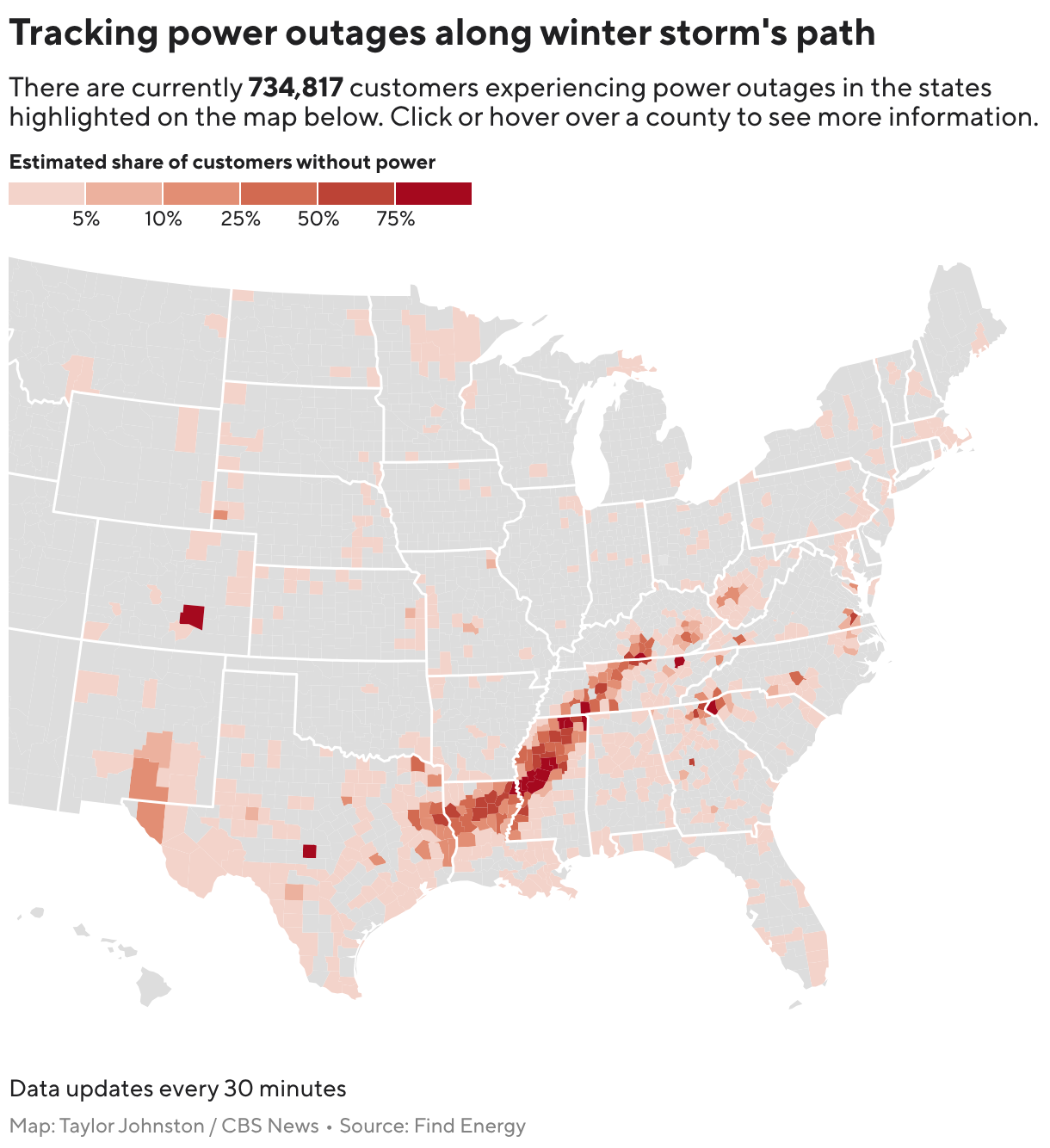
As dangerous conditions persist, many power outages were reported across Texas, Louisiana, Mississippi, Tennessee and Kentucky. The map below shows current data on power outages from PowerOutage.us, by county:
At one point, widespread heavy snow, sleet and freezing rain threatened nearly 180 million people — more than half the U.S. population — in a path stretching from the southern Rocky Mountains to New England, the National Weather Service said. It warned people to brace for a string of frigid days.
"The snow and the ice will be very, very slow to melt and won't be going away anytime soon, and that's going to hinder any recovery efforts," said Allison Santorelli, a meteorologist with the National Weather Service.
CBS News meteorologist Nikki Nolan said the storm "will linger in the New England region through Monday morning before finally exiting the U.S. later in the day," followed by "frigid cold temperatures well below average for this time of year."
President Trump approved emergency declarations for a dozen states by Sunday, with more possible. The Federal Emergency Management Agency pre-positioned supplies, staff and search and rescue teams in numerous states, Homeland Security Secretary Kristi Noem said.
"We just ask that everyone would be smart — stay home if possible," Noem said.
The Midwest saw windchills as low as minus 40 Fahrenheit, meaning that frostbite could set in within minutes. The minus 36 Fahrenheit reading in Rhinelander, Wisconsin, on Saturday morning was the coldest in almost 30 years.
Heavy snowfall for the Northeast
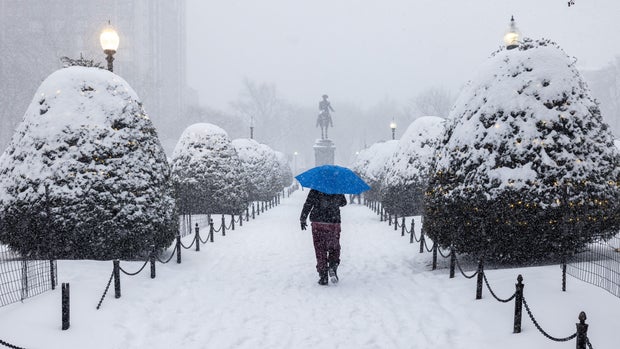
The storm began dumping heavy snow on the Northeast early Sunday. By Monday morning, parts of Massachusetts had more than 20 inches of snow, and Boston had 18 inches, CBS News Boston reported. Schools across the state were closed Monday because of the snowstorm.
A woman in Norwood, Massachusetts, was hit and killed by a snow plow truck on Sunday while walking with her husband.
In Pittsburgh, more than a third of the city's plow trucks broke down, forcing Mayor Corey O'Connor to declare a state of emergency on Monday. O'Connor said 37 of the 95 plows were in the repair garage, and the rest of the fleet was struggling to keep up, CBS Pittsburgh reported.
The state of emergency declaration "gives us the power to bring in additional help and support," O'Connor said at a news conference. "It allows us to bring in private contractors. They're not only going to help remove snow and plow streets, but also help haul snow out of our neighborhoods."
New York City got nearly a foot of snow — 11.4 inches in Central Park, a record for the date, CBS New York reported. City schools switched to remote learning for Monday.
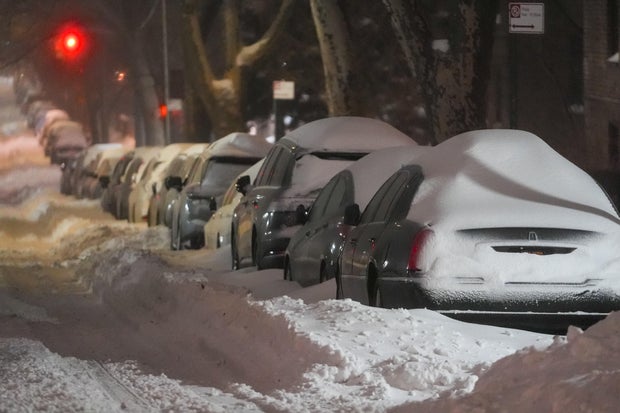
The Philadelphia area got upward of 9 inches of snow, the most the city has seen since 2016, CBS Philadelphia reported.
Three people died while trying to shovel and clear snow during Sunday's winter storm in Lehigh County, Pennsylvania, the coroner's office said. They ranged in age from 60 to 84 years old.
Forecasters warned the storm damage, especially in areas pounded by ice, could rival that of a hurricane. Weather forecasters also said the winter storm was unusual.
"I think there are two parts of this storm that make it unique. One is just a broad expanse of spatial coverage of this event. ... You've got 2,000 miles of country that's being impacted by the storm with snow, sleet, and freezing rain," said Josh Weiss, a meteorologist at NOAA's Weather Prediction Center. "The other part of this storm that's really impressive is what's going to happen right afterward. We're looking at extreme cold, record cold."
Deep freeze grips the South
Before moving northeast, the winter storm brought an unusually fierce deep freeze to a wide expanse of the South.
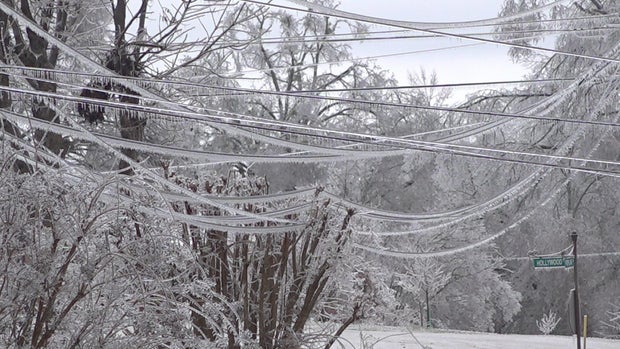
In Shelby County, Texas, near the Louisiana border, ice weighed down on pine trees and caused branches to snap, downing power lines, leaving thousands without power.
"We have hundreds of trees down and a lot of limbs in the road," Shelby County Commissioner Stevie Smith said from his pickup truck. "I've got my crew out clearing roads as fast as we can. It's a lot to deal with right now."
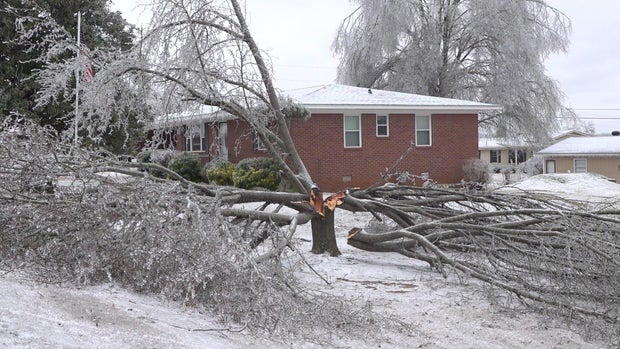
At least one person died in the Lone Star State: a 16-year-old girl, who was killed in a sledding accident in Frisco, according to local authorities. An elderly man in Colleyville, Texas, northeast of Fort Worth, was hospitalized after being found in a pond in freezing conditions on Sunday morning, CBS Texas reported.
As of Monday, two deaths were reported in Louisiana as a result of the winter weather, three in Tennessee, two in Mississippi and one each in New York and Kansas, where a missing woman was found dead in the snow in Emporia, authorities said.
There were reports of vehicles hitting fallen trees and trees falling onto houses in DeSoto Parish, Louisiana, where more than half of all electric customers lost power.
"We got limbs that are dragging the ground," said Mark Pierce, a spokesperson for the local sheriff's office. "These trees are just completely saturated with ice."
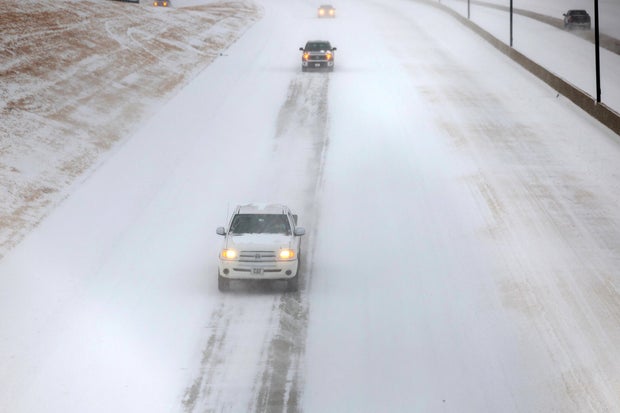
In Louisville, Kentucky, emergency services on Saturday handled more than 850 calls regarding collisions, stranded motorists and other emergencies related to exposure to cold, officials said, noting that the actual number could be even higher.
In Rabun County, one of the hardest hit parts of Georgia, officials say they've had fallen trees and downed power lines, along with icy and hazardous roadways around the county. Even when the storm moved out of the area, officials warned residents not to get on the roads, as below-freezing temperatures will cause ice to reform, making travel dangerous, CBS Atlanta reported.
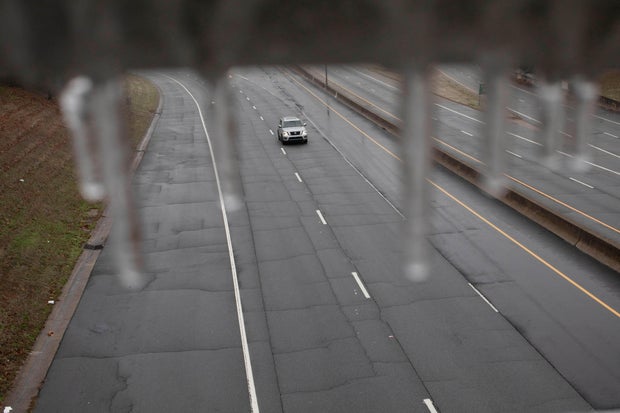
Churches moved Sunday services online, and the Grand Ole Opry in Nashville, Tennessee, decided to hold its Saturday night radio performance without fans. Mardi Gras parades in Louisiana were canceled or rescheduled.
Jami Joe of Nashville, 41, feared her electricity might not last as ice-heavy limbs from oak and pecan trees continued to crash around her house. "It's only a matter of time if a limb strikes a power line," she said.
Over 190,000 people in Tennessee were still without power Monday night, according to poweroutage.us. Nashville Electric Service said Sunday afternoon the outages could last days or longer.
School closings were announced for Monday in numerous cities, including Dallas, Houston and Memphis.
Some universities in the South canceled classes for Monday, including the University of North Carolina at Chapel Hill and the University of Mississippi's main campus in Oxford.
In Mississippi, some 140,000 had no power as of Monday evening.
Oxford city officials posted photos on social media of slick roads and ice-coated trees sagging or breaking under the added weight.
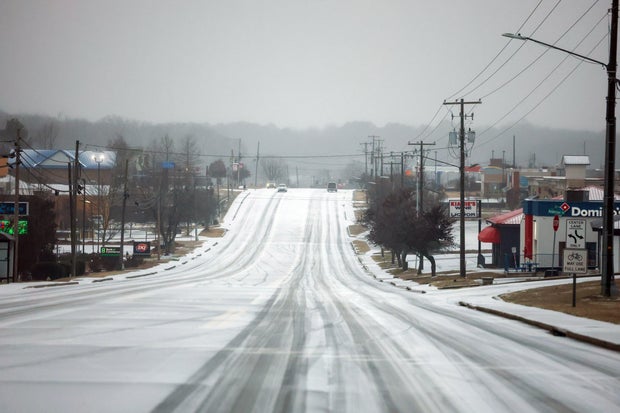
"We haven't seen a storm of this magnitude, in terms of ice, since 1994," Mississippi Gov. Tate Reeves said Sunday.
After the storm in 1994, some locals remembered being without power for weeks. During the press conference on Sunday, the governor was asked how long it would take for power to be restored, especially in harder hit areas, but said he didn't want to "begin to try to forecast or estimate when some of the power can or cannot be put back on."
Reeves said he was requesting help from FEMA to send cots and food to warming shelters, as well as generators to long-term care facilities and hospitals that don't have adequate backup generators.
On the highways, crews clearing downed trees were feeling overwhelmed.
"We're spread thin on equipment here, because there's so many guys in different directions and we're out here having to mainly do this where usually we would need a backhoe or bulldozer, something to help move this stuff," said John Sanford, a road worker with the Mississippi Department of Transportation. "One of the guys that worked with us, he couldn't make it back this morning. He's got two trees on his house."
Asked what the biggest challenges were with clearing the roads, Sanford replied, "No sleep, the cold, the rain, you know, just getting exhausted... You just get physically tired and you know, there's more and more trees falling, people needing help. The minute you get one cleaned up, another one falls."
In New Albany, Mississippi, resident Eddie Swords said the constant cracking limbs and falling trees "sound like a firecracker popping."
He added, "The first one fell last night, I thought, 'Who's shooting firecrackers this time of night?' They go 'pop, pop.'"
Swords said the power was out at his house, but he has a generator at his home, "thank goodness." One of his friends — who he said helped him chainsaw a path in and out of his neighborhood so they could get fuel — will be staying over to keep warm.
"I told anybody who wants to come down, 'I got natural gas that's good and toasted in there right now,'" Swords said.