Pete Hegseth says "we'll be hanging around" after Iran ceasefire announcement
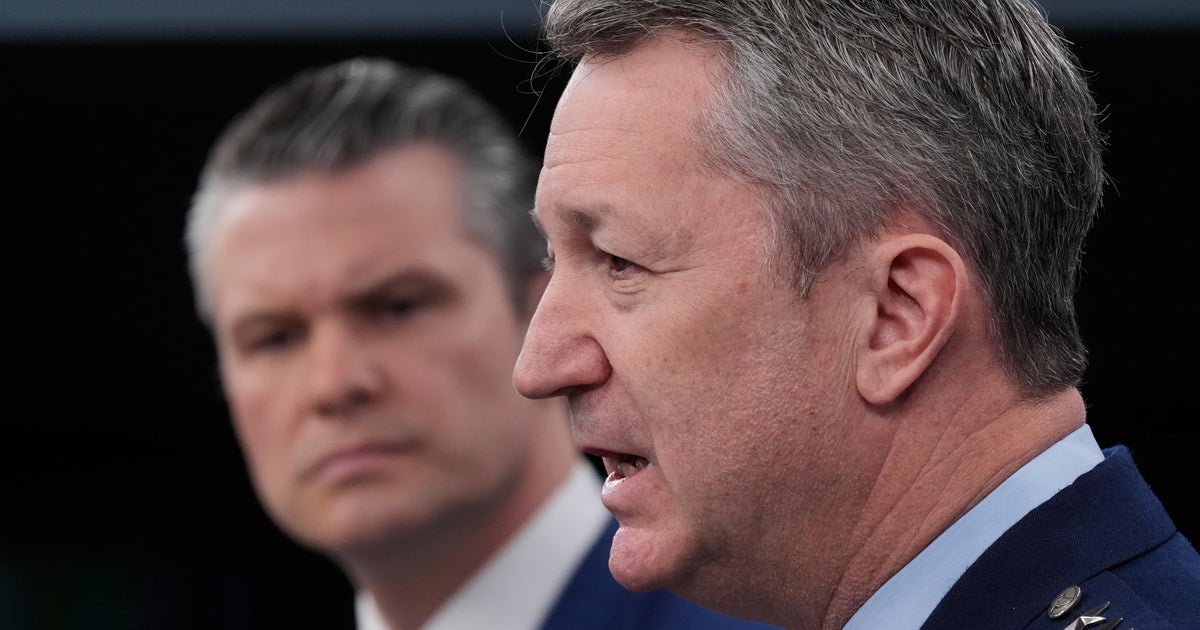
Defense Secretary Pete Hegseth on Wednesday said "we'll be hanging around" after the announcement of a two-week ceasefire with Iran, while saying that Iran knows "this agreement means that they will never, ever possess a nuclear weapon."
Hegseth announced at the start of Wednesday's briefing that the Pentagon's job is done in Iran. But he clarified that "we're not going anywhere" and "our troops are prepared to defend, prepared to go on offense, prepared to restart at a moment's notice" to ensure that Iran complies with the ceasefire.
Wednesday's briefing came after President Trump announced late Tuesday that he had agreed to "suspend the bombing and attack of Iran for a period of two weeks," adding that the U.S. has "already met and exceeded all Military objectives."
Mr. Trump said early Wednesday that under the agreement, "there will be no enrichment of Uranium, and the United States will, working with Iran, dig up and remove all of the deeply buried (B-2 Bombers) Nuclear 'Dust.'"
Hegseth said at the briefing that "it takes time sometimes for a ceasefire to take hold." He added that "we're watching it, we're prepared if necessary, but we hope and believe that it will hold."
Hegseth said as he opened the briefing that "Iran has been a threat to the United States and the free world for 47 years."
"No longer, not on our watch," he added.
Hegseth echoed the president's message, touting a "big day for world peace." And he praised the U.S.' military operation as a "historic and overwhelming victory on the battlefield."
"By any measure, Epic Fury decimated Iran's military and rendered it combat ineffective for years to come," he said.
Hegseth said "in less than 40 days," the U.S. "dismantled one of the world's largest militaries."
"The world's leading state sponsor of terrorism proved utterly incapable of defending itself, its people or its territory," he said. "We untied just a fraction of our strength, and Iran suffered a devastating military defeat."
Hegseth said "now we have a chance at real peace and a real deal" amid the ceasefire. He said the Pentagon "for now, has done its part," and stands ready to "ensure Iran upholds every reasonable term."
Caine said "over the course of 38 days of major combat operation, the Joint Force achieved the military objectives as defined by the president." The joint chiefs chairman said "we welcome the ongoing ceasefire," adding that "we hope that Iran chooses a lasting peace."
The ceasefire announcement came after Mr. Trump said early Tuesday morning that a "whole civilization will die" if Iran didn't agree to a deal.
Asked whether the U.S. was prepared to follow through on the threat, Hegseth said "we had a target set locked and loaded of infrastructure, bridges, power plants," and Iran "knew exactly the scope of what we were capable of."
"He ultimately said, 'we can take it all from you, your ability to export energy will be taken away,'" Hegseth said of the president. "That type of threat is what brought them to the place where they effectively say, 'OK, we want to cut this deal.'"
Amid the ceasefire announcement, oil prices plunged Wednesday, staying well above pre-war levels but dropping below the $100 a barrel mark, and stocks soared in early trading Wednesday.
But at least three explosions were heard around Iran's Lavan Island Oil Refinery, the country's state media reported Wednesday, hours after Mr. Trump said the U.S. and Iran had agreed to a conditional two-week ceasefire.
It was not immediately clear whether U.S. or Israeli forces had launched new attacks on the island, which sits less than 10 miles off Iran's coast in the Persian Gulf, west of the entrance to the Strait of Hormuz.
Israel has also agreed to the ceasefire proposal, a White House official told CBS News. But Israeli Prime Minister Benjamin Netanyahu's office announced late Tuesday night that while Israel supports the United States' two-week ceasefire with Iran, the accord doesn't cover the fighting between Israel's military and Hezbollah, the Lebanon-based Iranian proxy.
Iranian Foreign Minister Seyed Abbas Araghchi confirmed that Iran had agreed to halt "defensive operations," likely referring to its drone and missile strikes on U.S. allies in the region, if the U.S. stops attacking Iran. Araghchi also said Iran's armed forces will coordinate to allow for "safe passage through the Strait of Hormuz."
A maritime monitoring service said Wednesday that vessel movement was resuming in the Strait of Hormuz, with two ships moving through the vital waterway.
"Early signs of vessel activity are emerging in the Strait of Hormuz following a ceasefire," MarineTraffic said on X.
"Initial movements are now being recorded," it said. "The Greek-owned bulk carrier NJ Earth crossed the Strait at 08:44 UTC, while the Liberia-flagged Daytona Beach transited earlier at 06:59 UTC, shortly after departing Bandar Abbas at 05:28 UTC."