Third party will audit Medicaid billing at Minnesota's Department of Human Services, Walz says

Gov. Tim Walz on Wednesday said that a third party will audit billing for 14 Medicaid services that are deemed to be "high risk" for fraud in Minnesota.
The Department of Human Services is partnering with Optum on a one-year, $2.3 million contract using funds passed during the 2025 legislative session in an effort to flag potentially fraudulent claims.
According to Department of Human Services Temporary Commissioner Shireen Gandhi, the department will send Optum batches of claims every two weeks to verify.
Optum will identify any irregularities such as missing documentation and unusually high billing patterns, according to the governor's office. They'll then pass that information to the human services department to review.
Walz says that the review of payments could result in longer wait times before the providers are paid, but the state will still meet federal rules which require payment within 90 days. Gandhi says the department intends to pay most claims within 30 days.
"We cannot effectively deliver programs and services if they don't have the backing of the public's trust. In order to restore that trust we are pumping the brakes on 14 programs that were created to help the most disadvantaged among us, yet have become the target of criminal activity," said Walz, a Democrat.
In July, the state paused payments to 50 housing stabilization providers as federal agents moved to investigate a "massive" fraud scheme connected to the program. Eight people were charged with allegedly taking millions of dollars. Gandhi said Wednesday that the housing stabilization benefit will end after this week.
A search warrant from late last year also accused two Minnesota autism treatment centers of submitting fraudulent claims for services that were never provided. A 28-year-old woman faces several federal wire fraud charges tied to the $14 million scheme
The investigations came after more than 70 people were charged in the massive Feeding Our Future scheme, which prosecutors have said is the largest pandemic fraud case in the country, totaling $250 million. The ringleader, Aimee Bock, was convicted of conspiracy to commit wire fraud and federal programs bribery after taking money that was meant to feed hungry children.
"Governor Walz's decisive actions today to further crack down on fraud shows he is not just talking about fraud, he is acting to stop it before it happens," said state Senate Majority Leader Erin Murphy, DFL-St. Paul.
Lisa Demuth, a Republican and speaker of the Minnesota House, said that "Minnesota have watched scandal after scandal unfold under Governor Walz, but the fact that there are more than a dozen programs under suspicion proves that Walz's fraud crisis is far worse, and far more widespread, than anyone was lead to believe by the administration."
Rep. Kristin Robbins, a Republican from Maple Grove who is also running for governor, said that she's "glad to see Governor Walz is finally taking action to audit these programs after years of ignoring credible allegations of fraud. I called for a full federal audit months ago and am glad he has decided to take this seriously."
Below are the 14 services identified as high-risk for billing fraud:
- Early Intensive Developmental and Behavioral Intervention services for autism
- Integrated Community Supports
- Nonemergency Medical Transportation
- Peer Recovery Services
- Adult Rehabilitative Mental Health Services
- Adult Day Services
- Personal Care Assistance/Community First Services and Supports
- Recuperative Care
- Individualized Home Supports
- Adult Companion Services
- Night Supervision
- Assertive Community Treatment
- Intensive Residential Treatment Services
- Housing Stabilization Services
"Everybody's in survival mode"
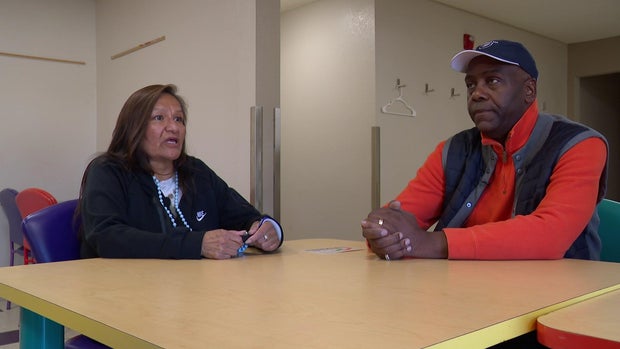
For Nancy Masiello, the housing stabilization program wasn't a handout but a hand up — one she says has allowed her to stay sober. Her one-bedroom apartment in St. Paul means safety and stability.
A few years back, things were falling apart. She broke her lease over safety and crime concerns. Her rental record then made it challenging to find housing.
"I was so discouraged I felt like I was going to start drinking again," Masiello said.
Her turning point came by chance. Masiello ran into someone who owned an HSS program. She says within six months she found a place to call home.
"I feel really lucky. I don't know where I would be without her and the program," Masiello said.
Dan Johnson and his wife run Nexa Home Connect, and they've helped about 50 people like Masiello find housing.
"It does make you say, 'Hey, this should continue,'" Johnson said. "There should be a way to make sure all people like Nancy get the help to move forward."
Johnson is one of nearly 2,000 owners who are HSS providers. He is upset that a few bad actors ruined a program he says is transformative.
"[State officials] need to arrive at a solution," Johnson said.
For Masiello, it feels personal.
"It's a sin that they are taking away from people they were supposed to be helping," she said. "Without proper housing, everybody's in survival mode, and nobody can advance like to get better jobs or education."
State officials have posted next steps online for people impacted. Click here for more information.


