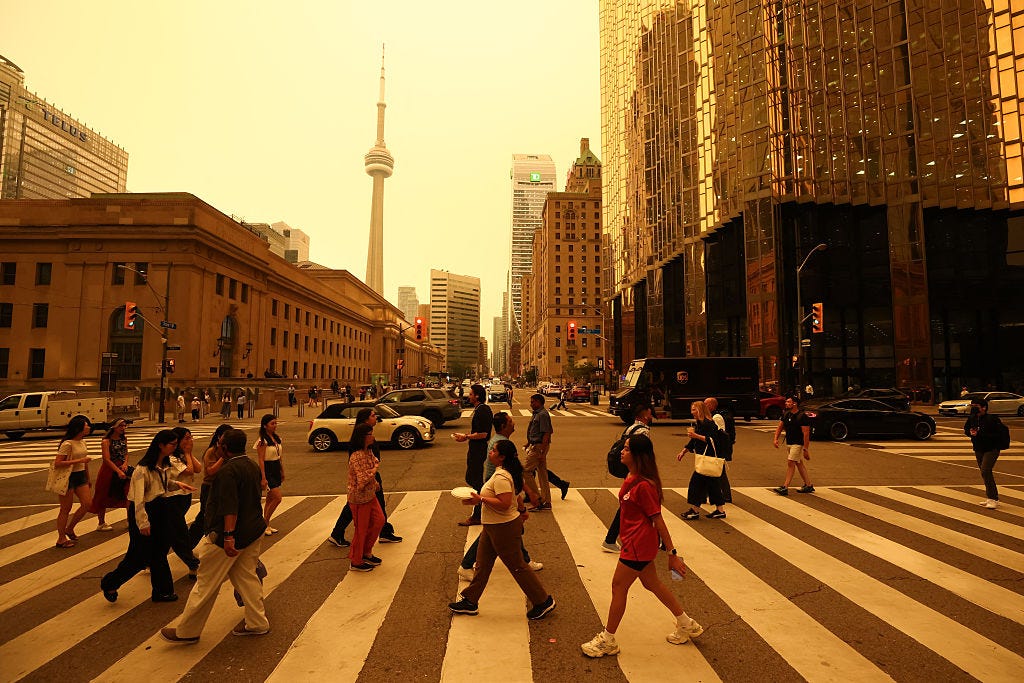
Maps show wildfire smoke forecast, air quality alerts due to pollution from Canadian, Minnesota fires
Heavy smoke from wildfires blazing in Canada and Minnesota engulfed large swaths of the Midwest and Northeast U.S. this week, impacting air quality and exposing millions of people to hazardous levels of air pollution. Conditions across the Northeast finally began to improve over the weekend while smoky air persists in parts of the Midwest.
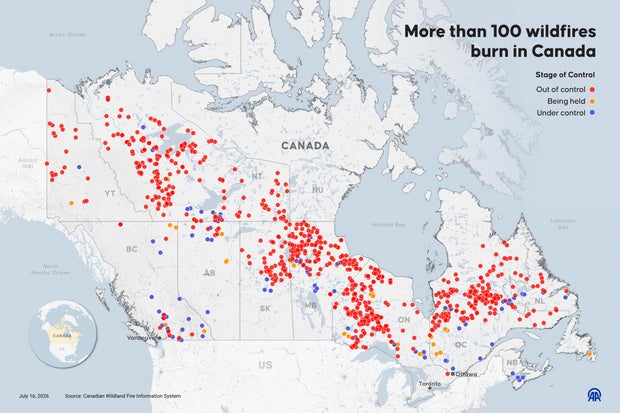
Hundreds of wildfires are burning in Canada, and winds are carrying the smoke southeast. Multiple wildfires are raging in northern Minnesota.
High levels of fine particulate matter in the air from smoke can be unhealthy, especially for sensitive groups such as children and people with heart or lung conditions.
Air quality today
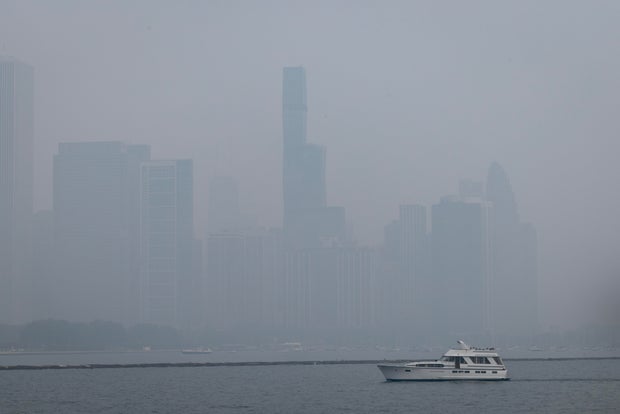
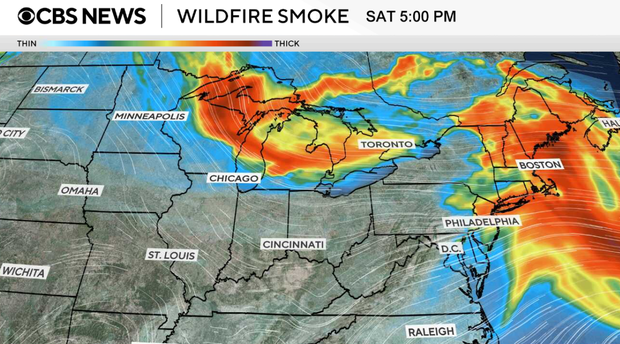
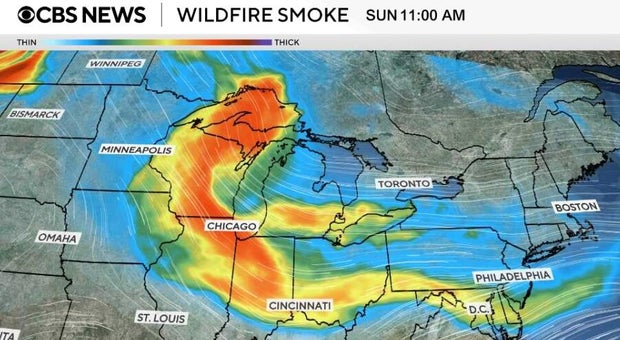
Chicago and Minneapolis ranked among the world's most polluted major cities on Sunday morning, as air quality alerts stretched across the Great Lakes region.
The wildfire smoke thinned thin out across the Northeast after a cold front moved through the region Saturday, bringing powerful storms.
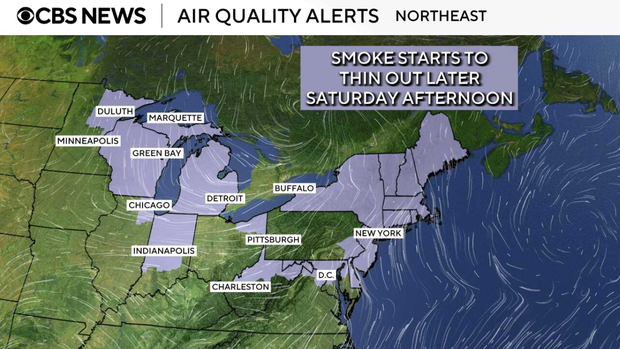
Minnesota officials issued an air quality alert that extends into the weekend for much of the state, with very heavy smoke across the state's northeastern corner. Air quality levels in northeast Minnesota reached hazardous levels, making it unsafe for everyone.
Officials in Michigan and Wisconsin also warned residents about air quality issues. The entire state of Michigan was under an air quality alert Friday before clearer air moved in.
In Chicago, more smoke was forecast to return late Saturday into Sunday.
Conditions in Washington, D.C., improved to "moderate" on Sunday. The district had been under a Code Purple alert Saturday, meaning the air was considered "very unhealthy" for everyone. The city urged healthy people to avoid "long or intense outdoor activities," and said older adults, children, and people with heart or lung conditions should avoid all physical activity outdoors.
Pennsylvania's Department of Environmental Protection declared a Code Orange air quality alert for Saturday — an improvement from the Code Purple in effect there on Friday.
Tens of thousands of fans gathering for the World Cup final in New Jersey on Sunday could see improved conditions for the Spain vs. Argentina matchup. World Cup organizers said Friday they were keeping a close eye on the situation.
"There's been discussion about it, and we have somebody with the National Weather Service that sits in FIFA headquarters there, so we're monitoring closely," Andrew Giuliani, the White House World Cup task force executive director, said at a briefing.
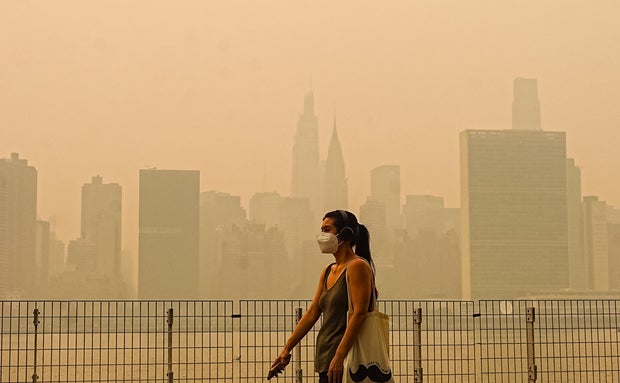
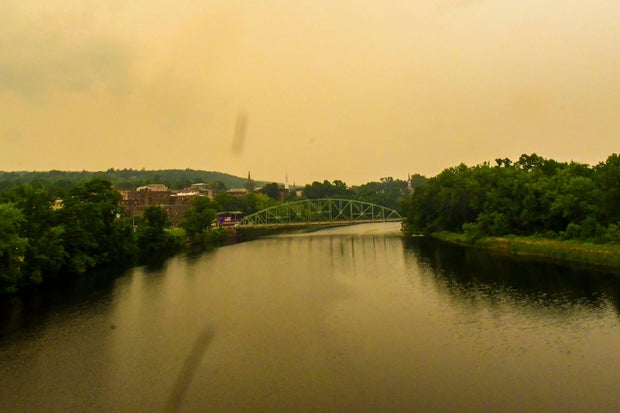
Last week, as a large plume of smoke from the fires seeped into New England, the skies morphed from a milky white to an ominous brown-yellow, CBS News Boston reported.
"It almost felt like you were at a campsite with an active fire going," West Roxbury resident James Venezia told the station.
Wildfire smoke maps
The following maps show the weekend's wildfire smoke conditions Conditions were forecast to improve for much of the Northeast on Sunday, while hazardous levels of smoke linger across parts of the Midwest.
"Not good from a health perspective"
People in the affected areas should stay indoors as much as possible to avoid the smoke, as well as extreme heat, said Tyler Hasenstein, a meteorologist with the National Weather Service in Chanhassen, Minnesota.
"Those two things coinciding with each other is not good from a health perspective," he said.
Fine particle pollution from wildfire smoke can cause shortness of breath, coughing, dizziness or fatigue and aggravate heart and lung diseases and other chronic health issues. Experts suggest reducing or eliminating outdoor activities, wearing an N95 mask if you have to be outside, and keeping your indoor air cleaner by closing windows and running an air purifier or air conditioner. Long term, exposure to fine particulate matter from wildfire smoke is one of the leading causes of premature death.
"If we keep being exposed to this level of air pollution over time, that increases our risks down the road for developing chronic health conditions," Dr. Alexander Azan, an assistant professor of population health and medicine at NYU Langone Health, told CBS News.
A study released earlier this year found that chronic exposure to air pollution from wildfires has been linked to tens of thousands of deaths annually in the United States.
"Whether you're somebody who's working outdoors [or] you have an errand that you just can't not do today or tomorrow, the best way to keep yourself safe is buying an N95 or KN95-grade mask," Azan said.
Canadian wildfires map
Dan Westervelt, associate professor at Columbia University's Climate School, said severe drought conditions combined with heat in Canada and the U.S. have created "a perfect storm for really dry conditions to provide a lot of fuel for these wildfires to burn." Research shows warming temperatures from burning coal, oil and gas are making fires more frequent and intense.
This map shows the span of the Canadian blazes, the majority of which are burning out of control.
A dramatic video captured the moment a freight train near Armstrong, Ontario, was suddenly surrounded by a wall of burning trees earlier this week. A panicked crew watched everything around them burn as they were unable to move until another train passed.
"This could potentially overtake us here, this has gotten a little scary," one crew member said in the video.
The Canadian National Railway later suspended rail operations there, but said everyone on board the train got through safely.
On Friday, President Trump threatened additional tariffs on Canada over the wildfire smoke, blaming the U.S.' northern neighbor for failing to contain the blazes.
Asked about the president's comments, Canadian Prime Minister Mark Carney's office referred CBS News to a statement from Canadian Minister of Emergency Management Eleanor Olszewski that said the country is "working with urgency alongside provincial and territorial partners." She also said Canada has spent billions of dollars on forest fire prevention in recent years.