Live updates: Trump says U.S.-Iran deal "not final," threatens to resume bombing "if they don't behave"
What to know about the Iran war today:
- President Trump said Wednesday that the U.S.-Iran agreement is not a final deal, and he warned that the U.S. could resume bombing Iran "if they don't behave."
- Israel has continued carrying out limited strikes in Lebanon since Mr. Trump announced the agreement with Iran. Tehran has said that if Israel keeps troops in Lebanon and continues attacks in the country, it would be considered a violation of the agreement with Washington.
- Iranian tankers are crossing the U.S. naval blockade line, adding to confusion for shippers after Mr. Trump said the blockade would only lift after the memorandum of understanding with Tehran is signed on Friday. Shipping firms say clarity and security guarantees are needed before normal operations can resume.
Vance says text of U.S.-Iran deal will be released Friday "at the latest"
Vice President JD Vance said Wednesday on "CBS Mornings" that the text of the U.S.-Iran deal would be released Friday "at the latest," adding that the White House is pushing to release it sooner. Vance said Qatari and Pakistani negotiators, who helped mediate the agreement, "asked us not to release the full text for a little while."
"We're actually trying to push them to get it out today, because we want to tell the American people what's in this deal," Vance said.
The vice president called it "a good deal for the American people," and said he had seen it being misrepresented.
Vance said the agreement would reopen the Strait of Hormuz "immediately" and provide a framework "whereby if the Iranians give us what we need on stopping the funding of terrorism, on no longer pursuing a nuclear weapon, then they can get some benefits, be reinvited into the world economy."
"When I say benefits, I'm talking about sanctions relief on their economy," he said. "We've destroyed their nuclear program, but one of the things the president is trying to do is give them the incentive not to try to rebuild that program for the long haul."
Pressed on whether the deal includes reconstruction financing of at least $300 billion for Iran, along with the release of all of Iran's frozen financial assets, as some reports have claimed, Vance said "none of those things flow to Iran unless Iran fundamentally changes how it behaves with the world."
"What the president is really saying is, if Iran fundamentally transforms how it deals with the United States and the region, the rest of the world, then Iran can get some economic benefits," said the vice president.
On gas prices, Vance said he expects prices to come down "a lot more" over the next few weeks.
"We really do think, as the president said, this was a short-term increase in prices," he said. "We understand it caused a lot of disruption, there are a lot of American families who are struggling, but this is not a long-term change."
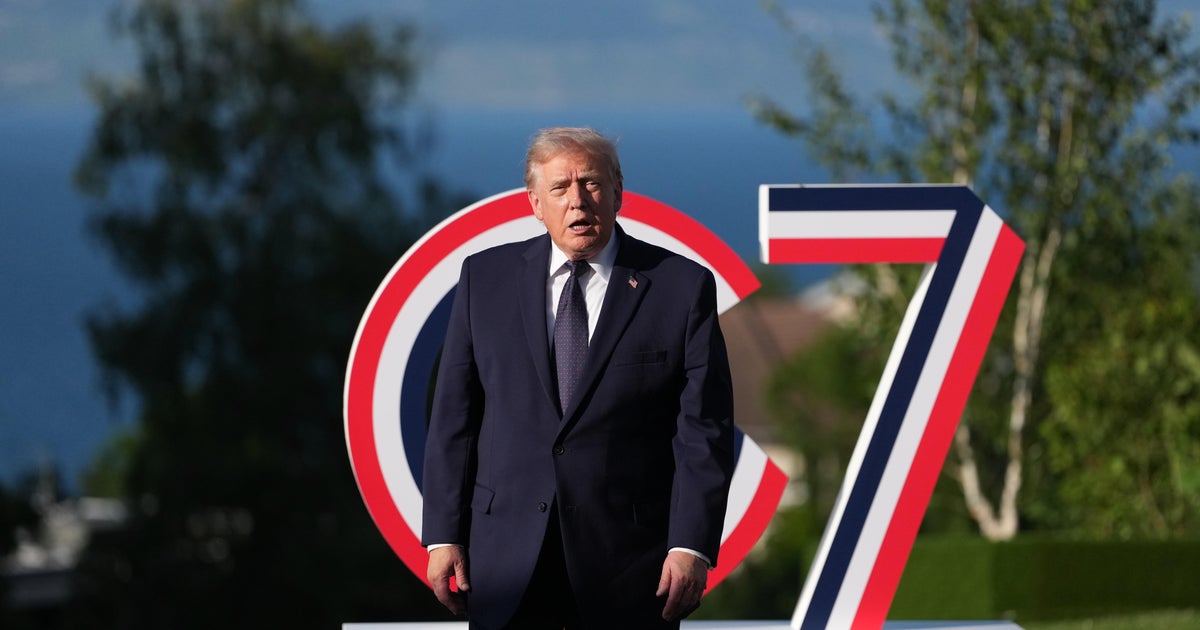
G7 leaders praise Trump's "strong leadership" in U.S.-Iran deal
Leaders at the G7 meeting praised the U.S.-Iran agreement as a "breakthrough" and "an historic opportunity to prevent Iran from acquiring any nuclear weapon."
"We welcome the announcement of a deal between the United States and Iran, secured under the strong leadership of President Trump, with the support of mediating countries," the statement said.
The leaders also called for an immediate ceasefire in Lebanon and the disarmament of the Iran-backed Hezbollah group.
Trump says he would resume "dropping bombs" if Iran doesn't "behave"
President Trump said on Wednesday the memorandum of understanding is not final and that he would resume fighting if Iran doesn't "behave."
Speaking to reporters in France at the G7 meeting, Mr. Trump said: "If I don't like it, we'll go back to shooting at them, dropping bombs on their head. If I don't like it, if they don't behave, we'll go right back to dropping bombs right smack in the middle of their head."
The president also said the deal does not include immediate sanctions relief for Iran, adding that he would clarify this matter at a later date.
Five Iranian ships have crossed U.S. blockade line in past 24 hours
Five sanctioned Iranian ships have crossed the U.S. naval blockade line in the Gulf of Oman over the last 24 hours.
Three crude oil tankers, one bulk carrier and a container ship departed the southern Iranian port of Chabahar and appeared to be headed east after transiting the blockade area Tuesday and Wednesday, according to open source tracking data from MarineTraffic.com.
Another sanctioned oil tanker, the Stream, turned off its location broadcasting system overnight Monday as it approached the blockade zone from the east, having left Pakistan's port of Karachi.
On Wednesday, crude oil tanker Herby and bulk carrier Aries were also tracked heading for the blockade area from Pakistan.
All of the vessels are Iranian-flagged and owned by the Islamic Republic of Iran Shipping Lines or the National Iranian Tanker Company, both of which are subject to U.S. sanctions in connection to Iran's oil trade and weapons program.
Commercial traffic through the Strait of Hormuz remains low, with the number of vessels transiting the gateway to the Persian Gulf in the single digits, compared to a historic average of around 135 vessels per day.
Price of oil continues to fall as market optimism grows over reopening of Strait of Hormuz
Oil prices stabilized after falling sharply earlier on optimism over a possible end to the war and reopening of the Strait of Hormuz, crucial for oil and gas transport worldwide.
Brent crude, the international standard, traded 1% lower at $78.19 per barrel early Wednesday after falling more than 5% on Tuesday. It was still above its roughly $70 a barrel level in late February, before the war started.
Benchmark U.S. crude was down 1.1% to $75.21 a barrel.
Mixed messaging over Strait of Hormuz
Mixed messages about the status of the U.S. naval blockade of Iran's ports and vessels around the Strait of Hormuz, and uncertainty over the terms in the U.S.-Iran agreement, have kept tanker traffic to a minimum so far.
On Sunday, President Trump announced an agreement had been reached with Iran and said in a Truth Social post that he would "authorize the immediate removal of the United States Naval blockade." He later said the strait would only reopen when the deal is signed on Friday, and a multilateral naval command, which includes the U.S., said Monday that the blockade was still in place.
On Tuesday, however, a senior Iranian diplomat said the U.S. blockade had been lifted ahead of the planned signing ceremony, and CBS News has tracked at least four sanctioned Iranian-owned vessels, crossing the U.S. blockade line since Mr. Trump's announcement on Sunday.
Major shipping companies have said they will only resume normal operations in the strait when details of the U.S.-Iran deal are clear, and they get assurances of safety in the vital shipping lanes.
"Due to lack of details and a history of overly optimistic reassurances, we believe the security situation for the shipping industry remains volatile, and we still consider it very risky for ships to commence transits at this point," Jakob Larsen, head of safety and security at BIMCO, one of the largest international shipping associations, said Monday.
Several Israeli strikes hit south Lebanon, country's news agency says
Israeli forces carried out airstrikes on several areas in south Lebanon Wednesday, Lebanon's National News Agency reported, despite a memorandum of understanding on the Middle East war that Iran insists includes Lebanon.
NNA said Israeli warplanes launched raids targeting the Nabatieh al-Fawqa area and the eastern outskirts of neighboring town Kfar Tebnit. The Israelis also launched a drone strike on the town of Ansariyeh in the Zahrani area, NNA reported.
Iran's Foreign Minister Abbas Araghchi said Tuesday that the continuing presence of Israeli forces in Lebanon would be a violation of the U.S.-Iran agreement set to be signed on Friday.
On Monday, Israeli officials said troops would remain in a wide section of southern Lebanon that they have effectively occupied over the last three and a half months, forcing tens of thousands of residents to evacuate.
"Trump's agreement does not bind us," Israel's far-right National Security Minister Itamar Ben-Gvir said.
Iranian tankers loaded with oil exit U.S. blockade zone ahead of peace talks
The first tankers carrying Iranian oil exited a U.S. blockade in the Strait of Hormuz, a tracking website said on Wednesday, two days before Washington and Tehran launch talks under terms of a memorandum of understanding between the two nations.
The negotiations on a final settlement are set to begin Friday at Switzerland's Burgenstock mountain resort after the memorandum is formally signed.
The TankerTrackers website, which monitors oil shipments and storage, marked Iran's "first crude oil exports in two months," citing digital tracking data corroborated by satellite imagery.
"At least two National Iranian Tanker Company (NITC) VLCC supertankers named DIONA (9569695) and HERO2 (9362073) have exited the U.S. Navy blockade perimeter carrying a combined total of 3.8 million barrels of Iranian crude oil between them," TankerTrackers said on X, later adding that a third tanker had exited.
The U.S. will let Iran immediately begin selling oil and fuel under the deal, the Wall Street Journal reported Tuesday, citing unnamed people familiar with the agreement.
The waiver of sanctions on oil sales will take effect immediately after the signing, the Journal said.
Graham says he's "pretty skeptical" about future Iran talks, but "it's worth a try"
Republican Sen. Lindsey Graham of South Carolina told CBS News he's "pretty skeptical" about planned U.S.-Iran talks, but is willing to "wait and see."
The two countries agreed to a memorandum of understanding to extend their ceasefire, reopen the Strait of Hormuz and launch longer-term nuclear talks over the next 60 days.
Asked if he believes that initial deal is a good or a bad idea, the GOP lawmaker and longtime Iran hawk said: "I don't know yet."
"I mean, I like the idea of opening the straits and ending the conflict," he said. "In terms of how the negotiations work long term … let's wait and see. I reserve judgment, but I don't mind jumpstarting the process."
Graham added: "When it comes to Iran, I'm pretty skeptical, but you never know till you try, so it's worth a try."
Graham spoke to reporters after he and other GOP lawmakers met with Defense Secretary Pete Hegseth to discuss Iran and the Pentagon's request for additional funding.