Live Updates: Iran and U.S. ramp up tit-for-tat strikes ahead of Ali Khamenei's burial
What to know about the Iran war today:
- Iran launched more missiles at U.S. allies Thursday and said at least 14 people were killed in U.S. airstrikes over the last two days of escalating tit-for-tat strikes, sparked by Iranian attacks on commercial vessels in the Strait of Hormuz earlier this week.
- The funeral procession for Iran's former Supreme Leader Ayatollah Ali Khamenei began Thursday ahead of his burial in the northeast city of Mashad. Khamenei was killed on the first day of the U.S.-Israeli war on Iran.
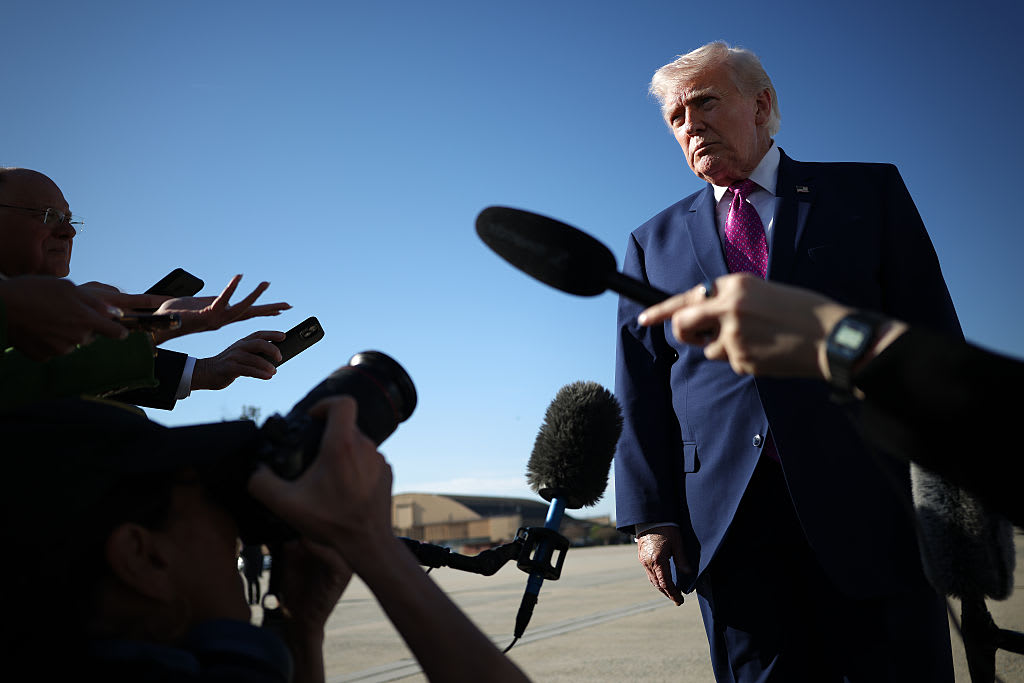
- President Trump said Wednesday that Iran "wants to make a deal so badly," but while he said he would let talks continue, there has been no sign of ongoing diplomacy, and he's also threatened "much worse" strikes if Iran attacks ships again.
Iran condemns U.S. strikes in call with Pakistan army chief
The foreign minister of Iran, Abbas Aragchi, condemned the U.S. strikes on his country in a phone call with Pakistan's chief of the army on Thursday.
Pakistan has served as an intermediary in negotiations between the U.S. and Iran.
"Araghchi said U.S. officials' statements rejecting their commitments under the Islamabad Memorandum demonstrate continued treaty violations and warmongering policies," according to a readout from the government of Iran. "He reaffirmed Iran's firm determination to defend its sovereignty, territorial integrity and national security."
The comments appear to be in opposition to remarks from President Trump, who said on his return flight from the NATO conference in Turkey overnight that Iran was begging to make a deal.
"They want to make a deal so badly," Trump said of Iran. "I just don't know if they're worthy of making a deal. I don't know that they're going to honor the deal, that's the problem."
Israel promises to attack Iran "with even greater force" if needed
Israeli Defense Minister Israel Katz on Thursday said his country was prepared to resume its military campaign against Iran if needed, vowing to do so "with even greater force."
The latest remarks came as new fighting erupted between the United States and Iran, raising fears of a return to full-scale war after an April ceasefire and a U.S.-Iran agreement in June to end hostilities.
"The army is ready and on alert for a resumption of fighting, in order to regain air superiority and strike again ... in Iran, to eliminate threats, including a third time if necessary," Katz said at a military ceremony.
"If we have to go back, we will go back, with even greater force," he added.
Speaking at the ceremony, Prime Minister Benjamin Netanyahu said Iran had been weakened by the two previous military campaigns Israel launched against it.
But he also acknowledged that the conflict was not yet over.
"The Iranian axis is weaker than ever before, while Israel is stronger than ever before," Netanyahu said.
"We proved that the long arm of the Israeli Air Force can reach anywhere, from Yemen to Iran," he added. "Yet we must also acknowledge that the campaign is not over."
Oil prices slip, stocks climb as calm returns to financial markets
Stocks rose on Wall Street and oil prices slipped Thursday in the wait to see what will come next after President Trump raised doubts about the temporary truce in the war with Iran.
The S&P 500 rose 0.7%, erasing its loss from the day before, even though the United States launched new airstrikes against Iran, which responded by targeting U.S. allies in the Middle East. The Dow Jones Industrial Average was up 198 points, or 0.4%, as of 12:33 p.m. Eastern time, and the Nasdaq composite was 0.9% higher.
In the oil market, prices gave back some of their jumps from the day before. The price for a barrel of Brent crude, the international standard, fell 2.1% to $76.39. That's down from $78.02 the day before but still above its $71.80 price from the end of last week.
The worry is that a return to full-blown war will block oil tankers from the Strait of Hormuz and prevent the delivery of crude from the Persian Gulf to customers worldwide. That could worsen inflation, which economists expected would ease with oil prices, and in turn force the Federal Reserve and other central banks to raise interest rates.
Strait of Hormuz traffic won't rebound without "substantial agreement" between U.S. and Iran, analysts say
The recovery of shipping through the Strait of Hormuz appeared to have stalled Thursday, with just six tankers making the transit through the gateway to the Persian Gulf, according to data from the Kpler trade intelligence group.
Wednesday saw 21 such vessels transit the waterway, but it also saw a sharp escalation in tit-for-tat attacks by Iran and the U.S., which was sparked earlier in the week by Iranian strikes on several tankers.
MarineTraffic.com data from earlier in the day showed just three tankers in the strait, two of which are under U.S. sanctions for links to Iran, and all of which were tracking along the northern part of the waterway, on the path designated by Iran.
President Trump declared the ceasefire over Wednesday but left the door open to more talks, and analysts said that the path to lasting peace was never going to be straightforward.
"Ebbs and flows, that's what I'm expecting, not just over the summer, but almost until the end of the year, until we get something concrete between Tehran and Washington," Andrew Wilson, head of research at BRS shipbrokers, said in a webinar held by maritime journal Lloyd's List on Thursday.
"We're certainly better than we were in March and April, but until we have some sort of substantial agreement ... it's just going to remain very, very volatile," he added.
"We're not going back to February 27, and I think everybody understands that," Lloyd's List editor-in-chief Richard Meade said in Thursday's briefing. "A tentative 60-day agreement with few guarantees was never really going to change the dial much in terms of shipping decisions."
Army review of Iran conflict's deadliest attack on U.S. soldiers to be shared with families
The U.S. Army has completed its investigation into the deadly Iranian attack on U.S. forces in Kuwait earlier this year, sources told CBS News, and Gold Star families are expected to be briefed Thursday on its findings.
Six Americans were killed in the March 1 strike on a tactical operations center at the Port of Shuaiba in Kuwait, one of several U.S.-allied countries in the Persian Gulf region that faced intense Iranian missile and drone attacks after the U.S. and Israel launched Operation Epic Fury, starting the war with Iran. The strike was the deadliest attack on U.S. troops in the Iran War to-date.
U.S. Army Central and Third Army ordered the Pentagon probe "to determine the facts and circumstances" of the Iranian attack. But even before the review was underway, a CBS News investigation began shedding light on what several survivors of the attack described as "strategic failures" ahead of, during and after the strike.
Ex-U.S. national security adviser says Iran back up to 50% of missile stockpiles, and war far from over
Iran is "getting back to about 50% of the missile stockpiles" it had when the U.S. and Israel launched their joint war 132 days ago, former U.S. national security adviser Lt. Gen. H.R. McMaster (retired) told CBS News on Thursday, adding that the war, far from being over, is just in "a new phase."
"This is not anywhere near an end of the war," McMaster said after two days of dramatically escalating attacks by the U.S. and Iran. "This is just entering, kind of a new phase. Like the ceasefire war phase is what we're in, of the 47-year-long war with Iran."
McMaster, a CBS News national security contributor who previously served as national security adviser to President Trump, said the memorandum of understanding signed by Mr. Trump and his Iranian counterpart in mid-June "was unsustainable" due to discrepancies in the way both sides interpreted it.
"The main thing," he said, "is the Strait of Hormuz and Iran's belief that it can gain the coercive power it needs over the Gulf states and and over the United States by controlling the strait."
He said by attacking ships in the strait and U.S. allies in the region this week, "what they're trying to do is drive this wedge between the United States and the Gulf states so they can get the Gulf states to cry uncle, and they can be left in control of the Strait of Hormuz as they reconstitute their missile and drone capabilities. And we think they're getting back to about 50% of the missile stockpiles that they had at the outset of the war."
Stock, energy markets steady despite flare-up between Iran and U.S.
Oil prices, stock markets and the dollar were steadier Thursday as investors assessed the outlook for Middle East peace efforts after the U.S. and Iran exchanged fresh strikes.
Crude prices rose but by far less compared to Wednesday, when President Trump said the ceasefire was over while leaving the door open to more talks and adding a prediction that any strikes would end quickly.
Qatar reportedly pauses plan to boost production at world's largest LNG facility after Iran strike
In another potential blow for global energy markets, Qatari authorities have reportedly suspended plans for a rapid expansion of production at the world's largest liquefied natural gas facility, following an Iranian attack on one of its LNG tankers in the Strait of Hormuz.
According to Bloomberg, QatarEnergy bosses met after the Iranian attack on the tanker earlier this week and CEO Saad Al Kaabi decided to halt plans to ramp production back up at the Ras Laffan LNG complex.
Bloomberg cited sources as saying the sprawling facility would continue operating at the minimum level required for safety.
Iranian strikes on Ras Laffan in March caused significant damage, reducing its LNG production capacity by 17%, according to Qatar's energy minister. In mid-June, QatarEnergy said the state-owned company could return to full LNG output nationally, by boosting production at other facilities, within a month, according to the Reuters news agency.
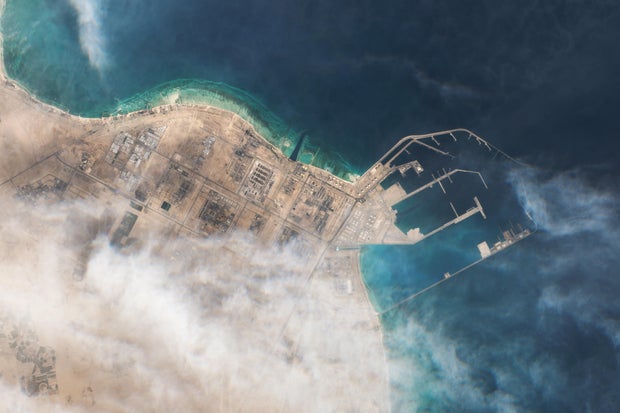
Roughly 20% of the world's crude oil and LNG supplies transited the Strait of Hormuz — the only gateway for ships in or out of the Persian Gulf — before the U.S. and Israel launched their war with Iran on Feb. 28.
Head of Iran's central military command vows retribution against Khamenei's killers
Major General Abdolrahim Abdollahi, commander of the Iranian military's Khatam al-Anbiya Central Headquarters, vowed that those responsible for the killing of Iran's former Supreme Leader Ayatollah Ali Khamenei would face retribution.
In a statement issued following Khamenei's funeral service in the city of Mashad, Abdollahi praised the large turnout at ceremonies held across Iran and Iraq over the last week, describing them as a historic demonstration of "grandeur, insight, faith, jihad and resistance."
He warned the United States and Israel not to "mistake the grief in the eyes of the nation and the outcry born of this sorrow for weakness. This sacred grief and anger will continue on the path of avenging the killers of the martyred leader."
Iran says U.S. "interference in determining shipping routes" in Strait of Hormuz will draw "forceful response"
Iran's Revolutionary Guard naval forces said Thursday that any U.S. "interference in determining shipping routes" through the Strait of Hormuz would draw a "forceful response" and "seriously disrupt the process of gradual reopening" of the vital waterway.
The IRGC Navy said U.S. military "adventurism" would "place the interests of countries using the Strait of Hormuz at serious risk."
Iran agreed in the memorandum of understanding signed with the U.S. in mid-June to "make arrangements using its best efforts for the safe passage of commercial vessels with no charge for 60 days" through the strait.
Soon after, however, Iran attempted to maintain control over the shipping lanes, demanding that all vessels coordinate with its authorities and use a northern route through the strait, passing very close to its coast. Early this week, Iran attacked three vessels attempting to transit the strait via a southern route close to Oman — a route that Tehran considers a violation the MoU.
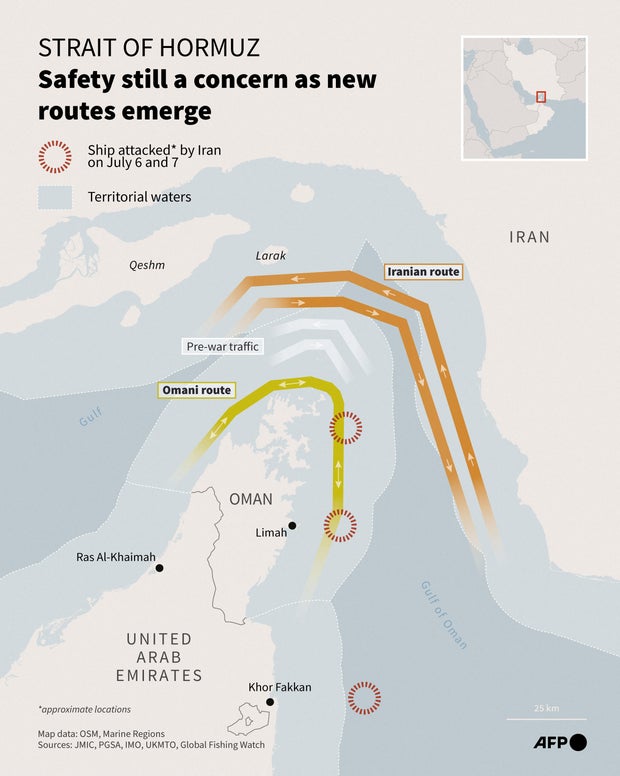
The IRGC Navy said Thursday that its forces, "by consolidating control over the Strait of Hormuz and ensuring its security over the past two weeks, and through its gradual reopening, have brought the capacity for maritime traffic to around 50% of pre-war levels."
"They are currently increasing the capacity for vessels to transit, with ships receiving authorization from the IRGC Navy after complying with security regulations and using routes designated by the Islamic Republic of Iran," the statement said.
Only 3 tankers - 2 linked to Iran - seen transiting Strait of Hormuz as tension soars
Only three fuel tankers — two of which are under U.S. sanctions over ties to Iran's illicit fuel shipments — appeared to be making their way through the Strait of Hormuz on Thursday as the U.S. and Iran exchanged strikes and after Tehran threatened to completely close the key waterway.
The liquified petroleum gas tanker Solix and crude oil tanker Berg 1 are both under U.S. sanctions. Public data reported by the MarineTraffic.com website showed both vessels in the Strait of Hormuz Tuesday morning. A third vessel, which is not sanctioned but has exhibited suspicious behavior consistent with ship-to-ship fuel transfers since the start of the conflict, was also broadcasting its location in the strait.
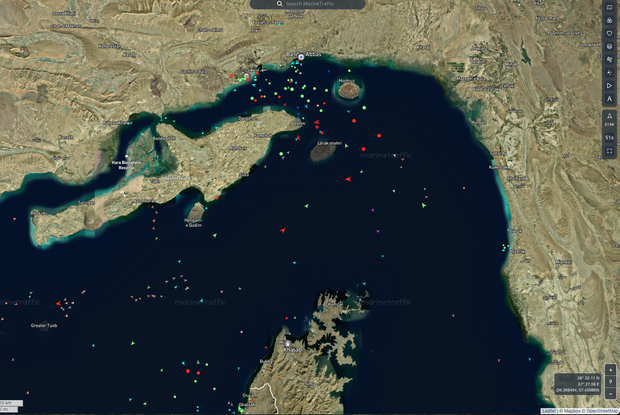
The Benin-flagged Berg 1 and the third vessel, an oil-chemical tanker operating under the Marshall Islands flag, were both heading out of the Persian Gulf loaded with cargo along the northern route that Iran has demanded all commercial vessels use, while the Equatorial Guinea-flagged Solix was tracked heading west into the Persian Gulf after leaving a port in China.
While only those three tankers were visible, it is possible that other ships could be trying to use a southern route through the narrow strait, close to Oman's coast, with their location transponders switched off. Iran has attacked three vessels this week trying to use that route.
On Monday, the head of the United Nations' International Maritime Organization said approximately 600 seafarers remained trapped in the Persian Gulf and surrounding waters as U.S.-Iran hostilities renewed.
Khamenei's funeral procession begins in Mashad ahead of burial
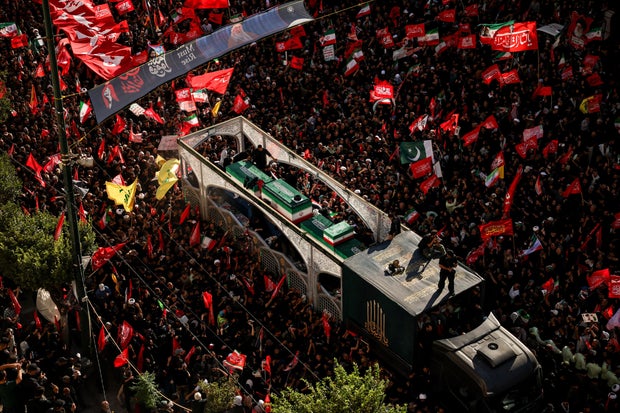
The funeral procession for Iran's former supreme leader Ayatollah Ali Khamenei began Thursday on Imam Reza Street in the northeast city of Mashhad, with huge crowds gathered to bid a final farewell as his coffin was carried toward the Holy Shrine of Imam Reza for burial.
State media aired video of crowds lining the street, thronging around a truck carrying Khamenei's coffin.
Organizers said that, due to the shrine reaching full capacity, worshippers and attendees would be able to follow the funeral prayer from outside the building on several adjoining streets.

The head of the shrine's information and media department said after the funeral procession and prayer, Khamenei's body, along with those of several family members killed in the same strike as the ayatollah on the first day of the war, would be moved to the inner area of the shrine where the burial ceremony would take place in the presence of Khamenei's surviving family.
Jordan's military says 8 Iranian missiles intercepted
Jordan's Armed Forces said Thursday that eight "missiles launched from Iran toward Jordanian territory" were intercepted, with debris falling to the ground but no casualties or material damage reported.
"We remain at the highest level of readiness to protect Jordanian airspace and defend the Kingdom's sovereignty and territorial integrity," the military said in its statement.
The statement came about 40 minutes after the U.S. Embassy in Amman warned people in the Jordanian capital to immediately seek shelter due to the threat of incoming weapons.
U.S. Embassy in Jordan's capital warns people to seek cover as Iran fires missiles
The U.S. Embassy in Amman warned people in the Jordanian capital to seek cover Thursday "and shelter in place immediately" due to reports of incoming missiles, drones, or rockets in the country's airspace.
The warning, shared on social media, came after Iran said it had targeted U.S. bases in Bahrain, Kuwait and Qatar on Wednesday amid an escalating exchange attacks.
Jordanian government spokesman Dr. Mahammad al-Momeni said in a brief statement posted on X that the country's security forces had "activated air raid sirens moments ago after the Kingdom's airspace was breached by missiles launched from Iran, which were intercepted and dealt with."
Iranian state news agency says U.S. strike hit perimeter of Bushehr Nuclear Power Plant
The perimeter area of the Bushehr Nuclear Power Plant was hit by a U.S. projectile on Thursday, according to Iran's IRNA state news agency, citing a deputy governor of Bushehr Province.
Ehsan Jahangirian told IRNA that continuing U.S. attacks had hit several locations in Bushehr Province, including the area surrounding the nuclear plant, the Choghaddak military base and a fishing pier in the south of the coastal province.
He said no casualties had been reported so far from the strikes in the area, but Iran's health ministry earlier said a total of 14 people had been killed in two days of U.S. strikes across the south of the country.
Jahangirian said the Benoud fishing pier in Asaluyeh, Bushehr Province, was targeted, resulting in fishing boats belonging to local residents catching fire. He said emergency response teams were at the affected sites and operations were underway to assess the extent of the damage and to secure targeted areas.
President Trump has said U.S. strikes would target small boats used by Iranian forces to lay sea mines in the Strait of Hormuz and surrounding waters. The U.S. military's Central Command said Wednesday evening that the latest attacks had hit about 90 Iranian targets, including air defenses, drone and missile storage, naval targets and logistics infrastructure on Iran's coast.
Khamenei's coffin arrives in Mashhad for burial, state media say
A plane carrying the coffin of late Iranian supreme leader Ali Khamenei landed in the eastern holy city of Mashhad on Thursday, ahead of his burial, state media reported.
Official news agency IRNA aired video of the Mahan Air flight taxiing at the airport after landing in Khamenei's home city. He was transferred from Iraq, where ceremonies took place in the holy cities of Najaf and Karbala.
Video aired by state media, which could not be independently verified by CBS News, showed the plane being escorted by at least one Iranian fighter jet.
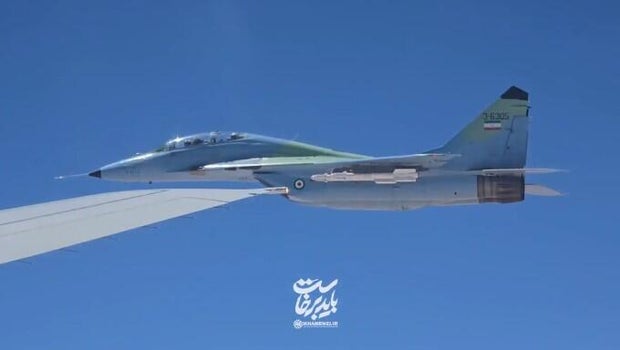
Iran's Revolutionary Guard Corps said Thursday that U.S. strikes overnight had hit two bridges on the route to Mashhad.
Khamenei was killed by U.S. or Israeli strikes on Feb. 28, the first day of the war. The week-long funeral period, culminating with Khamenei's burial on Thursday, was supposed to be a period of reduced tension and negotiations.
U.S. strikes killed at least 14, Iranian official says
U.S. airstrikes in Iran over the last two days have killed at least 14 people and wounded another 78, Iran's Health Ministry said Thursday.
Hossein Kermanpour, a Health Ministry spokesperson, reported the toll on social media. They were the first overall casualty figures from the strikes issued by the Iranian government.
In Iran's southwestern Khuzestan province, at least three people were killed Thursday, state media reported. In Iranshahr, authorities said a strike also had killed a firefighter at an airport.
Those fatalities followed at least nine members of Iran's armed forces being killed in Wednesday's strikes in Iran. It wasn't clear when the other fatality happened and who was killed.
Iran "wants to make a deal so badly," Trump says
President Trump told reporters aboard Air Force One that Iran "called a little while ago," alleging that Tehran's regime wants "to make a deal so badly."
Mr. Trump, on his way back to the U.S. after attending the NATO summit in Turkey, said he doesn't know if Iran is "worthy of making a deal. I don't know if they'll honor a deal."
When a reporter followed up by asking Mr. Trump why Iran launched attacks on three commercial vessels in the Strait of Hormuz earlier this week, the president responded, "Because they're sort of crazy, to be honest with you. They're sort of crazy. They're a little bit out of control. But they want to make a deal, badly."
Earlier Wednesday, Mr. Trump said he believed the 60-day ceasefire reached with Iran in mid-June was "over," but that he would allow peace talks to continue.
Since Iran's attacks on the tankers, the U.S. has launched two rounds of retaliatory strikes on the country, which the Pentagon says have targeted its military infrastructure.
Trump warns Iran strikes will get "much worse" if more ships are attacked
President Trump called Wednesday's strikes on Iran "retribution for yesterday's bombing of ships by Iran," referring to three commercial oil tankers that were attacked in the Strait of Hormuz on Monday and Tuesday.
"If it happens again, it will get much worse!" the president warned in a Truth Social post.
Mr. Trump also posted several undated videos of nighttime explosions.
Explosions heard in multiple Iranian port cities after U.S. announces new strikes
Iranian state television reported explosions in several cities after the U.S. announced that it had launched a second night of strikes on Iran.
The semi-official Fars News Agency, which is associated with the Iranian Revolutionary Guards, said that explosions were reported in the southern port cities of Chabahar and Konarak, as well as the western Gulf port city of Bushehr.
Bushehr is a key city because it contains Iran's only commercial nuclear power plant. It is also located near Kharg Island, a pivotal Iranian oil export hub.
If Iran tries to close down Strait of Hormuz, U.S. military will respond, Vance says
Vice President JD Vance echoed many of the points made throughout the day by President Trump as he spoke in Milwaukee, saying since Iran attacked commercial vessels in the Strait of Hormuz, the U.S. had no choice but to respond militarily.
"They were well behaved for about a week. But then they started shooting at ships," Vance said. "So the deal is very simple, if they shoot at ships, we're going to knock the hell out of them. And it's that simple."
Vance, who was involved in the negotiations to end the conflict with Iran during the 60-day pause outlined in the memorandum of understanding signed by the U.S. and Iran last month, repeatedly posed the choice as a simple one.
"If they try to close it down, there's going to be a response from the American military. It's that simple. That's the deal," said Vance, who was in Wisconsin for an event focused on stopping fraud. "They can either follow it or they can have exactly what happened to them last night."
He continued, "It's just going to keep on happening until they open up that lane and stop shooting at ships. It's simple."