While El Niño odds are rising, snow chances in Colorado this winter still depend on storm track

El Niño is becoming increasingly likely to play a role in the weather pattern heading into fall and winter, but for Colorado, the forecast is not as simple as "El Niño equals snow."
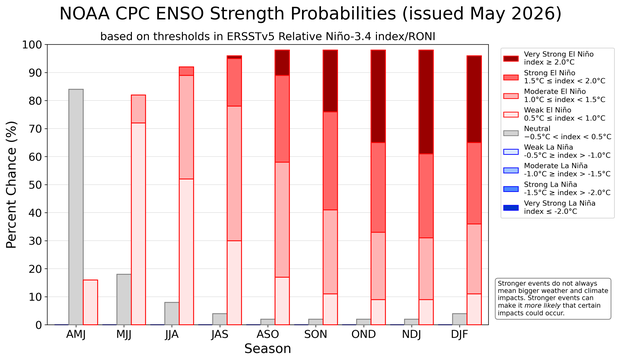
NOAA's Climate Prediction Center has an El Niño Watch in place. This means an El Niño is likely to emerge soon, with an 82% chance during June and July and a 96% chance of continuing through December, January, and February.
The strength forecast is what makes El Niño more interesting this year. The latest ENSO strength outlook shows the odds leaning toward the stronger side of the scale later in 2026. There is roughly a 66% chance of becoming strong to very strong by late fall or early winter.
Why strength matters
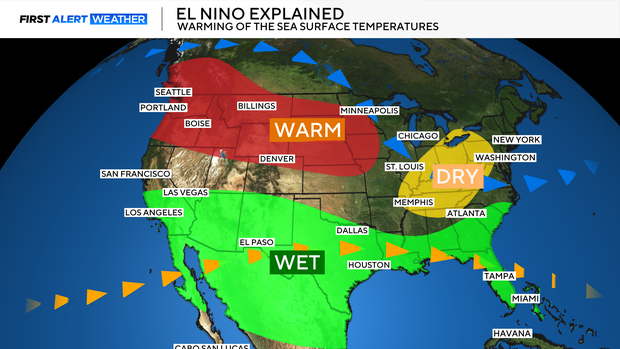
A stronger El Niño can increase the likelihood of the classic El Niño pattern. That often means a more active southern storm track, wetter odds across parts of the southern United States, and a bigger influence on the winter pattern.
But stronger does not mean guaranteed impacts everywhere.
Of course... Colorado is complicated
Colorado is one of the trickier places to forecast during El Niño.
The Colorado Climate Center notes that ENSO does play a partial role in Colorado's climate, but the state's complex terrain, distance from the oceans, and sensitivity to other weather drivers mean the outcome is not guaranteed.
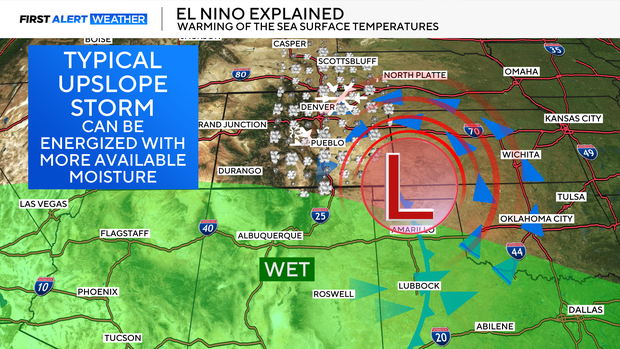
For Colorado, the ideal winter setup is specific: moisture coming out of the Southwest, a storm track near the Four Corners or southeast Colorado, and easterly upslope pushing moisture back into the Front Range.
That is how El Niño can become a real snow producer for Denver and the Front Range. But if the storm track is too far south or too far north, Colorado can miss the better snow setup.
I like to think of it this way: La Niña often sends the storm track north of Denver, which can mean more frequent, weaker storms, but not always the best setup for big Front Range snow.
El Niño is more boom-or-bust. Storms are more likely to come from the south, which can put Colorado in a better position. If everything lines up just right, an Albuquerque low can drop feet of snow along the Front Range.
El Niño does not guarantee that it will happen. It just opens the door.
What have previous very strong El Niños done in Colorado?
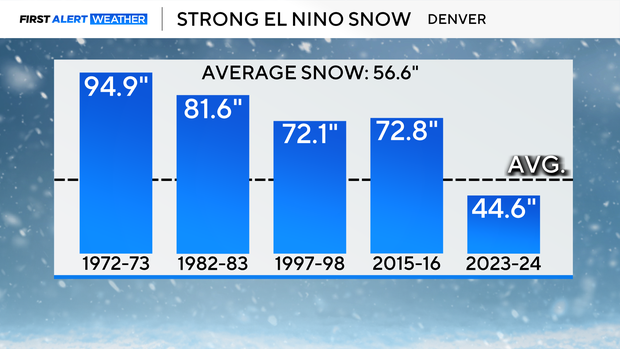
We have had five very strong El Niño winters since the 1970s: 1972-73, 1982-83, 1997-98, 2015-16, and 2023-24.
Denver's official long-term seasonal snowfall average is 56.6 inches, according to NWS Boulder's Denver snowfall history.
Those five very strong El Niño winters averaged 73.2 inches of snow in Denver. Four of the five finished above the long-term average.
But the most recent one did not...
1972-73 El Niño: Denver finished that season with 94.9 inches of snow, which was 38.3 inches above the long-term average.
That remains the clearest modern example of a very strong El Niño lining up with a major Denver snow season.
1982-83 El Niño: Denver finished with 81.6 inches of snow, which was 25 inches above average.
That season included a major March contribution, with Denver recording 30.5 inches in March alone.
1997-98 El Niño Denver finished that winter with 72.1 inches of snow, about 15.5 inches above average.
That season also had a major early-season signal, with 22.1 inches of snow in October.
2015-16 El Niño: Denver finished with 72.8 inches of snow, about 16.2 inches above average.
That winter is another example of a very strong El Niño producing an above-average Denver snow season, but not an extreme one.
2023-24 El Niño: Denver finished with only 44.6 inches of snow, which was 12 inches below average.
That is the key for 2026-27: even a very strong El Niño does not guarantee Denver gets buried, it just increases the odds.
What Coloradans need to know
A stronger El Niño raises the odds of a more active pattern for Colorado, especially if the southern storm track lines up with the Front Range upslope.
But it does not guarantee a big snow year.
The forecast is: higher odds, higher ceiling, but still track-dependent.


