Colorado highway managers monitor over 1,000 cameras statewide. Find out how it helps them solve traffic problems.
It was within moments of when the massive pileup on Interstate 70 happened on Tuesday, that staff watching cameras in one of Colorado's Traffic Operations Centers called out for help from maintenance supervisors by the Eisenhower Tunnel. They were there in less than a minute, CDOT said. Staffers also contacted the Colorado State Patrol, as the 70-car pileup happened, to alert law enforcement.
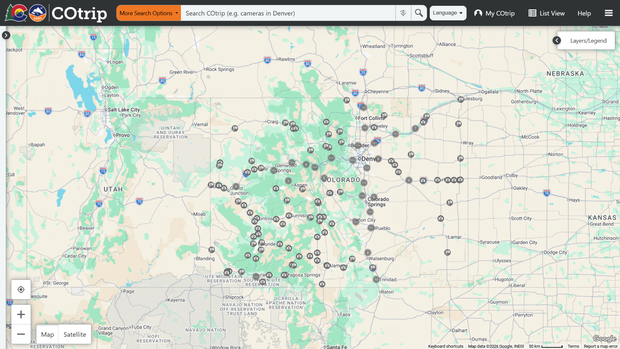
It's part of the job at one of the state's three Traffic Operation Centers, where workers monitor over 1,000 cameras. What many people don't realize is that CDOT does not keep the images.
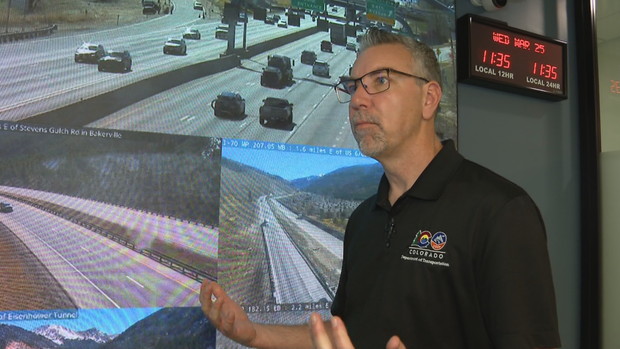
"Since we do not record, we have to hunt for these problems on 1,100 cameras and 9,000 miles of highways," said Bob Fifer, deputy director of operations for CDOT. People often believe there are recordings as investigators seek out drivers involved in crimes. That's not the case.
"We are not law enforcement," Fifer said. "All we are interested in is movement of the highway. So our priorities may be different than law enforcement with our cameras."
The images the public sees of a crash like the one on Tuesday are greatly reduced in quality.
"That bandwidth gets consumed, and it's exceeded our available funds, so we have to reduce that to lower resolution," Fifer said. Those lower-resolution images are used by newsrooms like CBS News Colorado.
The cameras in the operations centers mostly have high-definition signals displayed on the big monitors, but the size of the files for those signals is enormous and a big burden if CDOT kept the visuals. Instead, CDOT sends camera video to COTrip.org in lower resolution. Third-party recording services record from what's available on that site, but that also means lower resolution. While Fifer says they can spot things miles away on high-definition cameras, what's available for police doing an investigation after an incident is not as clear.
"They only record what we put out," he said.
CDOT is looking at new software with better compression rates than may make the higher-resolution images publicly available, but they are not there yet, Fifer says.
There are conversations about what they want from cameras, he said: "I think there's a thoughtful conversation around, 'what are we doing and what should we be doing?'"
Privacy is one concern, even while people are in public areas, while on camera. There are technologies that might help.
"What we found the best option is really tagging. So each thing gets a tag. A name, like, 'this is a red car, this is a white car, this is an SUV.' It's not necessarily A.I., but we're tagging that so when we go search for a red SUV, we can pull up the video that showed a red SUV," Fifer said. "There is no decision-making being made, at least at the applications we're looking at. I don't want any artificial intelligence to come in currently and tell us how to operate our highways. Because this is life safety."


