Robert Mueller, who investigated allegations of Russian election meddling, dies at 81


Robert Mueller, a former FBI director who led the investigation into allegations of Russian meddling in the 2016 election, has died, his family confirmed to CBS News on Saturday. He was 81.
"With deep sadness, we are sharing the news that Bob passed away" on Friday, his family said in a statement, asking for their privacy to be respected.
A cause of death was not shared. Mueller is survived by his wife of nearly 60 years, Ann Cabell Standish, their two daughters, and three grandchildren.
Mueller served as FBI director from 2001 to 2013. In 2017, the Justice Department appointed him special counsel to investigate potential coordination between Russia and the Trump team during the 2016 presidential election.
The nearly two-year investigation resulted in seven guilty pleas and charges against 34 individuals, including Trump allies Paul Manafort and Roger Stone, and three separate companies. It did not find that the Trump campaign or anyone associated with it conspired or coordinated with Russia to influence the 2016 election. The report detailed 10 instances in which President Trump may have obstructed justice, but did not conclude whether he had done so.
President Trump frequently criticized the investigation as a "witch hunt." On Saturday, Mr. Trump addressed Mueller's death on Truth Social.
"Robert Mueller just died. Good, I'm glad he's dead. He can no longer hurt innocent people!" Mr. Trump wrote.
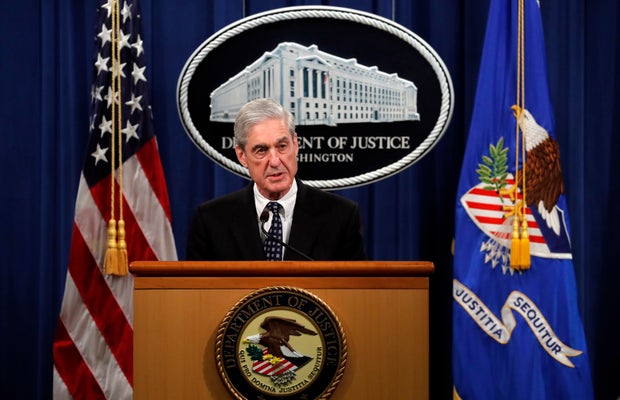
Mueller was born in New York City and grew up outside of Philadelphia. He graduated from Princeton University and served as a U.S. Marine Corps officer for three years during the Vietnam War. During his service, he led a rifle platoon and was awarded a Bronze Star, Purple Heart and two Navy Commendation Medals. He then enrolled in the University of Virginia School of Law and graduated in 1973.
In the late 1970s and through the 1980s, Mueller worked as a U.S. Attorney, rising quickly through the ranks. In 1990, he was appointed the U.S. Assistant Attorney General for the Department of Justice's criminal division. He oversaw high-profile prosecutions, including those of Panamanian dictator Manuel Noriega and New York crime boss John Gotti.
In 2001, he was named director of the Federal Bureau of Intelligence. The September 11 attacks were a week later. Mueller oversaw a massive transformation of the bureau over the next 12 years. He was known for personally digging into the details of bureau investigations, even on minor cases, and surprising agents who suddenly found themselves on the phone with him.
"The management books will tell you that as the head of an organization, you should focus on the vision," CBS News previously quoted Mueller as saying. But "for me, there were and are today those areas where one needs to be substantially personally involved."
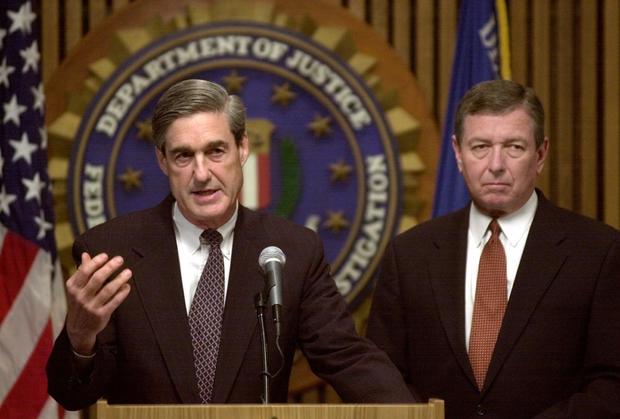
Mueller said in 2012 that he "expected to focus on areas familiar to me as a prosecutor — drug cases, white-collar criminal cases and violent crime," but instead "had to focus on long-term, strategic change."
"We had to enhance our intelligence capabilities and upgrade our technology. We had to build upon strong partnerships and forge new friendships, both here at home and abroad," he said.
The FBI Agents Association, a nonprofit and advocate of active and retired agents, called Mueller "a lifelong public servant" who led the agency "during a period of significant change and played an important role in strengthening its ability to confront evolving national security threats while maintaining its core criminal investigative mission."
"The FBIAA extends its condolences to Director Mueller's family and honors his commitment to public service and to the FBI's mission," the organization said in a statement to CBS News.
Mueller led the FBI until 2013, when he was replaced by Comey.
"Bob Mueller was a truly good and honest person and an extraordinary American patriot. May his example inspire people of integrity to serve our country," Comey said in a statement on Saturday.
When he was named head of the Russia investigation, Republicans and Democrats alike praised Mueller as someone widely respected for his integrity and independence.
After the Russia probe ended, Mueller participated in a six-session course on the investigation at the University of Virginia School of Law. He also wrote the introduction for a book by a top prosecutor who helped lead the investigation.
In September 2025, Mueller was subpoenaed to testify in front of the House Oversight Committee about the case involving convicted sex offender Jeffrey Epstein, but the request was withdrawn due to new information on his health, a committee aide told CBS News at the time. The aide said that Mueller had "health issues that preclude him from being able to testify."
The New York Times reported in September 2025 that Mueller had Parkinson's disease. His family told the paper he was diagnosed with the condition in 2021.
Some U.S. lawmakers and political figures in Washington reacted to the news of Mueller's death, remembering him for his public service to the country.
"I joined many Americans mourning the loss of Robert Mueller. He led a career of public service, always committed to the rule of law," Sen. Mark Warner told reporters at the Capitol. "I didn't always agree with him, but I join many and mourning is passing."
The Virginia Democrat said he was disappointed in the tone of the president's message, saying, "I guess I shouldn't be shocked anymore, but it still seems shocking."