"Incredibly safe mode of transportation": Behind-the-scenes look at Logan Airport's runway operations

With more than 600 takeoffs and 600 landings every day, safety at Boston Logan International Airport depends on far more than what passengers see from inside the terminal.
From runway markings and lighting systems to grass height and vehicle tracking, Massport Aviation Operations crews work around the clock to keep aircraft moving safely at one of the nation's busiest airports.
"There are just dozens and dozens of jobs that people do day in and day out to keep the airport safe," said David Ishihara, Massport's Deputy Executive Director of Aviation. "Not only the Massport crews, but the air traffic control, and all of the workers that help support this operation."
Ishihara and his team gave news crews a behind-the-scenes look at airfield operations as airport safety has come under increased scrutiny following several recent aviation incidents, including a close-call between two planes at Logan just weeks ago that remains under investigation by the Federal Aviation Administration.
"These things become stories because, thank God, there aren't a lot of incidents," Ishihara said. "But the system is designed to alert the industry when you start to get close to accidents, and that's what happens. The system works."
Ishihara highlighted the airport's safety infrastructure, including radar systems, runway lights and signs, and even routine lawn maintenance. Keeping the grass at a specific height helps reduce insects, which in turn attracts fewer birds and lowers the risk of bird strikes.
He also showed one of the airport's Engineered Materials Arresting Systems, or EMAS, platforms, designed to stop an aircraft if problems are encountered during takeoff. It's essentially a porous concrete block that allows the wheels of an airplane to sink in, causing it to stop much faster.
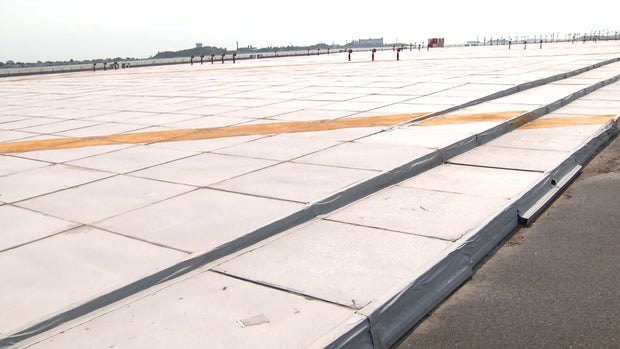
One EMAS system is already in place to prevent an aircraft from overrunning a runway into Boston Harbor, while another is under construction to help prevent an aircraft from leaving the runway toward Winthrop.
"We haven't used one yet, thank God, but we have them if it's needed," Ishihara explained.
Airport officials also rely on technology to monitor every vehicle operating on the airfield. Each vehicle is equipped with a transponder, so its identity and location are known at all times.
Ishihara said the combination of technology, training and constant vigilance helps make air travel one of the safest forms of transportation.
"It's an incredibly safe mode of transportation. If you look at the statistics, you'll see that, and it's because of the investment in not only the technology but the training, pilot training, controller training, the training that our folks go on to just to drive a vehicle out here," he said. "Together we watch each other, and we work together to solve any problems that may come up. But we do that collaboratively. It's the way it needs to be."
Airport operations teams also continuously adjust for changing conditions that could affect flights, including the number of tall ships currently in Boston Harbor and the heat and humidity the area is seeing this week.


