Holy Cross rowing team crash survivor, who recovered at Spaulding Rehab, now works there offering patients hope

Hannah Strom has a lot to be proud of. She is a rehabilitation aide at Spaulding Rehab Hospital in Boston, a volunteer with a peer support group for traumatic brain injury patients, and an active 26-year-old who works every day to walk or run 10,000 steps. A little more than six years ago, she was a patient at Spaulding relearning how to walk and talk.
In January 2020, Hannah survived the devastating crash that killed her friend and Holy Cross rowing teammate Grace Rett. The team was in Florida on a training trip when their van hit a truck in Vero Beach. Ten students and the team's head coach were injured. Hannah's injuries were critical. She survived with a broken leg, a broken pelvis, a collapsed lung, and a traumatic brain injury.
"I assumed that I was dead"
After doctors stabilized her, first in a medically induced coma in Florida, and then in a state of semi-consciousness at Mass General Hospital, she arrived at Spaulding, a member of the Mass General Brigham system. She was admitted about a month after the crash (at the start of the COVID lockdown) not altogether certain she was actually alive. She remembers occasionally feeling for her heartbeat. "I assumed that I was dead when I was a patient here," she explains.
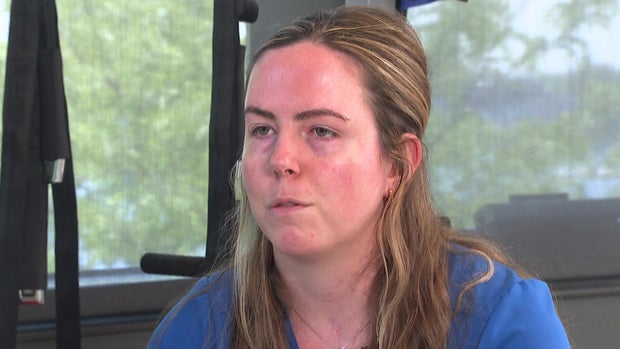
She recognized her mom who, because of COVID protocols, was the only family member allowed in the hospital. Her father and teenaged brother were home in Marion, Massachusetts.
With no memory of the accident, Hannah could not make sense of her predicament or surroundings. "I just assumed that my mom and I were in an accident, and we must both have died, and, like, we were in the afterlife," she said. Because her mom could walk and talk, Hannah surmised that her mother was in heaven, and she was in hell. "Because I thought I was dead, I thought nothing mattered." She remembers just wanting to sleep. When physical therapists entered her room to work with her, Hannah gestured for them to get out. She was angry and confused. She remembers how therapists would "bribe" her to get her to do the exercises that would prove critical to her recovery. They would tell her she could go back to bed if she would climb a flight of stairs first. Over time, the work began to pay off. Six months after the crash, Hannah left Spaulding to go home.
At the time she had no idea she would one day return to work with patients. In 2022, she sat on stage for Holy Cross graduation wearing Grace Rett's photo on her cap in tribute. It took another two years to earn her psychology degree. Because of her memory challenges, academic work, which had come so easily for most of her life, was very difficult. "It was a fight to get my bachelor's," she said. There were times that, she says, she felt stupid because of the accommodations she needed to finish her course work. "I had been through something so traumatic and life changing. So, like, I wasn't stupid at all. But that's how I felt," she said. She now realizes, with pride and gratitude, how resilient she is and how far she has come. In June, she will celebrate her first anniversary as a Spaulding employee.
Connecting with Spaulding patients
Hannah offers patients hope in some of their darkest days. "I know what they're going through," she says. That matters to patients like Chip Krause from Manchester, New Hampshire. Chip has been at Spaulding for a month regaining strength lost to muscle weakness from a rare form of cancer. He lights up when Hannah enters the room. "She's very familiar with the other side of the deal which, I don't think necessarily the OT and PT people, they're very caring, but they haven't been on the other side of the deal," he says, appreciating that Hannah can relate to his experience.
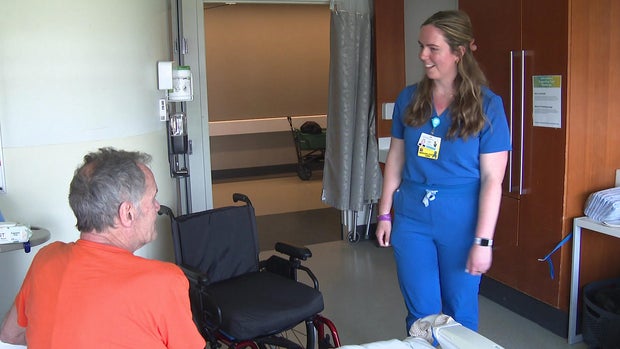
Working with someone who has made such a remarkable recovery also offers a psychological boost. Chip says that he would not have known that Hannah had recovered from critical injuries if she hadn't told him. He is thankful for her encouragement, "It's nice to have someone saying, 'Yeah, you're doing good.' Right?"
Hannah's ability to connect with brain injury patients is a special comfort. She recounts an experience with a patient who complained about physical therapy. He had been at Spaulding for a few weeks and was angry that his stay was extended. He wanted to go home. Hannah assured him she understood his frustration but offered a perspective that only a former patient could. "They're extending you because they're seeing progress in you and they want to keep progressing you," she explained and then shared her story. "I'm so happy they extended my stay," she told him, "Because now I'm at a place where I'm here and I can give back and help patients like you. And he immediately changed his mind."
She says that, after that, he embraced his therapy with new vigor. The ability to connect with patients from her own lived experience makes Hannah uniquely qualified for a job that, she says, fills her with a sense of purpose.
"She brings the connection that's needed for people to get better," said Dr. Joseph Giacino, Spaulding's Director of Neuropsychology and Professor of Physical Medicine and Rehabilitation at Harvard Medical School. Dr. Giacino says researchers now know that recovery prospects rely, in part, on the connection between the people helping and the person receiving help. With Hannah, he says, there is immediate connectivity. In addition, he says, she is emblematic of what doctors have learned about severe traumatic brain injury recovery. "Somebody can go from a very severe brain injury, where they are completely disabled, to where she is now, fully back in society," Dr. Giacino said. "Engaged, happy, interacting, back in the community."
Recovery continues long after injury
He is eager to dispel two myths. First, if patients don't recover early (within the first 7-14 days) their prospects for recovery are poor. Second, that recovery ends after about a year. "We now know," he explains, "that recovery now continues a decade after injury. And we're not talking about small changes. We're talking about meaningful changes that impact the person's ability to literally reengage with the world around them."
Hannah is proof that when someone is supported in her recovery over time, he or she can continue to make great strides. The key, Hannah says, is time. It was a word that her mother came to during Hannah's recovery. Nothing seemed to progress early enough in those early days. But Hannah says, while it is hard to be patient when you are rebuilding your life, time is a measure of progress even now. "I do notice myself doing things that I couldn't do a week ago," Hannah said. "It's a continual healing process."
Hannah says, for example, her short-term memory is improving. She no longer has physical therapy. Her goal for the future, in addition to inspiring more patients on their path to recovery, is to drive. It has been six years since she has been behind the wheel of a car. Her occupational therapy now is preparing her for the day she is able to drive again and experience that feeling of independence. Based on all that she has accomplished so far, she knows that day will come. "Looking back at pictures of me, I'm like, in harnesses and… I'm so proud of myself."
She pauses to consider how much her life has changed since her 100 days at Spaulding as a patient. "I did that. Like, I did, honestly, the unthinkable because… I wasn't, I was not supposed to be where I am. So, I'm, like, grateful for every day." She listens to the St. Finnikin song "Grateful" each morning. "Even when I'm having a bad day I'm just, like, proud that I get to be here and share my story and help other people," Hannah said.
A documentary from The Model Systems Knowledge Translation Center (MSKTC) follows Hannah's recovery journey. MSKTC is a national center that supports Model Systems programs in providing information to patients. Spaulding Rehabilitation Hospital is part of the federal government's Model System's Network.