Baltimore activists rally against Johns Hopkins University's police force

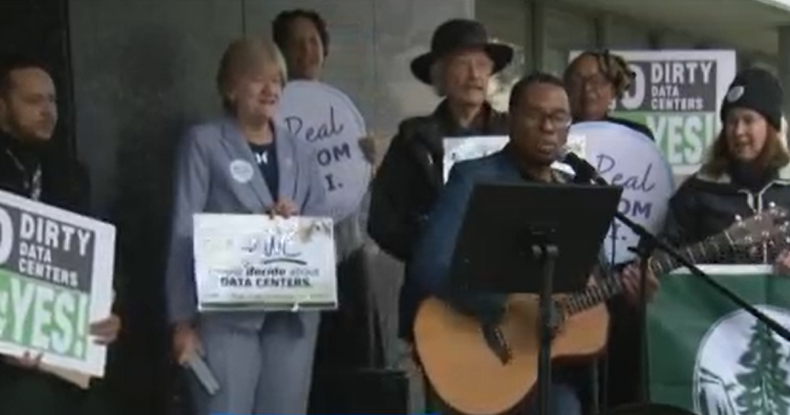
Activists in Baltimore rallied on Monday evening to protest the Johns Hopkins Police Department (JHPD), claiming the private police force was created without input or consent from community members.
The activists, including members of the Baltimore Abolition Movement (BAM), Baltimore Teachers Union (BTU), JHU Grad Workers Union, Hospital Workers Union, and others, are calling for a city council hearing on the issue.
According to rally organizers, the police force puts the safety of students and residents at risk.
"For them, it's kind of a status symbol to try to put them on a tier with other top institutions. But for us, that is a kind of tell that this isn't actually about what's proven in terms of public safety," Jack Lewis, organizer with BAM, said.
During the rally, speakers shared how the police force impacts them and why the city should end the Memorandum of Understanding (MOU) between the Baltimore Police Department and JHPD, which allows the campus to have a private and armed police force.
"The JHPD, which in its first semesters of its rollout, has already become physically violent against students, resulting in injuries," one rally-goer said.
According to organizers, nearly 1,000 people and 30 community organizations have signed a petition calling for a city council hearing. They plan to bring this petition before the council on Dec. 15.
BAM says it wants the council to void an agreement between Baltimore City Police and JHPD, which allowed the university to establish a private, armed police force. The organization is calling for a council hearing, for the department to stop hiring, for the city to withdraw from the agreement, and to get rid of the department all altogether.
It also says university leaders originally established the department at the state level. In 2024, Baltimore City voters approved a ballot measure to bring the city police department back under local control, after being under state control for decades. Because of this, the protesters argue the city now has the power to act and disband the JHPD.
A Johns Hopkins University spokesperson says the university's priority is safety and issued the following statement:
Johns Hopkins is committed to building and supporting a safe environment for our students, faculty, staff, patients, and neighbors. The Johns Hopkins Police Department upholds the highest standards of constitutional, accountable law enforcement, working to address the root causes of crime and establish community trust.
Since being signed into law in 2019, the Community Safety and Strengthening Act--the comprehensive statutory process the General Assembly set out for the development and operation of the Johns Hopkins Police Department--has been affirmed by the Maryland Courts and supplemented by the robust community input that shaped the JHPD's policies, modeling best practices in criminal justice reform.
WJZ reached out to the Baltimore City Council and Councilwoman Odette Ramos, who represents the area near the Homewood Campus, but has not heard back.
Protest against JHPD
Johns Hopkins University says it has 24 sworn officers and three civilian staff members. It can hire up to 100 people to fill out the department.
Just last month, a repeat violent offender was charged after he allegedly attempted to rape a student on campus. Protesters say violent crime is rare on campus and doesn't justify private police.
According to its crime log of the last 60 days, the Johns Hopkins Police Department mostly investigated theft, vehicle theft, and various types of assault.
"We just don't understand why Hopkins wants to have more cops in cars with guns. There are going to be occasional violent crimes, but they don't justify the need for an entirely new police department. We have a Baltimore Police Department," Emil Volcheck, who represented the Abell Improvement Association at the rally, said.
Protesters believe the department is performative and does more harm than good in their neighborhoods.
"The university is worried that parents won't send their children to Baltimore because they think it's unsafe, and that if they have a police department, maybe it will make those parents feel more comfortable, but that's not what actually brings down crime," Volcheck added.
Among the proposed solutions, Volcheck says he would support disarming the department. He also encouraged the university to work with the city, asking instead to set up designated posts for Baltimore City Police.
Developing the private police force
This is not the first time Baltimore residents have raised concerns about Johns Hopkins' police force.
The department was established in 2024 after a Maryland law signed in 2019 allowed the university to create its own private, armed police force.
In 2020, the university paused the plan following nationwide protests over police brutality after the death of George Floyd. In 2022, the university revived the proposal, sharing details about the department and later holding a 60-day public comment period.
Some students, staff and community advocates raised concerns about safety and accountability. The Coalition Against Policing by Hopkins filed a lawsuit over the MOU between the Baltimore Police and JHPD.
The MOU creates boundaries between the departments, dictating which agencies respond to which calls and when city police lead an investigation.
Some argued that the police would not be held accountable or be able to keep students safe.
"To me, the answer isn't more police, especially police that isn't accountable to the public," Councilwoman Odette Ramos said during one of the protests.
Despite the opposition, the school proceeded, sharing final policies and procedures and swearing in its first officers in December 2024.