Marietta ICE protest draws clashing views as activists decry detention expansion, others defend enforcement
A protest outside a grocery store in Marietta on Saturday brought together demonstrators and countering voices as part of a nationwide day of action opposing the expansion of immigration detention facilities.
The event, held along Powder Springs Street, was one of more than 160 demonstrations across the country tied to the "Communities Not Cages" campaign — a coordinated effort by advocacy groups to push back against the expansion of detention centers operated by U.S. Immigration and Customs Enforcement (ICE).
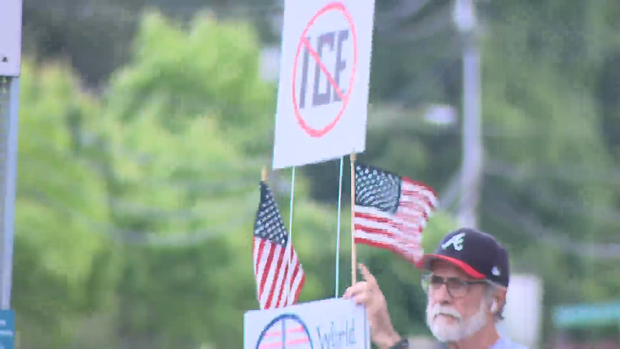
Protesters call detention expansion "inhumane"
Several demonstrators said they were motivated by concerns over how immigrants are being treated in detention and what they described as a growing reliance on large-scale holding facilities.
Ryan McClure, a 78-year-old Marietta resident, said he joined the protest out of concern for human rights.
"These people are human beings, and I think we need to treat them a little better than we have so far," McClure said, adding that current detention practices are "not humane."
McClure also raised broader concerns about the direction of U.S. immigration policy, saying the country needs "more peace and love" amid rising tensions.
Organizers framed the demonstration as part of a larger national push to stop ICE from using warehouse-style facilities to house detainees.
Stacy Parlato, who identified herself as a leader with Indivisible Cobb, said protesters are calling for systemic changes.
"We're absolutely and unequivocally opposed to ICE buying up warehouse space and turning them into human concentration camps," Parlato said.
Parlato argued that while immigration enforcement has a role, current policies under the Trump administration are "immoral," "unconstitutional," and disproportionately target immigrants.
Concerns over conditions and due process
Other demonstrators echoed concerns about conditions inside detention centers and access to legal protections.
Julie Pearson Clark, a Marietta resident, said the idea of converting warehouses into detention facilities raises serious questions.
"How you can take a huge warehouse that's meant for products … and think you can convert that into a safe place? I'm appalled," Clark said.
Clark also pointed to what she described as reduced access to immigration courts and due process, calling the situation "completely against the Constitution."
Support for ICE and enforcement also voiced
Not everyone at the scene agreed with the protesters.
Rosalba Hansen, a Mexican-American Marietta resident who said she stopped after seeing the gathering, expressed support for immigration enforcement efforts.
"I support the job that they're doing," Hansen said. "I don't want the U.S. to be like Mexico — a lot of drugs, a lot of crime. I want my kids to live in a free country."
Hansen also thanked President Donald Trump for his immigration policies and questioned the makeup of the protest crowd.
"It's mostly white people. I don't know what they're protesting about," she said.
Part of a broader national movement
Saturday's protest was part of a coordinated national mobilization organized by groups including Disappeared in America, Detention Watch Network, Indivisible, MoveOn, Public Citizen, and Workers Circle.
Organizers say the demonstrations are aimed at drawing attention to what they describe as a rapid expansion of immigration detention and deportation efforts, while calling for alternative approaches to immigration policy.
A local snapshot of a national divide
The Marietta protest reflected a broader national debate — one that continues to divide communities over how the U.S. should balance border enforcement, public safety, and human rights.
As demonstrators packed up signs and conversations continued along the sidewalk, one thing was clear: the issue remains deeply personal, and deeply polarizing, for many Americans.


