ANCHOR:
00:00:03
When people visit Paris, they often arrive with a list of famous places to go to. But there's one unlikely landmark that's a must-see for millions of tourists and locals each year. Barry Petersen takes us for a stroll in one of Paris's largest green spaces that serves another, more permanent, purpose. [SOFT MUSIC]
BARRY PETERSEN:
00:00:27
Paris is the City of the Eiffel Tower, the City of the Louver, the city of Notre-Dame, and one more unusual tourist attraction-- This is part of the whole beauty. Just walking, the trees. Yeah.
BARRY PETERSEN:
00:00:40
The City of the Dead-- Pere-Lachaise Cemetery. So here, we're walking through what used to be the limits of the old cemetery and the beginning of the newer one, which--
BARRY PETERSEN:
00:00:51
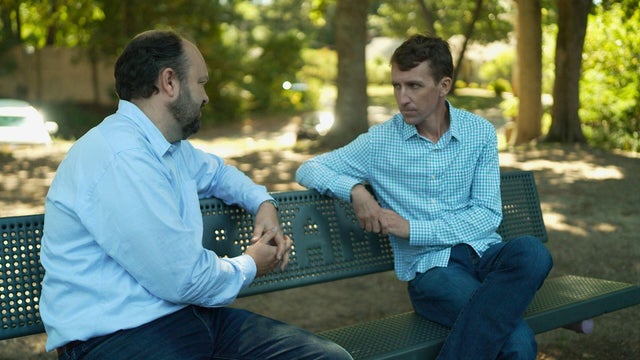
Our guide is Lucien Lebrun of the company My Private Paris. This is the cemetery. You'll find some of the most important people in the history of Paris. So if you're buried here, then you become one of the most important people in Paris. Hopefully, hopefully.
BARRY PETERSEN:
00:01:06
With more than three million visitors a year, it may be the world's most visited cemetery. Established by Napoleon in 1804, it was an immediate flop, with all of 13 people buried, until it was saved by a tragic love story. So that's them. That's them.
BARRY PETERSEN:
00:01:23
Heloise and Abelard were the real-life French Romeo and Juliette-- lovers-- until she was exiled to a convent and he to a monastery. They died 900 years ago, having never reunited until their separate graves were dug up and moved to this huge monument-- together, at last. It was done after the cemetery figured out a very modern day truth that celebrity sells, even if it's selling cemetery plots. And of course, once they're buried here, everybody wants to be buried next to them. And so, there's this explosion of people being buried here in the 1820s-- we get up to 30,000 people-- and it continues after that. I don't have to be French or Parisian to be buried here, I just need to die in Paris. Yes. There's three conditions-- either you die in Paris or you own property in Paris or you're born in Paris. Of the many times you've been here, do you still find new things when you come here? Yes, every single time.
BARRY PETERSEN:
00:02:21
As you walk among the 70,000 graves, listen closely. Very early in the morning, the cemetery both opens very early or closes very late, so you do feel something lingering around.
BARRY PETERSEN:
00:02:29
Like the echoes of Jim Morrison, who died in Paris in 1971. His faithful make his the cemetery's most visited grave, and many leave tokens of love. What do you see that people have brought? I see pictures, I see flowers. Pictures, flowers. If you come here early enough in the morning, you might find the gifts of the night before, which usually revolve around alcohols and more or less hard drugs.
BARRY PETERSEN:
00:02:55
On her first trip to Paris, [INDISTINCT] Madden, from the San Francisco Bay area, came here but without a gift. Next time, you'll bring flowers? A whole bouquet. [GIGGLES]
BARRY PETERSEN:
00:03:07
And here, another echo of the woman they called The Little Sparrow, singer Edith Piaf. Buried with her daughter, who died at age two, and her lover, a boxer killed in a plane crash flying to New York to see her. And yet, her defiant anthem, "I Regret Nothing," rallied French spirits after the German occupation in World War II. A lot of families, myself included, were impacted by the Second World War. And so, it is really hopeful looking towards the future and if somebody like Edith Piaf or the life that she led can have this look for the future, maybe all of us can have it, as well.
BARRY PETERSEN:
00:03:48
Nearby, you can almost hear the gentle notes of His Nocturnes at the grave of Frederic Chopin, where he is buried-- well, most of him. What I find interesting is that he's not all here.
LUCIEN LEBRUN:
00:03:59
Yes.
BARRY PETERSEN:
00:04:00
Where is his heart? His heart was sent back to his homeland a little bit later after-- To Warsaw. To Warsaw. Exactly. To Warsaw, Poland.
BARRY PETERSEN:
00:04:09
Writer Oscar Wilde was persecuted for his homosexuality, but he found an after death redemption here. He was originally buried in a pauper's grave in a rural vineyard. Wait, let me get this right. Yeah. Oscar Wilde dies in Paris. Yes. Which qualifies him for a spot. Yes. But he's too poor, so they put him somewhere else. Yes. Because, in that part of life, he was considered a very bad person because of his homosexuality. Yeah. So then he becomes famous and the cemetery says, ah! Yes, exactly right. And they bring him back here and put him here. Yeah, exactly right. Yeah. It's all about marketing. Yeah.
BARRY PETERSEN:
00:04:48
Across 110 acres, each row has a story. The French actor, who will look forever at his grieving widow, the painter still at work, the poet who seems intent on beating death by climbing back into life. The writer Moliere, who is also buried here, once said, "we die only once and for such a long time." And as the many faces stare at you, it feels like there is one last wish for their long time that may not be forgotten. For CBS Saturday Morning, Barry Petersen, Paris. What a collection, what a museum and mosaic of the lives of so many people, right? The history and the humanity of the impact from the lives in that land alone are just incredible. The impact they've had on us, even to this day. It was such a well done piece too. It really was. Barry Petersen, you go. Yeah.