Venezuelan leader's capture comes exactly 36 years after U.S. arrested Panamanian dictator Noriega
President Trump announced the capture of Venezuelan President Nicolás Maduro and his wife early Saturday morning, 36 years to the day after U.S. forces arrested another indicted Latin American leader.
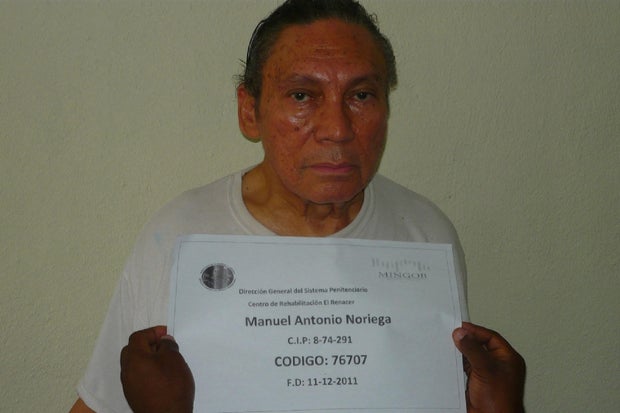
A one-time U.S. ally and CIA informant, Manuel Noriega led Panama for much of the 1980s.
He was raised in the slums of Panama City and rose to prominence under Gen. Omar Torrijos, who seized power in a 1968 coup. After Torrijos was killed in a 1983 plane crash, Noriega took control of the Panamanian government. He was propped up by U.S. officials, who paid him hundreds of thousands of dollars to fight drug trafficking.
Noriega spent years on the CIA's payroll, assisting U.S. interests throughout Latin America and acting as a liaison to Cuba's Fidel Castro. Former U.S. officials testified that Noriega's assistance was crucial to advancing foreign policy interests in South America during that time.

Noriega fell out of favor with Washington due to his demands for independence and allegations that he was accepting bribes to allow drugs into the U.S. in the late 1980s. Former President George H.W. Bush ordered the U.S. military to invade Panama in late 1989, sending 24,000 troops to topple Noriega's government. The operation left 23 American soldiers dead and hundreds more injured.
Noriega hid out in the Vatican embassy before surrendering to U.S. authorities on January 3, 1990. He was taken to the U.S. to face drug trafficking charges. His fall led to the end of Panama's military dictatorship.
Noriega was convicted on drug trafficking charges and spent 20 years in an American prison. He was extradited to France in 2010 to serve a seven-year money laundering sentence. In 2011, he was sent to Panama to complete a 60-year sentence for murder, corruption and embezzlement during the military's three-decade rule.
In 2015, Noriega gave his first interview in nearly 20 years from his Panamanian prison. He called himself "the last general of the military era" and apologized to those "offended, affected, injured or humiliated" by his own actions or those of his superiors and subordinates during the military regime.
Noriega died after complications from a surgery to remove a benign brain tumor in 2017. He was 83. Juan Carlos Varela, Panama's president at the time, said that his death "closes a chapter in our history."
House Intelligence Chair Rep. Rick Crawford commented on the connection between Noriega's capture and the operation in Venezuela in a statement shared on social media.
"This is a historic day in the Western Hemisphere, 36 years after the capture of Manuel Noriega, when the U.S showed we will not allow cartels to take over countries in our shared neighborhood. The arrest of Cartel De Los Soles leader Nicolas Maduro shows this clearly," said Crawford, a Republican from Arkansas. "Venezuela could never start the road back to the great nation it once was until Maduro was out of the way. I call upon the Venezuelan people to reclaim their freedom."