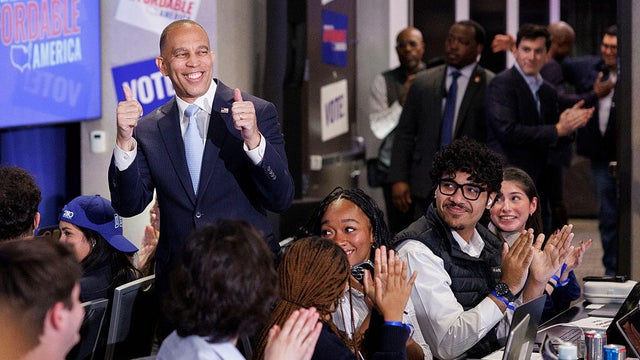
"An attention treadmill": Lawmakers' hearing on use of algorithms
Senators questioned the addictive business models of Facebook, Twitter and YouTube.
Watch CBS News
Senators questioned the addictive business models of Facebook, Twitter and YouTube.

Advertisers are shifting into high gear as they prepare for the economy to roar back to life with mass vaccinations.

On "Intelligence Matters" this week, former Google CEO Eric Schmidt joins host Michael Morell to make the argument for A.I. as a national security priority.

The justices found that Google's use of Oracle code was protected under fair use.

Lawmakers are looking at ways to regulate social media platforms to combat misinformation. Critics say these platforms have caused extremist groups to grow, and played a role in inciting the January 6th assault on the U.S Capitol. The CEOs' of Twitter, Facebook and Google deny their platforms are solely responsible for the spread of misinformation. Jonathan Peters, an associate professor at the College of Journalism and Mass Communication at the University of Georgia, joined CBSN's Lana Zak to discuss.

Questions remain as to whether any Seattle-area office employees will be given the option to continue working remotely.

Starting later this year, the app will default to showing the most fuel-efficient route unless drivers choose otherwise.

The CEOs of social media giants Facebook, Twitter and Google faced a grilling as congressional lawmakers tried to draw them into acknowledging responsibility for helping fuel the January insurrection at the U.S. Capitol and contributing to rising COVID-19 vaccine misinformation. CBS News reporter Musadiq Bidar joins CBSN's Lana Zak with more.

CEOs from Facebook, Twitter and Google faced intense scrutiny from Democrats and Republicans on Thursday.

Google, Facebook, and Twitter executives joined a virtual hearing with House members on Thursday to discuss the role of social media in promoting extremism and misinformation. Ashley Gold, Axios' technology and policy reporter, joins CBSN's "Red & Blue" anchor Elaine Quijano with more on how the CEOs defended themselves, and why the pressure they're facing to make changes to their business practices is greater than ever.

The heads of Facebook, Twitter, and Google testify Thursday before Congress over what role their platforms play in the spread of dangerous disinformation. CBSN technology reporter Dan Patterson joined CBSN with a preview of what to expect.

A new report reveals how Federal Trade Commission's antitrust regulators missed an opportunity to challenge Google's dominance of the search engine space in 2013. Politico reporter Leah Nylen joins CBSN AM to discuss the findings.

A German court has sentenced former Syrian intelligence officer Eyad Al-Gharib to prison for aiding crimes against humanity. In the United Arab Emirates, the captive daughter of Dubai's ruler, Princess Latifa al-Maktoum, is calling on U.K. authorities to reopen the investigation into her sister's kidnapping over 20 years ago. CBS News foreign correspondent Ian Lee joins CBSN AM from London to discuss those stories and more international headlines.

Search giant is phasing out third-party cookies in Chrome, but will still personalize ads using technologies it calls less invasive.

Senator Mark Warner joins CBSN's Lana Zak to discuss President Biden's latest executive order to strengthen American supply chains. He also weighed in on the growing domination of big tech companies and next week's Senate Intelligence Committee hearing on the SolarWinds hack.

False and dangerous information about the coronavirus pandemic and politics continues to spread online, and memes are often the vehicle of choice for misinformation on social media. Axios media reporter Sara Fischer joins CBSN to discuss why memes pose a significant threat and what users can do about it.

Facebook has tentatively agreed to resume negotiations with Australia after a new proposed law prompted the social media platform to ban news links from being shared on the platform. If passed, the law would make Australia the first country to force internet companies to pay news organizations for their content. Syracuse University assistant professor Jennifer Grygiel joins CBSN to discuss Facebook's response to the law.

"Where to get covid vaccine" was the most Googled question across the U.S. over the past month. CBSN technology reporter Dan Patterson joins CBSN's Lana Zak to discuss the overwhelming interest in the vaccine among Americans.

Despite a botched initial rollout, Americans are hungry for COVID-19 vaccine information, Google data show.

Right-wing friendly social network was booted by Amazon, Google and Apple but says it won't be relying on "Big Tech" anymore.

Australia is poised to adopt legislation that would wreck the way the internet works, according to the tech companies.

Nearly 150 Republican members of Congress voted to overturn the 2020 presidential election results.

The legislation would force big tech companies to pay news outlets to use their content. Google says that would make its business model unworkable.

When a mob of pro-Trump rioters stormed the U.S. Capitol, disturbing footage of the insurrection flooded social media platforms. It wasn't until days later in some cases that tech companies began taking a more rigid approach to monitoring their platforms with Twitter, followed closely by Facebook, banning President Trump then Apple, Google and Amazon cracking down on Parler, but some experts said the effort to censor potentially harmful content on the web came too late. Roger McNamee, author of the New York Times bestseller "Zucked: Waking Up to the Facebook Catastrophe," joined CBSN to discuss.

In wake of Capitol assault, Amazon suspends the social media forum from its web hosting service, saying violent content on the site violated its terms of service.