Another stretch of high temperatures in the 90s hitting the Pittsburgh area this week

It's going to be another hot week in the Pittsburgh area with high temperatures back into the 90s.
Any Alert Days Ahead? I have us hitting 90 degrees starting on Tuesday through Friday, so that stretch of 4 days are First Alert Weather Days. A severe storm setup looks to be in place for Saturday, so we may also see a FAWD issued for Saturday.
Aware: So far this year, we have seen five 90° days. Tuesday may be our 6th of the year.
Heat index values today are expected to be in the mid-90s, near 100 degrees.
The hottest days of the week will be on Wednesday & Thursday. I have both days seeing highs at 92°.
Rain chances start to tick back up on Friday, late in the afternoon. I have Friday highs still hitting 90, with highs in just the mid-80s on Saturday and Sunday.
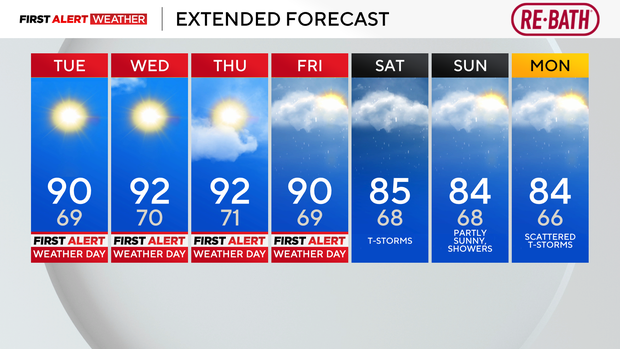
There still remains a concern for severe weather on Saturday, with all the ingredients in place. Right now, the chance looks low due to morning rain keeping instability numbers low.
Congress again considering making Daylight Saving Time year-round
I am not surprised that the U.S. Congress is taking up making Daylight Saving Time standard year-round again. The Sunshine Protection Act is the latest attempt by Congress to solve the issue of time and daylight. It's a plan that you may not realize has been attempted before, and people disliked it so much that it didn't even last a year.
Let's start with a brief history of changes to the clock and what we will call Daylight Saving Time. Before World War 1, there was very little in the way of guidelines for states to follow when it came to time. WWI changed things, as the government dictated that Daylight Saving Time be in effect until the war was over in the hopes of conserving energy. Farmers were glad after the war to see the changes come to an end because the later sunrise in the winter meant less time to get out in the fields and get produce to market. Overall, the move to permanent DST was seen as unpopular.
The next big push for DST came during World War 2, and again, the reason for the change was the conservation of energy. Franklin Roosevelt, the president, called year-round DST 'war-time.' Once again, after the war, states were allowed to do their own thing. There remained no real federal policy on DST through 1966. That all changed in 1966 with the passing of the Uniform Time Act, signed into law by Lyndon Johnson. This put into effect a mix of daylight saving time and standard time, similar to what we have today; standard time lasted around 3 months longer than what we have today.
Our next energy crisis came in 1967 with the worldwide oil embargo by the Organization of Arab Petroleum Exporting Nations (OAPEC). Our Congress decided to try out a year-round DST across the country. They put the trial period beginning at the start of 1974 and going through the spring of 1975. What could go wrong, right? Well, everything. The public hated the changes, and even worse, nearly 10 kids were killed in early morning hours that first winter period due to low visibility. A program that was supposed to last just two winter seasons was cancelled before we even got to the second winter.
It appears to be a big push again to get Congress to push for permanent Daylight Saving Time hours. I hope they are considering the impact on everyone. For Pittsburgh, that would mean sunrise on some days in the winter around 9 a.m. Sunsets during that time would still be before 6 p.m. The issue is that during the wintertime, Pittsburgh only has around nine and a half hours of 'daylight.' We have to figure out the best way to align our clocks to that time. I think what we are doing right now is pretty close to perfect. What do you think?


