Defining relative humidity and how it relates to rain | Hey Ray
I love getting your questions, and I got a great one from Steve! He asks: It's pouring rain, but the outdoor humidity gauge says 74% relative humidity. How's that possible? Shouldn't it be 100%?
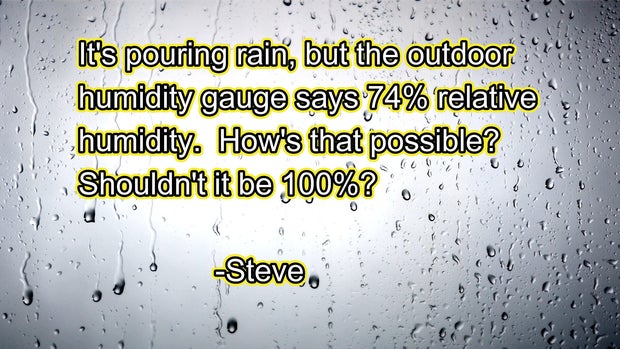
This is a great question because it shows Steve is paying attention to some of the meteorological ingredients needed to make rain.
Obviously, to get rain, you need the water cycle.
Surface water evaporates. That water vapor rises into the atmosphere, where it condenses into cloud droplets. Those cloud droplets bump into each other, causing them to grow. When they get too heavy, they fall back to the surface as precipitation.

The thing about this is that the ingredients for weather on the ground are different from the ingredients high up in the sky.
While Steve had a relative humidity of 74% on the ground, once the water vapor condenses into a cloud, that is where you would find the 100% humidity!
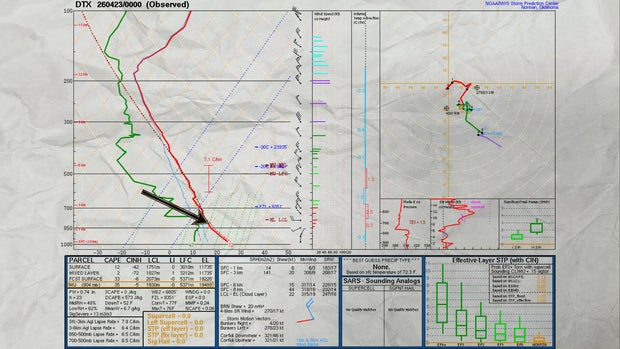
We can see how the temperature and dew point change with height by using weather balloons. When the temperature, or red line, intersects with the dew point, or the green line, you would find condensation or 100% relative humidity.
Now, you do need an elevated relative humidity level at the surface for rain to make it to the ground.
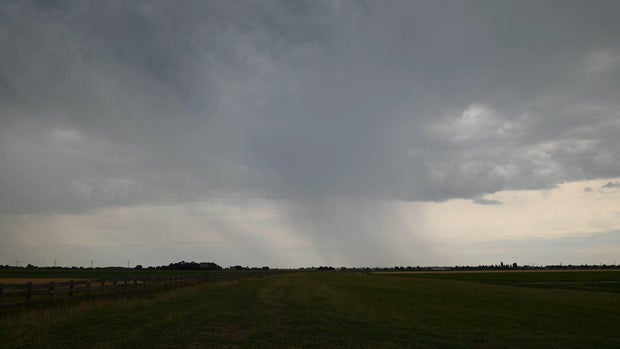
If it is too dry at the surface, the raindrops will evaporate before they hit the ground.
This rain shows on the radar but does not make it into a rain gauge.
This evaporating rain is known as "virga"! For rain to survive, you typically need a relative humidity level of at least 50%, but levels closer to 70% are better.