Iran's foreign minister travels to Pakistan and Russia after U.S. envoys' trip canceled
Follow updates on the war in the Middle East for Monday, April 27, here. See earlier developments below.
What to know about the Iran war today:
- Iranian Foreign Minister Abbas Araghchi returned to Islamabad on Sunday, where he participated in talks focused on ending the war with the U.S., Iranian state media reported. U.S. envoys Steve Witkoff and Jared Kushner had been expected to head to Islamabad Saturday for peace talks, but President Trump said he canceled their trip to Pakistan.
- Mr. Trump said Sunday that any possible Iran talks can take place over the phone. "If they want to talk, they can come to us, or they can call us. You know, there is a telephone," the president told Fox News, adding, "we're not sending people to travel 18 hours to meet."
- Mike Wirth, chairman and CEO of Chevron, told "Face the Nation with Margaret Brennan" that the global energy system "has lost an incredible amount of flexibility" since the start of the Iran war.
Iran's foreign minister, in Russia, blames U.S. for Pakistan talks failure, Iranian state media report
Iranian Foreign Minister Abbas Araghchi on Monday blamed the United States for the failure of peace talks in Pakistan, after arriving in Russia for a meeting with President Vladimir Putin.
"The U.S. approaches caused the previous round of negotiations, despite progress, to fail to reach its goals because of the excessive demands," Araghchi was quoted as saying by Iranian state media.
He also said "safe passage through the Strait of Hormuz is an important global issue," as the US and Iran continue their rival blockades of the vital waterway.
Iran's top diplomat to meet with Putin in St. Petersburg, Russia
Iran's Foreign Minister Abbas Araghchi was in Russia Monday for a meeting with President Vladimir Putin as part of a regional tour that included two stops in Pakistan and a visit to Oman, which shares the Strait of Hormuz with the Islamic Republic, Iran's state-run IRNA news agency reported.
Pakistan-led mediators are working to bridge significant gaps between the U.S. and Iran, according to a regional official involved in the mediation efforts who spoke to The Associated Press on the condition of anonymity because they were not authorized to discuss the matter.
CBS/AP
Oil prices rise again as Pakistan talks fail to materialize
Oil prices rose when the market opened Sunday as traders absorbed the news of the stalled ceasefire talks.
West Texas Intermediate, the U.S.-produced light, sweet crude, was selling for $96.50 a barrel Sunday, up 2% since the market closed on Friday. The price was 44% higher than before the start of the Iran war, when oil was selling for about $67 a barrel.
Brent crude, the international standard, was trading at $107.75 per barrel Sunday, up about 3% since Friday and 48% since the war began, when oil was selling for $72 a barrel.
Oil prices have risen steadily since the war began and tankers full of crude became stranded in the Persian Gulf, unable to safely transit through the Strait of Hormuz.
Iran's foreign minister departs for Russia
Iranian Foreign Minister Abbas Araghchi has departed for Russia, where he will meet with Russian leaders, following a nearly 5-hour stopover in Islamabad, Pakistan. While in Pakistan, Araghchi met with Pakistan's army chief, Asim Munir.
Iranian foreign minister's calls with counterparts in France and Qatar
Iranian Foreign Minister Abbas Araghchi spoke to his French counterpart and the Qatari prime minister on Sunday, between visits to the Omani capital and then Islamabad for the latest round of peace talks, according to Iranian state media and the Qatari Foreign Ministry.
During a phone call with French Foreign Minister Jean Noel-Barrot, Araghchi discussed the ceasefire agreement between the U.S. and Iran as well as diplomatic efforts to end the war, Iranian state media outlet Tasnim News reported. The Iranian official also highlighted the importance of European countries playing a role in the process, according to the outlet.
Qatari Prime Minister and Foreign Minister Sheikh Mohammed bin Abdulrahman bin Jassim Al-Thani pressed for continued mediation and the reopening of the Strait of Hormuz during a separate call with Araghchi.
"The call discussed efforts to achieve peace and enhance security and stability in the region," the Qatari ministry said, adding that Al-Thani "expressed the need for all parties to engage with the ongoing mediation efforts, which would open the way for addressing the root causes of the crisis through peaceful means and dialogue, leading to a sustainable agreement and preventing renewed escalation."
The Qatari official "also stressed the need to open sea lanes, ensure freedom of navigation, and not use them as a bargaining chip or pressure tactic," pointing to the regional consequences of the closure as well as the impacts on global energy, food supplies and security, the ministry said.
Rubio discusses "growing strategic relations" between U.S. and UAE with country's foreign minister
U.S. Secretary of State Marco Rubio discussed the Iran war and broader conflict in the Middle East during a phone call on Sunday with the United Arab Emirates' Foreign Minister Abdullah bin Zayed, the country's foreign affairs ministry said.
According to the ministry, their call focused on "the growing strategic relations" between the U.S. and UAE, with bin Zayed praising President Trump's "efforts towards achieving peace" and establishing "sustainable security and stability at the regional and international levels."
The foreign minister also shared "his sincere appreciation" for steps the Trump administration has taken to resolve fighting between Israel and Lebanon.
Death toll in Lebanon rises to 2,509, health ministry says
Lebanon's health ministry says 2,509 people have been killed in the latest Israel-Hezbollah war that broke out on March 2. Another 7,755 people have been wounded
The war broke out after Hezbollah fired rockets at northern Israel two days after the U.S. and Israel attacked Iran.
A 10-day ceasefire between Israel and Hezbollah went into effect on April 17. The ceasefire was extended by three weeks on Thursday.
Israel, Hezbollah trade accusations over Lebanon truce violations
Israel and Hezbollah traded blame over violations of the fragile ceasefire in Lebanon on Sunday, with Prime Minister Benjamin Netanyahu saying the military was "vigorously" targeting the Iran-backed militia as both sides claimed new attacks.
The accusations came as the foes said they carried out fresh attacks in southern Lebanon, with AFP correspondents reporting residents in heavy traffic heading north to flee an Israeli warning and strikes, while Israel's army reported one soldier killed.
Hezbollah released several statements on Sunday saying its fighters targeted Israeli troops and positions in response to Israeli ceasefire violations and attacks on Lebanese villages, vowing to keep up the attacks.
Claims that both sides have breached a 10-day ceasefire agreed earlier this month have continued even after President Trump announced its extension for three weeks on Thursday.
"Hezbollah's violations are, in practice, dismantling the ceasefire," Netanyahu told his weekly cabinet meeting.
U.S. oil executive suggests impacts of Strait of Hormuz closure will "be with us for some time"
Oil executive Mike Wirth suggested on Sunday that the impacts of the Strait of Hormuz closure will "be with us for some time."
"Because even if the strait were to open today, getting supplies to where they're needed and resuming the normal functioning of the system is going to take some time," Wirth, the chairman and CEO of Chevron, said on "Face the Nation with Margaret Brennan."
About a fifth of the world's oil typically flows through the strategic shipping lane, which has been effectively closed since the start of the conflict.
Wirth said the key thing is to restore flow through the strait.
"It allows markets to begin to rebuild these inventories. It allows us to get products to where they're needed, and to alleviate some of the pressure," he said.
"What's really needed is for flow to resume through the Strait of Hormuz," he said. "You can't take 20% of the energy out of the system."
British ambassador to U.S. says U.K. shares same intent, policy as U.S.
British Ambassador to the U.S. Christian Turner emphasized his country's allyship with the U.S. in an interview Sunday, amid tensions between the Trump administration and U.K. leadership over the Iran war, and just ahead of King Charles III's visit to Washington, D.C., on Monday.
"We share the same intent, the same policy as the U.S.," Turner said on "Face the Nation with Margaret Brennan." "We want to constrain this regime and its threat."
He also reiterated Britain's desire for the Strait of Hormuz to reopen, as U.K. Prime Minister Keir Starmer and French President Emmanuel Macron lead a coalition of countries aiming to secure the strait and support a lasting ceasefire.
"It is planning, once the straits are open, to ensure that the navigation we need has got the assurance of a whole package of boats, of drones, of intelligence to be able to make sure that shipping goes through," said Turner. "Because that's what American citizens need. That's what British citizens need. The people of Asia need. The global economy is suffering, and we want to see that resolved."
Sen. Graham calls Trump's decision to cancel U.S. envoys' trip "very wise"
Sen. Lindsey Graham called President Trump's decision to cancel the U.S. envoys' trip to Islamabad "very wise."
"President Trump's decision to cancel the Witkoff-Kushner visit was very wise, in as much as Iran's response since the ceasefire has been continued attacks on international shipping and more provocation," Graham, a Republican from South Carolina and one of Mr. Trump's closest allies in Congress, said on social media.
"The blockade has been brilliant in concept and execution," he said. "I applaud the president and his team for growing the blockade and making it global."
Graham said he spoke with the president Sunday "about the way forward" in the Iran war, and has "every confidence that he has many good options to make sure the gains against the Iranian regime are maintained, and most importantly, sustained."
Steve Witkoff and Jared Kushner had planned to travel to Pakistan this weekend to participate in another round of peace talks, but Mr. Trump said he called off their visit. He said an offer he received from Iranian officials to agree to a lasting peace deal was "not enough."
Trump: "We're not sending people to travel 18 hours to meet"
President Trump told Fox News' Jacqui Heinrich on Sunday that any possible Iran negotiations can take place over the phone.
"If they want to talk, they can come to us, or they can call us. You know, there is a telephone," the president said. "We have nice secure lines. Although I'm not sure any telephone line is secure, frankly, but, we have secure lines, and if they want we can talk. But we're not sending people to travel 18 hours to meet."
"They know what has to be in the agreement," he said. "Very simple. They cannot have a nuclear weapon. Otherwise there's no reason to meet."
Mr. Trump also described the blockade on the Strait of Hormuz as "unbelievably effective."
"When you have lines of vast amounts of oil pouring through your system, if for any reason that line is closed because you can't continue to put it into containers or ships, which has happened to them, they have no ships because of the blockade, what happens is that line explodes from within," he said.
Iranian foreign minister returns to Islamabad, state media reports
Iranian Foreign Minister Abbas Araghchi returned to Islamabad on Sunday, where he is expected to participate in talks focused on ending the war with the U.S., Iranian state media reported.
Araghchi arrived in the Pakistani capital after a brief trip to Oman.
While President Trump announced that U.S. envoys would not be involved in the discussions as planned, Araghchi said that conveying Iran's conditions for a lasting peace deal to mediator Pakistan is one of his top priorities for the trip, according to Iranian state media.
Chevron CEO says global energy system "has lost an incredible amount of flexibility"
Mike Wirth, chairman and CEO of Chevron, said in an interview that aired Sunday that the global energy system "has lost an incredible amount of flexibility" since the start of the Iran war.
In an interview on "Face the Nation with Margaret Brennan," he called for the restoration of the flow of goods through the Strait of Hormuz, saying a ceasefire alone is not enough to lower rising oil prices.
The global economy uses about 100 million barrels of oil each day, with one barrel comprising 42 gallons. About 20% of that overall inventory normally moves through the strait, said Wirth. The conflict has also impacted what he called "shock absorbers," like extra inventory in tanks, ships and other strategic reserves, which typically act as buffers when supply issues arise.
"What it's done is, it's taken those shock absorbers and made them much less effective in the system," said Wirth, referring to the war. "Disruptions normally are met by moving these inventories around, and price response can be muted. As the shock absorbers are withdrawn, the shocks translate a little bit more directly."
Wirth's comments came on the heels of others from the head of the International Energy Agency, who said the scope of the current energy crisis is larger than those catalyzed by the 1973 Arab oil embargo, the 1979 Iranian oil crisis, and the 2022 Russian invasion of Ukraine, combined.
Iranian foreign minister departs Oman for Pakistan
Iranian Foreign Minister Abbas Araghchi has departed Oman and is now en route back to Pakistan, where he is set to attend "key consultative meetings" with Pakistani officials in Islamabad before traveling to Moscow for talks with senior Russian leaders.
In Oman, Araghchi met with the Sultan and Prime Minister of Oman, Haitham bin Tariq, while on an official visit to the Omani capital, Muscat.
Iran's president tells U.S. to end blockade, state media says
Iranian President Masoud Pezeshkian said his country won't negotiate while the United States imposes a blockade on its ports, according to Iranian media.
Pezeshkian told Pakistani Prime Minister Shehbaz Sharif during a phone call Saturday night that the U.S. "should first remove operational obstacles, including the blockade," to allow a new round of negotiations, the ISNA and Tasnim news agencies reported.
The Pakistani premier described the call as a "warm and constructive discussion."
Iranian Foreign Minister Abbas Araghchi concluded a one-day trip to Pakistan's capital Islamabad on Saturday after meeting with Pakistani military and government officials.
The trip did not produce a breakthrough in efforts to relaunch negotiations after U.S. President Trump canceled a planned trip by his envoys to Islamabad.
U.S. Navy clearing Iranian mines from Strait of Hormuz
President Trump says the U.S. Navy is clearing Iranian mines from the Strait of Hormuz. The vital sea route for Persian Gulf oil is closed to most ships, putting strain on the global economy.
Experts say sweeping for underwater explosives could take months despite a tenuous ceasefire between the U.S. and Iran.
New strikes reported in Lebanon
Lebanese state media reported a series of new Israeli strikes in the country's south on Saturday night, after attacks earlier in the day killed six people despite a recently extended ceasefire in the war between Israel and Hezbollah.
The new attacks followed orders from Israeli Prime Minister Benjamin Netanyahu for the military to "forcefully attack Hezbollah targets" after the army accused it of breaching the truce.
Lebanon's health ministry said Israeli strikes on a truck and a motorbike in the town of Yohmor al-Shaqeef killed four people, and an attack on the town of Safad al-Battikh killed two and injured 17.
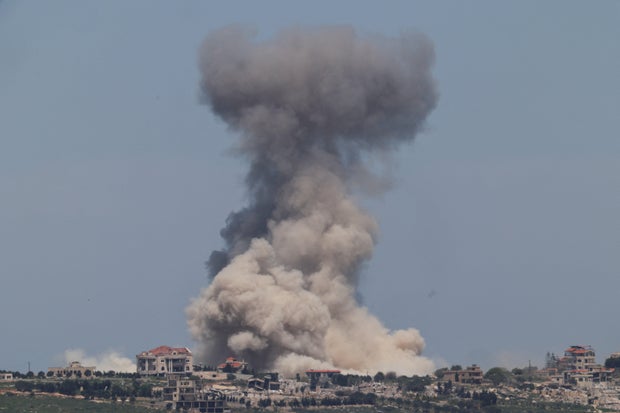
Israel's military said it "eliminated" three Hezbollah operatives on Saturday who were driving "a vehicle loaded with weapons," as well as another one riding a motorcycle, and two more armed members of the group elsewhere.
It also said it identified two projectiles launched from Lebanon, decrying "a blatant violation of the ceasefire understandings" by Hezbollah, and later intercepted another "suspicious aerial target."
Hezbollah, meanwhile, said it targeted an Israeli army vehicle in south Lebanon in retaliation for the attack on Yohmor al-Shaqeef.
Following Netanyahu's order to attack the group, Lebanon's state-run National News Agency reported a pair of strikes in quick succession in a town in Bint Jbeil district, another on a town in Tyre district, and strikes on two more towns in Nabatieh district.
The Israeli military said that it had "struck Hezbollah terrorist infrastructure used for military purposes across southern Lebanon", and would "continue to operate decisively against threats."
U.S. chopper intercepts sanctioned merchant vessel in Arabian Sea, CENTCOM says
The U.S. military Saturday intercepted a sanctioned merchant vessel in the Arabian Sea, U.S. Central Command said.
The M/V Sevan was intercepted by a U.S. Navy helicopter from the guided-missile destroyer USS Pinckney, said CENTCOM, which is responsible for U.S. military operations in the Middle East.
"The merchant vessel is currently complying with U.S. military direction to turn back to Iran under escort," CENTCOM said in a social media post.
M/V Sevan is one of 19 vessels belonging to a shadow fleet that was sanctioned by the Treasury Department Friday. A shadow fleet is a group of vessels that use deceptive practices to traffic oil from countries that are under U.S. sanctions.
M/V Sevan flies a Panama flag and is owned by the Marshall Islands-based Anka Energy and Logistics Company, according to the Treasury Department. It transported about 750,000 barrels of Iranian propane and butane to Bangladesh between August and November of 2025, the Treasury Department said.
Iran state media says foreign minister expected to return to Islamabad after Oman visit
Iranian Foreign Minister Abbas Araghchi is expected to return to Islamabad after he visits Oman and before traveling to Russia, according to Iran's state news agency IRNA.
IRNA said Araghchi arrived in Muscat on Saturday evening after meeting Pakistani officials and conveying Iran's positions on the terms of any understanding to fully end the war and establish peace.
Part of the Iranian delegation that accompanied Araghchi to Islamabad returned to Tehran after the talks for consultations and to receive further instructions on issues related to the war, according to IRNA.
The delegation members are expected to rejoin Araghchi in Islamabad on Sunday night.
Iran's foreign minister travels to Oman after peace talks canceled
Foreign Minister Abbas Araghchi traveled to Oman on an official visit after President Trump canceled U.S. envoys' travels to Pakistan to participate in peace talks.
A spokesperson for the Iranian office said on social media that this was the first visit to the region following the recent U.S.-Israeli aggression, which has impacted the broader area.
"Iran continues to place great importance on its relations with Persian Gulf states and remains committed to strengthening mutual trust and constructive cooperation," the post said.
The Persian Gulf states have faced attacks from Iran since the war began. Iran has launched drones and missiles and closed the Strait of Hormuz, causing economic impacts in the region.
Pakistani prime minister spoke to Iranian president following meeting
While no mention was made of President Trump's decision to cancel Steve Witkoff and Jared Kushner's trip to Islamabad, Pakistani Prime Minister Shebaz Sharif said he spoke to Iran's president, Masoud Pezeshkian, by phone on Saturday night after the in-person meeting with Iranian Foreign Minister Abbas Araghchi earlier in the day.
"During their warm and cordial conversation that lasted fifty minutes, the two leaders had a detailed exchange of views on the current regional situation and ongoing efforts to promote peace and stability in the region," Sharif said in a statement, though no details on a possible peace deal were released.
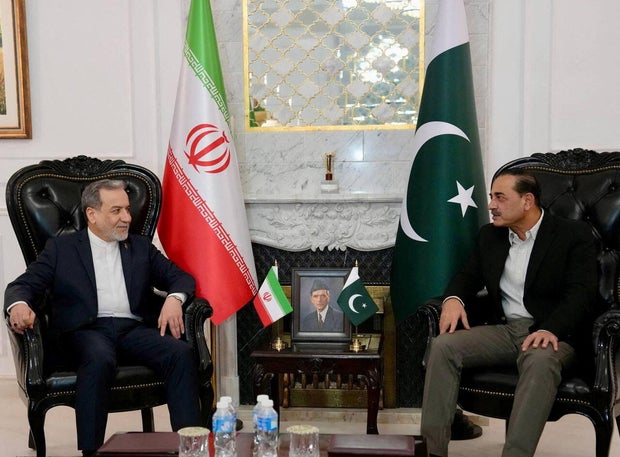
It's unclear if the call came before or after President Trump called off a trip by his envoys.
"I think the prime minister of Pakistan is great. They'd like to see something happen, but we're not gonna be traveling 15, 16 hours to have a meeting with people nobody has ever heard of," Mr. Trump said before boarding Air Force One to travel back to Washington.
Trump says "paper" from Iranians was "not enough" to make a deal
President Trump said the offer he received from Iranian officials to agree to a lasting peace deal was "not enough," and he called off Steve Witkoff and Jared Kushner's trip to Islamabad as he awaits another call about a deal.
"They gave us a paper that should've been better, and interestingly, immediately when I canceled it, within 10 minutes we got a new paper that was much better," Trump said from the tarmac before boarding Air Force One in Florida to return to Washington for the White House Correspondents' Dinner.
While he wouldn't say exactly what Iran offered in the negotiations, he echoed the familiar argument that Iran must end its nuclear program.
"They will not have a nuclear weapon, it's very simple. … They offered a lot, but not enough," Trump said.
Earlier in the conversation with reporters, he said he would deal with "whoever we have to, but there's no reason to have to wait two days, have people traveling for 16, 17 hours, and we're not doing it that way. When they want, they can call me."
Trump says he called off Witkoff, Kushner trip: "We have all the cards, they have none!"
President Trump confirmed he called off a trip for envoys Steve Witkoff and Jared Kushner to travel to Islamabad for peace talks.
"I just cancelled the trip of my representatives going [to] Islamabad, Pakistan, to meet with the Iranians," he wrote on Truth Social Saturday. "Too much time wasted on traveling, too much work!"
"Besides which, there is tremendous infighting and confusion within their 'leadership,'" he said. "Nobody knows who is in charge, including them. Also, we have all the cards, they have none! If they want to talk, all they have to do is call!!!"
White House press secretary Karoline Leavitt said on Friday the duo would head to Islamabad for "direct talks" in pursuit of a lasting peace deal more than 50 days after the U.S. and Israel started bombing Iran.
Iranian Foreign Minister Abbas Araghchi spoke with Pakistani Prime Minister Shebaz Sharif on Saturday, but has already departed for Oman. The Pakistanis have been serving as intermediaries for discussions between Iran and the U.S.
Trump cancels U.S. envoys' trip to Pakistan, Fox News reports
President Trump said Saturday that Steve Witkoff and Jared Kushner will no longer be going to Pakistan today for Iran talks, Fox News reported.
"I've told my people a little while ago they were getting ready to leave, and I said, 'Nope, you're not making an 18 hour flight to go there," the president said, according to Fox News' White House correspondent Aishah Hasnie. "We have all the cards. They can call us anytime they want, but you're not going to be making any more 18 hour flights to sit around talking about nothing."
The White House deferred to Mr. Trump's quote to Fox News when asked for comment.
Iranian foreign minister leaves Pakistan, expected to return Sunday or Monday
After about 20 hours of talks with top Pakistani officials, including Field Marshal Asim Munir and Prime Minister Shebaz Sharif, Iranian Foreign Minister Abbas Araghchi has departed Islamabad and is on his way to the Omani capital, Muscat.
Pakistani officials are being tight-lipped about whether the Iranians have agreed to a second round of talks, however, they have told CBS News that Araghchi is expected to return to Islamabad on Sunday or Monday.
Following Saturday's talks, a statement released by the Iranian Foreign Ministry provided few specifics other than thanking Pakistan for serving as an intermediary between Iran and the U.S.
Araghchi had previously said he had no plans to meet in person with U.S. special envoy Steve Witkoff or President Trump's son-in-law Jared Kushner, who were both scheduled to fly to Islamabad on Saturday.
2 projectiles fired toward Israel from Lebanon, army says; no one injured
Sirens sounded in several northern Israeli towns on Saturday afternoon as two more projectiles were fired from Lebanon, according to the Israeli army.
One projectile was intercepted while another fell in open territory, according to Israel. No one was injured. It was not immediately clear if the one projectile landed in Israeli territory.
"This incident constitutes a blatant violation of the ceasefire understandings by the Hezbollah terrorist organization," the Israel Defense Forces said in a statement.
Both sides have accused the other of violating a tenuous ceasefire in place since April 16.
Israel said it also intercepted a "suspicious aerial target" in southern Lebanon earlier in the day Saturday. That projectile did not cross into Israeli territory, Israel said.
Iranian officials provide few details in wake of meeting in Pakistan
The Iranian Foreign Ministry provided few concrete details following a much-anticipated meeting between Foreign Minister Seyed Abbas Araghchi and Pakistani Prime Minister Muhammad Shehbaz Sharif on Saturday.
Araghchi thanked senior Pakistani officials for serving as an intermediary between Iran and the U.S. in pursuit of a lasting deal to end the U.S.-Israeli war with Iran, according to a statement.
The Foreign Ministry said Araghchi "outlined Iran's principled positions regarding the latest developments related to the ceasefire and the full end of the war." The statement did not provide any details on the exact positions.
Araghchi also conveyed to Pakistan his criticism of continued attacks by Israel in Lebanon despite the ongoing ceasefire.
Israel continues fight on two fronts despite ceasefires
The Israeli army said it took action in both Gaza and Lebanon over the last two days as it addressed threats posed to Israeli forces.
On Friday, Israel identified a pickup truck filled with alleged terrorists that posed an "immediate threat" to soldiers in the area. Israel conducted an airstrike that took out the truck, according to the Israel Defense Forces.
Israel and Hamas agreed to a ceasefire in October, bartered by the U.S., but Israel has continued to respond to alleged threats to its forces in Gaza. There have been 738 people killed in Gaza over the six months — from Oct. 10, 2025, to April 10, 2026 — since the deal was signed, according to the Palestinian Ministry of Health.
The Israeli air force also acted to intercept a "suspicious aerial target" in southern Lebanon on Saturday afternoon. Israel said it posed a threat to Israeli forces in the area but never crossed into Israeli territory.
Despite the ceasefire signed two weeks ago, and extended by another three weeks on Thursday, Israel has continued to target alleged threats to its forces in southern Lebanon. Both sides have accused the other of repeated violations of the ceasefire deal.
Iranian delegation meets with Pakistani prime minister
A meeting has begun between Iranian Foreign Minister Abbas Araghchi and Pakistani Prime Minister Muhammad Shehbaz Sharif, according to Pakistani officials.
Pakistani Deputy Prime Minister Muhammad Ishaq Dar and Chief of Army Staff Syed Asim Munir are also meeting with the group of Iranian officials.
Araghchi arrived in Islamabad on Friday ahead of his meeting with Sharif. The U.S. is sending special envoy Steve Witkoff and Jared Kushner to Islamabad on Saturday, though Araghchi said he had no plans to meet with the U.S. representatives and will convey Iran's position on a peace deal only through the Pakistani mediators.
Araghchi was initially only expected to be in Islamabad for a few hours, but the talks have lasted longer and he remains in Islamabad.
Iran's president calls on people to save electricity
Iran's president has urged people to reduce their use of electricity after American and Israeli strikes damaged the county's energy infrastructure, state media reported.
President Masoud Pezeshkian said the government aims to "control consumption" of electricity, according to Iranian state television.
"Instead of turning on 10 lights at home, turn on two lights. What is wrong with that?" he said.
He said the U.S. and Israel "destroyed our infrastructure," and noted the U.S. imposed a blockade on Iran's ports.
Commercial flights resume at Tehran airport
Iran has resumed commercial flights from Tehran's international airport for the first time since the conflict with the U.S. and Israel began.
State-run TV reported that flights departed Saturday from Imam Khomeini International Airport in Tehran, heading to Istanbul, Oman's capital Muscat and the Saudi city of Medina.
Flightradar24, a flight tracking platform, showed at least three Istanbul-bound flights departed Saturday morning.
This follows a partial reopening of Iran's airspace amid a ceasefire with the U.S.
Unclear if direct talks will be held
It is unclear whether the Iranian side will meet directly with the U.S. envoys who are heading to Iran.
Iranian state television said Foreign Minister Abbas Araghchi had no plans to meet with the Americans, and Islamabad would serve as a bridge to "convey" Iranian proposals.
Pakistan's foreign ministry said Araghchi had arrived in Islamabad Friday to discuss "ongoing efforts for regional peace and stability" with Pakistani officials, without directly referencing talks with Witkoff and Kushner.
An Iranian spokesman said Araghchi would later visit Oman and Russia to discuss efforts to end the war.
Tehran's defense ministry, in a statement carried by news agency ISNA, said "the enemy is looking for a face-saving way to escape the war quagmire it has become trapped in."
White House press secretary Karoline Leavitt had said Friday that "the Iranians want to talk," and "they want to talk in person."
Naval escorts will likely be needed when Strait of Hormuz reopens, Chevron CEO says
Chevron's chief executive said it's likely that the U.S. Navy may need to escort commercial vessels through the Strait of Hormuz once it reopens in order to ensure a level of security.
The standoff over the strait has intensified amid Iran's threats against the critical channel and a U.S. blockade on Iranian ports, effectively closing it. The tensions have led to several maritime incidents in recent days.
Asked Thursday by "Face the Nation" moderator Margaret Brennan what Chevron would need to see to feel confident to send a ship through the strait, CEO Mike Wirth said, "We'd have to believe that our people on the ship will be safe, the cargo will be safe, and they can be transited with a high degree of confidence."
U.S. says detained Kuwaiti-American journalist released by Kuwait
The State Department says a detained Kuwaiti-American journalist who was arrested in Kuwait has been released after intervention by the Trump administration.
The department said late Friday that Ahmed Shihab-Eldin had been freed and allowed to leave Kuwait. It offered no other details, citing privacy concerns.
CBS partner BBC News had reported Thursday that Shihab-Eldin was acquitted of charges that he had re-posted videos and images related to the Iran war. He had been accused of spreading false information, BBC News reported.
CBS/AP
Some businesses paying $4 million to traverse Panama Canal amid Strait of Hormuz crisis
Some businesses are paying $4 million to cross the Panama Canal amid the near-total closure of the Strait of Hormuz, according to the Panama Canal Authority.
While passage through the waterway usually comes at a flat rate via reservations, companies without reservations can cross by paying an additional fee in an auction for slots, which are awarded to the highest bidder rather than waiting for days off the coast of Panama City.
That price has ballooned in recent weeks as Iran and the U.S. have bottlenecked the strait, and demand for those slots has skyrocketed. Ships have increasingly traveled through the Panama Canal as shipments are rerouted and buyers purchase from other countries to avoid commerce through the now-treacherous Middle Eastern waterway.
"With all the bombings, the missiles, the drones...companies are saying it's safer and less expensive to cross through the Panama Canal," said Rodrigo Noriega, a lawyer and analyst in Panama City. "All of this is affecting global supply chains."
U.S. freezes $344 million in cryptocurrency over alleged ties to Iran, Bessent says
Treasury Secretary Scott Bessent announced Friday that the U.S. had frozen $344 million in cryptocurrency due to alleged ties to Iran in an effort to "degrade Tehran's ability to generate, move, and repatriate funds."
Bessent said in a social media post that the Treasury's Office of Foreign Assets Control was "sanctioning multiple wallets tied to Iran."
"We will follow the money that Tehran is desperately attempting to move outside of the country and target all financial lifelines tied to the regime," Bessent said.
Earlier this week, Bessent also threatened to sanction anyone who attempted to facilitate the movement of Iranian oil amid the U.S. blockade of Iran's ports.
In 8 weeks, the Iran war has dented the U.S. economy. The damage could linger, economists say.
In the eight weeks since the Iran war started, the conflict has driven gas prices above $4 a gallon, strained homebuyers and pushed inflation to its highest level in nearly two years. Even if the war ends soon, Americans are likely to feel the financial sting for months, economists say.
"I think the damage has already been done, in part because there's no going back on oil prices, at least not any time in the near future," Mark Zandi, chief economist at Moody's Analytics, told CBS News.
The war has disrupted traffic through the Strait of Hormuz, a strategic waterway through which one-fifth of the world's oil supply normally flows. Oil prices have jumped as a result, creating widespread consequences for Americans as they fuel their cars and book travel. As of midday Friday, Brent crude, the international benchmark, was trading at $105 a barrel, up 44% since before the war started.
Oil production will take a long time to ramp up to prewar levels of 100 million barrels a day because of the widespread damage to energy facilities across the Middle East, Zandi said.
Trump administration sanctions Iran-linked oil tankers and Chinese refinery
The U.S. Treasury Department imposed sanctions Friday on more than a dozen tankers that it accused of transporting billions of dollars' worth of Iranian crude oil and other petroleum products, in the latest move to economically hobble Iran's oil industry.
The Treasury's Office of Foreign Assets Control said the 19 tankers belong to a "shadow fleet," a term for tankers that use questionable registrations and other methods to transport oil from heavily sanctioned countries like Iran. The office also imposed sanctions on another 19 firms that it said were "operating in the petroleum or petrochemical sectors of the Iranian economy."
The U.S. is also sanctioning Hengli Petrochemical (Dalian) Refinery Co., an independent Chinese oil refinery that it called "one of Iran's largest customers for crude oil and other petroleum products." The Hengli refinery was accused of buying billions of dollars' worth of crude oil from Iran-linked shadow tankers, including from firms linked to Iran's armed forces.
Iran plans to make an offer to U.S., Trump tells Reuters
President Trump told the Reuters news agency that Iran plans to make an offer to the U.S. that would satisfy Washington's demands as a new round of peace talks are expected to take place in Pakistan.
"They're making an offer and we'll have to see," Mr. Trump told Reuters in a phone interview Friday.
The president said he didn't immediately know details about the offer, Reuters reported.
Mr. Trump wouldn't tell the news agency which individuals his administration was negotiating with.
"We're dealing with the people that are in charge now," he said.
Iranian foreign minister arrives in Pakistan's capital
Pakistan's Foreign Ministry said an Iranian delegation led by Foreign Minister Abbas Araghchi arrived in Islamabad on Friday.
Araghchi was received by Pakistan's Foreign Minister Ishaq Dar, Chief of Army Staff Field Marshal Asim Munir and other senior officials upon arrival.
In a statement, the Foreign Ministry said Araghchi is expected to meet with Pakistan's senior leadership to discuss the latest regional developments and ongoing efforts to promote regional peace and stability.
Iran war will keep natural gas market tight for 2 years, International Energy Agency says
The implications of the Iran war on energy markets will extend well beyond this year, according to a new report from the International Energy Agency on Friday.
The conflict in the Middle East, now in its second month, is expected to crimp global natural gas supplies for two years as damage to liquefied natural gas facilities in Qatar disrupts supply, the agency predicts.
"The Iranians want to talk," White House says
White House press secretary Karoline Leavitt said the U.S. has seen progress from Iran ahead of the potential new round of peace talks between the two countries in Pakistan.
"The Iranians want to talk," Leavitt told reporters. "They want to talk in person."
Asked if Iran had put forward a unified proposal, Leavitt said, "We've certainly seen some progress from the Iranian side in the last couple of days. Again, the president has made the decision to send Steve (Witkoff) and Jared (Kushner) to hear the Iranians out, and so we'll see what they have to say this weekend."
Vance on standby to go to Pakistan for new Iran talks, White House says
Vice President JD Vance will be on standby while President Trump's special envoy Steve Witkoff and son-in-law Jared Kushner are in Pakistan for the latest round of negotiations with Iran, White House press secretary Karoline Leavitt told reporters Friday.
"The president, the vice president, the secretary of state will be waiting here in the United States for updates, and the vice president, I understand, is on standby and will be willing to dispatch to Pakistan if we feel it's a necessary use of his time," Leavitt said.
Witkoff, Kushner head to Pakistan for talks with Iran through Pakistani intermediaries
Special envoy Steve Witkoff and President Trump's son-in-law Jared Kushner are heading to Islamabad for conversations about a peace deal with Iran, White House press secretary Karoline Leavitt said Friday afternoon on Fox News.
"I can confirm special envoy Witkoff and Jared Kushner will be off to Pakistan again tomorrow morning to engage in talks, direct talks, intermediated by the Pakistanis who have been incredible friends and mediators throughout this entire process with representatives from the Iranian delegation," Leavitt said.
Vice President JD Vance will not be attending the talks, as had been discussed earlier in the week, but Leavitt said he will be standing by and consulting President Trump alongside Secretary of State Marco Rubio.
Iranian Foreign Minister Abbas Araghchi said Friday he was departing for a "timely tour of Islamabad, Muscat, and Moscow," confirming his trip to Pakistan. The Pakistani intermediaries have been trying for weeks to organize a second round of direct U.S.-Iran peace talks.
Leavitt reiterated that the deal with Iran to end the war must include them turning over nuclear material and committing to not building a nuclear weapon.
Hezbollah "trying to sabotage" Israel-Lebanon ceasefire, Netanyahu says
Hezbollah is "trying to sabotage" the ceasefire between Israel and Lebanon, Israeli Prime Minister Benjamin Netanyahu said Friday.
In a video statement, Netanyahu said the U.S. and Israel had "begun a process to achieve a historic peace" between his country and Lebanon, a day after President Trump announced an agreement for a U.S.-brokered ceasefire to be extended by three weeks.
"It is clear to us that Hezbollah is trying to sabotage this," Netanyahu said.
Both Israel's military and Iranian-backed Hezbollah have accused each other of violating the ceasefire repeatedly since it was first signed on April 16.
A prominent Hezbollah lawmaker said Friday that the group "firmly rejects" the ceasefire extension.
"We are maintaining full freedom of action against any threat, including emerging ones," Netanyahu said in his Friday remarks. "We attacked yesterday and we attacked today."
Several villages in the south of the country were hit by Israeli airstrikes Friday, Lebanese media reported, one of which the military confirmed.
On Iran, Netanyahu said Israel and the U.S. were "operating in full cooperation."
Iran claims U.S. seized Touska cargo ship carrying "critical" medical supplies, breaching international law
Iran's mission to the United Nations claimed Friday that a cargo ship seized by American forces as part of the U.S. naval blockade was carrying critical medical equipment, and called it a "flagrant breach of international law."
In a post on X, Iran's mission to the United Nations said the M/V Touska was "carrying critical dialysis supplies and medical equipment" when it was fired on and then seized by U.S. forces Sunday.
The mission characterized it as an "illegal seizure" and said the crew were taken "hostage," calling it a "coercive and unlawful act [that] endangers lives … and places vulnerable patients at grave risk."
According to the U.S. military, "after Touska's crew failed to comply with repeated warnings over a six-hour period," personnel on board the USS Spruance destroyer directed them to evacuate the engine room before striking it with "several rounds" to "disable Touska's propulsion."
"The TOUSKA is under U.S. Treasury sanctions because of its prior history of illegal activity," President Trump said Sunday in a post on his Truth Social platform, adding: "We have full custody of the ship and are seeing what's on board."
Since the U.S. blockade of Iranian ports and vessels began on April 13, American forces have "redirected" 34 vessels, U.S. Central Command said Friday.
Iran has enforced a de-facto blockade of the Strait of Hormuz since the U.S. and Israel launched their war with Iran on Feb. 28, and its forces have seized two vessels this week
Iran will exempt Russia from shipping fees in Strait of Hormuz, its ambassador in Moscow says
Iran is to make Russia exempt from any tolls in the Strait of Hormuz, according to its ambassador to Moscow.
In remarks reported by Russian state news agency RIA Novosti, Ambassador Kazem Jalili said several countries, including Russia, would not be charged fees for passing through the contested waterway.
"We've currently provided exceptions for some countries, but I don't know what will happen in the future," he said. "However, our foreign ministry is currently trying to implement the exceptions envisioned for friendly countries, such as Russia."
The U.S. military has imposed a blockade for more than two weeks on Iran's ports, which was expanded to include any vessels transporting Iranian energy products or other suspected contraband. Many commercial vessels linked to Iran and Russia are subject to U.S. sanctions, which would make them subject to interdiction by American forces.
Despite multiple reports of Iran-linked vessels continuing to transit the strait, Secretary of Defense Pete Hegseth insisted again on Friday that no ships deemed to be in violation of the blockade were making it through.
Italian officials rule out replacing Iran at soccer's 2026 World Cup
Sports officials in four-time world champion Italy say the country is not interested in replacing Iran at the upcoming 2026 World Cup, following a suggestion of the move by a Trump administration official.
Iran has not withdrawn from the World Cup, and the team is preparing to play in the championship taking place this year in the U.S., Mexico and Canada despite the ongoing war in the Middle East.
FIFA, the global soccer authority behind the World Cup, has insisted that Iran's group stage games in California and Washington state will go ahead as planned in June.
The Financial Times reported this week that Paolo Zampolli, the U.S. special envoy for global partnerships, had suggested the swap to President Trump and FIFA president Gianni Infantino.
In a phone interview with The Associated Press on Thursday, Zampolli said his "request is not a political request," but rather meant as a contingency plan in case Iran could not participate in the soccer tournament.
After suggesting to the FT that, with four previous titles, the Italian national team's appearance in the World Cup would be justified, he told the AP it was his "dream … for the Italian people and the American-Italian people."
Italian officials pushed back hard at the suggestion, with Sports Minister Andrea Abodi saying Thursday, "first of all, it's not possible. Secondly, it's not a good idea."
Luciano Buonfiglio, the president of the Italian Olympic Committee, which oversees all sports in Italy, also dismissed the idea, saying he "would feel offended," as "you need to deserve to go to the World Cup."
CBS/AP
Iran foreign minister says he's off to Pakistan, Oman and Russia "to closely coordinate with our partners"
Iran's Foreign Minister Abbas Araghchi said in a brief social media post Friday that he was departing for a "timely tour of Islamabad, Muscat, and Moscow," confirming his trip to Pakistan, an intermediary that has been trying for weeks to organize a second round of direct U.S.-Iran peace talks.
Echoing reports by state media, Araghchi said the purpose of his visits to Pakistan, Oman and Russia was "to closely coordinate with our partners on bilateral matters and consult on regional developments."
"Our neighbors are our priority," the Iranian diplomat said.
There has been no indication from the White House that a U.S. delegation is heading for Pakistan, which brokered the ceasefire that has halted major attacks by the U.S. and Israel on Iran, and Iran's retaliatory missile and drone fire at Persian Gulf states.
President Trump, earlier this week, said he was extending that ceasefire indefinitely to give what he insists is a deeply fractured Iranian regime time to formulate a unified response to the latest American peace proposals.
Thus far, Iranian officials have indicated no willingness to reengage in direct talks with the U.S. while the American naval blockade of its ports remains in effect.
The Reuters news agency reported Friday, citing anonymous sources, that Araghchi would present Iranian terms for a peace deal to Pakistan, to be conveyed to U.S. officials.
New airstrikes in Lebanon after Israel warns residents to flee one village despite tense ceasefire
Israel carried out airstrikes on several towns in southern Lebanon Friday, Lebanese media said, hours after President Trump announced a three-week extension of a tense ceasefire between Israel and Lebanon.
An Israeli military spokesman warned residents of one southern village to flee their homes before the strikes were reported, saying Iranian-backed Hezbollah was launching operations from Deir Aames, "forcing the Defense Army to act against it in your place of residence."
The IDF struck the town as well as the outskirts of Kunin and Bint Jbeil Friday, according to Lebanese media, which showed images of the apparent strikes.
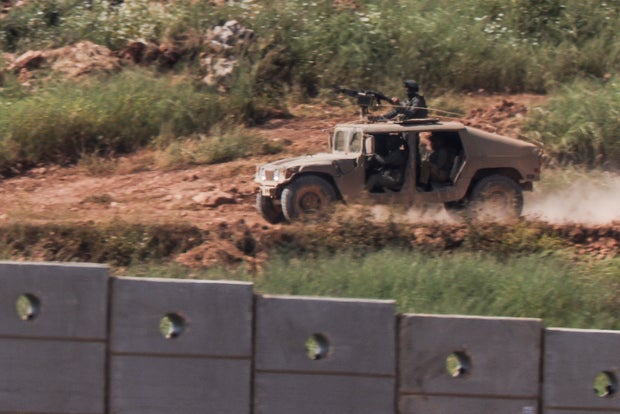
Earlier Friday, both the IDF and Hezbollah confirmed that the Iranian-backed group, long designated as a terrorist organization by the U.S. and Israel, had shot down an Israeli drone in the skies over southern Lebanon.
On Thursday evening, ambassadors from Lebanon and Israel in Washington D.C. signed an extension to a tenuous ceasefire deal that both the IDF and Hezbollah have accused each other repeatedly of violating.
A prominent Hezbollah lawmaker said earlier Friday that the group "firmly rejects" the three-week extension of the truce, and Israel warned that it would "continue to act decisively" against threats from Hezbollah.
Journalist kidnapped in Iraq thanks "those who worked for my release"
An American freelance journalist who was kidnapped in Iraq's capital in March has thanked "those who worked for my release" in her first comments since being freed.
In a post on X, Shelly Kittleson wrote that she was "incredibly grateful" to those who helped orchestrate her release from the Iranian-backed militia Kata'ib Hezbollah, which kidnapped her on a Baghdad street.
"So many people – including but not limited to government officials, press freedom organizations, and my wonderful community of fellow journalists and friends – put an immense amount of effort into ensuring that the level of attention to my case remained high. Thank you all so very, very much," Kittleson wrote.
She was held by the group for about a week before being released on April 7.
Her name was on a Kata'ib Hezbollah list of U.S. journalists to target for kidnapping, multiple sources told CBS News.
Iran state news agency confirms foreign minister visiting Islamabad, says it's for "bilateral consultations"
After Pakistani sources told CBS News that Iranian Foreign Minister Abbas Araghchi was due in Islamabad Friday evening for an "expected" second round of U.S.-Iran peace talks, Iran confirmed his pending visit, but said nothing about him meeting with U.S. officials.
Araghchi was to begin a tour on Friday evening that would include stops in Islamabad, Oman's capital Muscat, and Moscow, Russia, Iran's official news agency IRNA said. It said the "purpose of the trip is to hold bilateral consultations, discuss ongoing regional developments, and review the latest situation regarding the U.S.- and Israeli-imposed war against Iran."
The Iranian government later confirmed his trip in a social media post.
President Trump has voiced optimism that Iran will eventually agree to a deal to end the war on his terms, and said he is in no rush to make an agreement that would do so before his demands are met.
Mr. Trump and U.S. Defense Secretary Pete Hegseth have said the American military blockade of Iranian ports and vessels will force the regime in Tehran to capitulate, and they have both warned that military strikes could resume if Iran refuses to make a deal.
There was no immediate comment from the White House on Friday about any plan to send a negotiating team back to Islamabad for a second round of negotiations. Vice President JD Vance had been expected to head to Pakistan earlier in the week for talks, but he never left Washington as Iran declined to send a delegation.
U.S. deserves allies in Europe and Asia who are "loyal," Hegseth says
Secretary of Defense Pete Hegseth said Friday that the "free ride" is over for American allies he said were benefiting from U.S. actions in the Strait of Hormuz.
"This should not be America's fight alone. We barely use the Strait of Hormuz as a country. Our energy doesn't flow through there, and we have plenty of energy," Hegseth told reporters at the Pentagon. "Europe and Asia have benefited from our protection for decades, but the time for free riding is over."
About 7% of U.S. crude oil and condensate imports and 2% of U.S. petroleum liquids consumption came through the Strait of Hormuz in the first half of 2025, according to the U.S. Energy Information Administration.
Due to all petroleum products being traded on international markets, however, prices at the pump have soared for Americans since the war began, and inflation was up sharply last month due to the war's impact on the flow of oil and gas through the strait.
"America and the free world deserve allies who are capable, who are loyal, and who understand that being an ally is not a one-way street. It's a two-way street," Hegseth said, looking directly into the camera. "We are not counting on Europe, but they need the Strait of Hormuz much more than we do and might want to start doing less talking and having less fancy conferences in Europe and getting on a boat. This is much more their fight than ours."
Iran to resume international flights as Qatari and Kuwaiti airlines also ease flight restrictions
International flights from Tehran's Imam Khomeini Airport will resume Saturday, Iran's state-run ISNA news agency reported Friday, days after the Iranian regime announced the reopening of its airspace amid the ceasefire with the U.S.
The first flights to resume will be to Istanbul and Muscat, the announcement said. Iran's airspace was shut when the U.S. and Israel launched their war with the country on Feb. 28, and it has been slow to reopen during the ceasefire, which President Trump said earlier this week was being extended indefinitely to make room for diplomacy.
Officials announced last week that Mashhad airport, which serves the country's second city in its far northeast, was reopening on Monday. On Friday, public tracking data showed at least two international flights departing the airport, to Turkey and Oman respectively.
Iran Air, the country's flagship carrier, reopened domestic routes after a 50-day suspension on Wednesday.
Qatar Airways announced Thursday that it was resuming flights between Doha and "key destinations across the Middle East," including to Dubai, Sharjah, the United Arab Emirates and Syria. Kuwait Airways has also announced it will resume flights to several destinations on Sunday.
While flights have been canceled due to the threat of missiles and drones flying across the Persian Gulf region, airlines have also been hit hard by the price of jet fuel roughly doubling since the war began, as attacks in the region and shipping gridlock in the Strait of Hormuz constrains production and transportation petroleum products.
KLM-France, Lufthansa and Delta are among the airlines that have cut down flight routes and increased ticket prices.
CBS/AFP
Hegseth says blockade of Iranian ports and ships now "global," will remain in place during negotiations
Secretary of Defense Pete Hegseth stressed on Friday the strength of the U.S. blockade of Iranian ports and vessels linked to the Islamic Republic, saying it had gone "global."
"This growing blockade has also gone global. Just this week, we seized two Iranian dark fleet ships in the Indo-Pacific region that had left Iranian ports before the blockade went into effect," Hegseth said. "They thought they'd made it out just in time. They did not. We seized their sanctioned ships, and we will seize more. Our blockade is growing and going global."
Hegseth said the number of Iranian ships prevented from exiting the Strait of Hormuz by U.S. forces had risen to 34, an increase of one since Thursday evening.
The secretary repeated the president's rhetoric from Thursday, when Mr. Trump said he had "all the time in the world" to make a deal with Iran, and the defense secretary urged Tehran to come to the negotiating table with a meaningful proposal to end the war.
"Iran knows that they still have an open window to choose wisely. As we said previously, choose wisely at the negotiating table," he said. "All they have to do is abandon a nuclear weapon — and in meaningful and verifiable ways. Or instead, they can watch their regime's fragile economic state collapse under the unrelenting pressure of American power. A blockade as long as it takes. Whatever President Trump decides."
Spain's leader dismisses report U.S. Defense Department considering move to suspend Spain from NATO
Spanish Prime Minister Pedro Sanchez on Friday dismissed a report that the U.S. Department of Defense is considering suspending Spain from NATO, saying his country is a "reliable member" of the seven-decade-old transatlantic military alliance.
The Reuters news agency reported Friday that an internal Pentagon email had floated the idea of punishing allies deemed to have failed to support the U.S.-Israeli war with Iran. One option being considered, a U.S. official told Reuters, was suspending Spain from the alliance.
Neither the Trump administration nor the Department of Defense have confirmed the existence of the email or its contents.
Arriving at a meeting of European Union leaders Friday, Sanchez dismissed the report.
"We don't work on emails but on official documents and positions taken by the U.S. government," Sanchez told reporters. "The position of the Spanish government is clear; absolute collaboration with allies but always within the limits of International Law."
He called Spain a "reliable member" of the alliance, and said, "as a result, I am absolutely not worried."
A NATO official told CBS News on Friday that it would not be possible for the U.S. to unilaterally suspend another member state, saying the organization's founding treaty "does not foresee any provision for suspension of NATO membership, or expulsion."
Pakistani sources say Iran's foreign minister due in Islamabad Friday night ahead of expected U.S.-Iran talks
Iran's Foreign Minister Abbas Araqchi is expected to arrive in Islamabad Friday evening local time with a small team, Pakistani government sources told CBS News.
Following important discussions with the Pakistani mediation team, a second round of Islamabad peace talks between the United States and Iran is expected, the sources said.
A U.S. logistics and security team is already present in Islamabad to facilitate the negotiation process, the sources said.
A large part of Islamabad has been on lockdown for the past week as Pakistani officials have worked to orchestrate a second round of direct U.S.-Israel peace talks.
President Trump announced early this week an indefinite extension of the ongoing ceasefire with Iran, which he said was to enable Tehran to formulate a full response to his proposal for a lasting peace deal.
Vice President JD Vance had been expected to lead a U.S. delegation to Islamabad for talks with Iran early this week, but he never left Washington as Iran declined to send its own team for new negotiations.
Long-term concerns emerge over advanced munitions supplies as U.S. re-arms during Iran ceasefire
Days after the United States opened its military campaign against Iran, President Trump sought to project confidence in the nation's war footing, declaring that America had a "virtually unlimited supply" of key munitions and could fight wars "forever" using them.
The remark conveyed a familiar image of American military power, a projection of being technologically unmatched, logistically dominant and capable of sustaining operations indefinitely. But recent congressional testimony from Pentagon officials and an analysis of the U.S. arsenal point to a more constrained reality, where the U.S. advantage lies less in limitless supply than in highly advanced, but finite, systems.
Of particular concern are supplies of advanced long-range missiles capable of striking targets hundreds of miles away, as well as interceptor munitions used to defend U.S. forces against incoming attacks.
Hegseth and Joint Chiefs chair Dan Caine to hold news conference on Iran war
Defense Secretary Pete Hegseth and Gen. Dan Caine, chairman of the Joint Chiefs of Staff, will hold a news conference on Operation Epic Fury at 8 a.m. ET on Friday, the Pentagon said.
Hezbollah lawmaker says group "firmly rejects" Israel-Lebanon ceasefire after Trump announces extension
A prominent member of Hezbollah's political wing, Lebanese parliamentarian Ali Fayyad, said in a statement on Friday that the three-week extension of the Israel-Lebanon ceasefire announced the previous day by President Trump in Washington was "meaningless" in light of continued "hostile acts" by Israel.
Fayyad, a longtime member of the Iranian-backed group which is both a powerful political entity in Lebanon and a well-armed proxy force for Tehran, said Hezbollah reserved the right to respond to any future Israeli "aggressions."
"A ceasefire is meaningless in light of Israel's continued escalation of hostile actions — assassinations, bombardment, and opening fire — as well as its ongoing destructive annihilation of Lebanese border villages and towns, and its insistence on freedom of movement under the pretext of potential threats," Fayyad said in a statement conveyed by Lebanon's official National News Agency.
The freedom of movement remark was likely in reference to Israel's military occupation of a buffer zone across southern Lebanon. Israeli leaders say troops will remain in the zone, which extends about six miles into Lebanese territory, indefinitely, and that residents will not be allowed to return until the threat posed by Hezbollah to Israeli residents is eliminated.
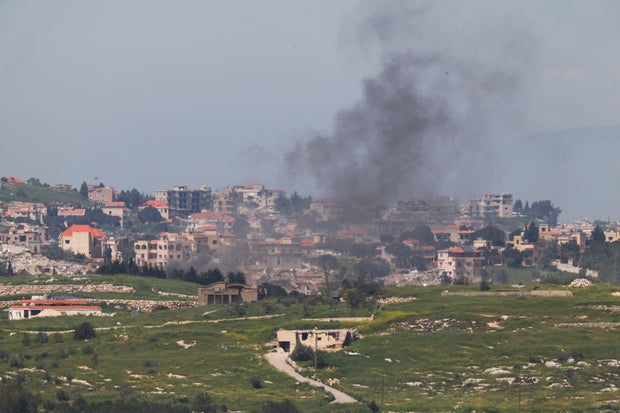
Fayyad said the extension of the agreement between Israel and Lebanon's government, which Hezbollah has not been involved in negotiating, was "something the resistance cannot accept; it firmly rejects and confronts it."
"Any Israeli aggression against any Lebanese target, regardless of its nature, gives the resistance the right to respond appropriately," he said. "Likewise, any ceasefire that does not constitute a prelude linked to Israel's withdrawal from Lebanese territory affirms the Lebanese people's firm and final right to resist the occupation and expel it from our land in order to restore full Lebanese sovereignty."
Israel vows to "continue to act decisively" against Hezbollah threats as Lebanon ceasefire extended
Hezbollah and the Israeli military have continued accusing each other of violating the fragile ceasefire between Lebanon and Israel. President Trump announced a three-week extension of the truce Thursday at the White House.
On Thursday night, the Iran-backed militia based in Lebanon said it had fired rockets at northern Israel in response to what it called a violation of the ceasefire by Israel.
Friday morning, the Israel Defense Forces said it had "struck Hezbollah military structures used to plan and carry out terror attacks" in response to the U.S. and Israeli-designated terrorist group launching rockets toward the northern Israeli town of Shtula the previous day.
The IDF said it would "continue to act decisively against threats directed at the Israeli civilians and IDF soldiers, in accordance with directives from the political echelon."
Lebanon's state-run National News Agency said Friday that Israeli strikes had hit the city of Tyre in the south of the country.
While Israel has halted the large-scale airstrikes in southern Lebanon and around the capital Beirut that were the cornerstone of its war with Hezbollah for weeks after the Iran war erupted on Feb. 28, both sides have continued accusing each other of attacks and violations of the ceasefire.
Wednesday was one of the bloodiest days since the ceasefire came into effect, with Lebanese officials saying journalist Amal Khalil was among several people killed in what her newspaper and rights groups called a targeted Israeli attack.
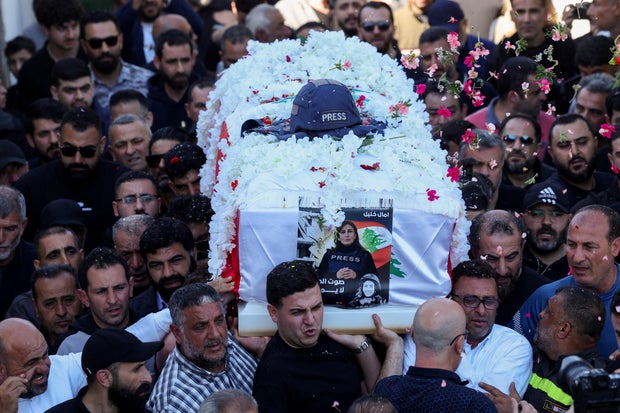
Israel's military said it was reviewing the incident in which Khalil was killed and two other journalists were wounded, but said it does not target journalists.
Iran regime tries to show unity after Trump says "they just don't know" who their leader is
The standoff between the U.S. and Iran over the Strait of Hormuz intensified Friday after President Trump said he ordered the U.S. military to "shoot and kill" Iranian small boats in the strait, while Iran pushed back his claim of a leadership rift in the Islamic Republic.
"In Iran there are no 'hard-liners' or 'moderates'. We are all Iranians and revolutionaries," Iranian President Masoud Pezeshkian and Speaker of Parliament Mohammad Bagher Qalibaf wrote in almost identical social media statements.
Since the killing of former Supreme Leader Ali Khamenei in the first wave of U.S.-Israeli strikes of the war on Feb. 28, it has been unclear who in Iran wields ultimate authority over the civilian figures and powerful generals who appear to be in charge.
Iran announced Khamenei's son, Mojtaba Khamenei, as his successor, but U.S. officials say he was wounded in the same strike that killed his father. While statements attributed to him have been released, he has not been seen publicly since purportedly taking the helm in Tehran.
Mr. Trump said in an early Thursday post on his Truth Social platform that "Iran is having a very hard time figuring out who their leader is! They just don't know! The infighting is between the 'Hardliners,' who have been losing BADLY on the battlefield, and the 'Moderates,' who are not very moderate at all (but gaining respect!), is CRAZY!"
CBS/AP
U.S. futures and European shares lower, oil prices rise
World shares were mostly lower while oil prices pushed higher Friday as talks on ending the war between the U.S. and Iran remained stalled.
U.S. futures also wavered after Wall Street pulled back from its all-time highs. The future for the S&P 500 was flat, while that for the Dow Jones Industrial Average was down 0.38% early Friday.
In early European trading, Germany's DAX lost 0.2% to 24,106.17 and the CAC 40 in Paris dropped 1% to 8,147.70. Britain's FTSE 100 sagged 0.6% to 10,397.64.
Shares were mixed in Asian trading Friday.
Oil prices have remained elevated since the Iran war began on Feb. 28. International benchmark Brent Crude was trading just shy of $107 a barrel on Friday morning, while U.S. mainstay West Texas Intermediate was up about 1.4% on the day, trading just over $97 a barrel.
CBS/AP
Top EU diplomat says unless nuclear experts involved in talks, "we will end up with a more dangerous Iran"
The European Union's head of foreign policy, Kaja Kallas, said Friday that without nuclear experts involved in any further U.S.-Iran peace talks, "we will end up with a more dangerous Iran."
Speaking in Cyprus at a meeting of EU leaders, Kallas warned that a new agreement crafted without nuclear experts involvement could be weaker than the Joint Comprehensive Plan of Action (JCPOA), the deal brokered in 2015 by the Obama administration, which President Trump unilaterally pulled the U.S. out of during his first term in office.
Under that deal, Iran agreed to let the United Nations' nuclear watchdog agency, the IAEA, monitor its nuclear program to ensure limits on its enrichment activities were adhered to in return for a lifting of sanctions against the regime.
Mr. Trump had dismissed the JCPOA – which focused only on Iran's nuclear program, not its other military actions – as too weak. He has recently insisted that Iran will eventually be forced to accept a deal that more severely constrains its nuclear program, if not eliminates it entirely.
"If the talks are only about the nuclear [program] and there are no nuclear experts around the table, then we will end up with an agreement that is weaker than the JCPOA was," Kallas said Friday.
She added that if a new deal does not also address Iran's "missile programs, their support to proxies, also hybrid and cyber activities in Europe … we will end up with a more dangerous Iran."
U.S. puts $10 million bounty on leader of Iran-backed militia group
The U.S. has placed a $10 million bounty on the leader of an Iranian-backed Shiite militia in Iraq.
The State Department's Rewards for Justice program issued a notice that it sought the leader of Kataib Sayyid al-Shuhada. It said Hashim Finyan Rahim al-Saraji led the group, whose members "killed Iraqi civilians and attacked U.S. diplomatic facilities in Iraq."
It also said Kataib Sayyid al-Shuhada attacked U.S. military bases and personnel in Iraq and Syria.
Iraq has several Shiite militias backed by Iran that are part of the country's Popular Mobilization Forces, which was created after the fall of Mosul in 2014 to formalize volunteer units that defeated the Islamic State group.
Militants from another Iran-backed group in Iraq, Kata'ib Hezbollah, abducted American journalist Shelly Kittleson last month. She was later released.
CBS/AP