NYC Mayor Mamdani says either wealthy get taxed more or property taxes will go up

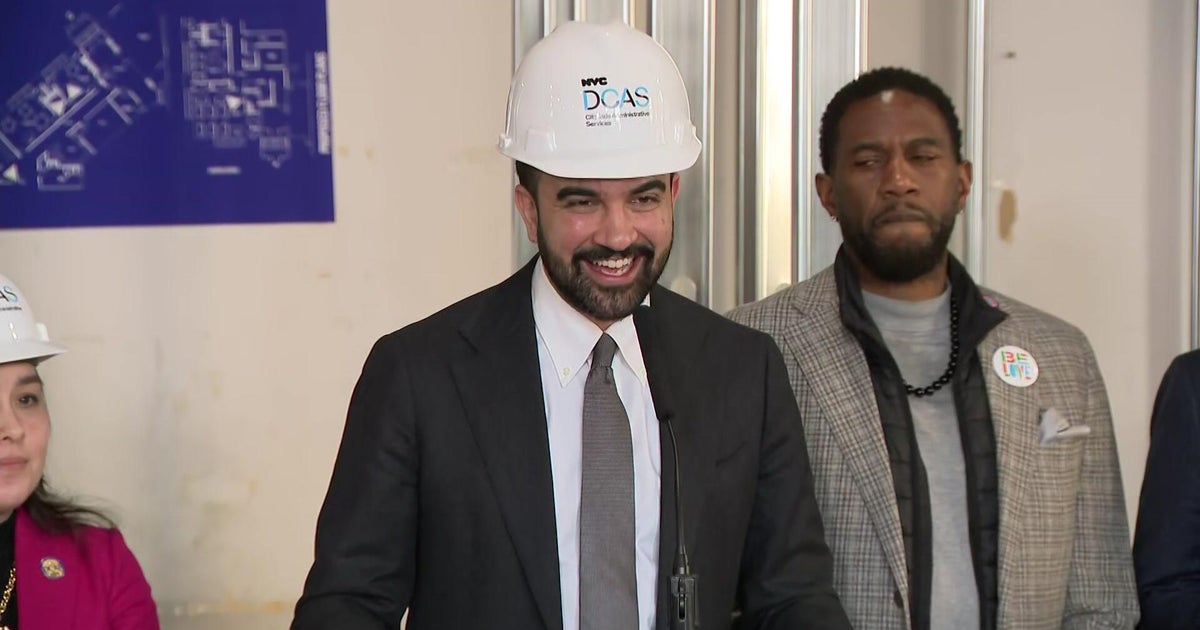
New York City Mayor Zohran Mamdani unveiled his preliminary financial plan Tuesday on the heels of the announcement that the state will give the city $1.5 billion to help fix a massive budget shortfall.
His tax-centric new fiscal plan seeks to close a multibillion budget gap with two choices: sock it to the rich or sock it to property owners.
Mamdani started his remarks by mourning the loss of Jesse Jackson, who he called a "true titan."
"Time and again, we know hope still lived because Rev. Jesse Jackson kept it alive," Mamdani said.
Mamdani then turned his attention to the budget.
"A significant chasm"
Mamdani says his new spending plan is the truth, gimmick-free. To some, however, the threat of raising property taxes if he doesn't get a wealth tax from Albany is the biggest gimmick of all.
"As the mayor of New York City, I have a legal obligation to balance the budget. I will meet that obligation," Mamdani said. "When we took office, we inherited a historic budget gap."
Mamdani said that what had initially been a $12 billion gap was lowered to $7 billion due to steps his administration has taken, as well as incorporating income from Wall Street bonuses. That gap has since been lowered even further to $5.4 billion due to an infusion to New York City of $1.5 billion from the state, thanks to Gov. Kathy Hochul.
"While considerably less, it is still a significant chasm," Mamdani said. "There are two paths to bridge this gap. The first is the most sustainable and the fairest path. This is the path of ending the drain on our city and raising taxes on the richest New Yorkers and the most profitable corporations. The onus for resolving this crisis should not be placed on the backs of working and middle class New Yorkers. If we do not fix this structural imbalance, and do not heed the calls of New Yorkers to raise taxes on the wealthy, this crisis will not disappear. It will simply return, year after year forcing harder choices each time."
Mamdani said the only other option - a so-called "second path" - is the city would have to raise property taxes and raid its reserves.
"The options of the second path are the options of last resort," Mamdani said. "Options that we will only employ if there is no other means of arriving at a balanced budget."
Mamdani said he will do everything in his power in the coming months to work on a solution with lawmakers in Albany to avoid raising property taxes locally.
Mamdani might have some trouble getting taxes on the wealthy approved since Hochul has repeatedly said no to the idea.
Wall Street plays a role
"Part of our ability to shrink the gap has come from incorporating higher-than-expected revenues from Wall Street. Wall Street profits are at a record high, surpassing any projections and allowing us to incorporate more revenue than anyone anticipated. Those record profits translate into increased tax revenue," Mamdani said.
He said Wall Street's hot streak means $2.4 billion in more revenue in FY2026 and $4.9 billion in FY2027.
"But responsible governance is not only about revenue. It is also about discipline. That means finding savings across city government, reducing bureaucratic waste, and rendering agencies more efficient and cost effective," Mamdani said.
Mamdani said he's created chief savings officers in every city agency for the purpose of identifying ways to streamline their organizations.
Mamdani called for a 2% raise on the personal income tax of the 33,000 New Yorkers who make more than $1 million a year, along with raising corporate taxes, to help close the ongoing budget gap.
"As we know, New Yorkers contribute 54.5% of state revenue, but receive only 40.5% back," Mamdani said. "Once again, I am calling on Albany to end the drain."
A 9.5% property tax hike?
Mamdani said if Albany doesn't raise taxes on the wealthy or corporations, that leaves the city with only one option - raising property taxes.
"At the heart of this path is a property tax increase. This would effectively be a tax on working and middle class New Yorkers who have a median income of $122,000," Mamdani said. "The second path also requires us to raid our reserves."
The mayor's financial plan says the property tax would affect over 3 million residential units and over 100,000 commercial buildings.
"The property tax increase, if the city was forced to do so, would be at a 9.5% increase. That is something that we do not want to do, and this is something that we are going to utilize every single option to ensure does not come to pass," the mayor added.
To some, however, it was a cynical attempt to wring more money out of Albany. Hochul, who is facing re-election, has already ruled out taxing the rich, even though by Mamdani's calculations it is only 33,000 New York City residents.
Tuesday, she said she was against a property tax hike.
"I'm not supportive of a property tax increase. I don't know that that's necessary. But let's find out what's really necessary for him to close the gap," Hochul said.
Mamdani said this is not an issue of ideology versus reality.
"This is not a conversation on the basis of ideology. This is a conversation about a fiscal crisis," Mamdani said. "And when faced with this crisis, the question is who should pay these taxes? I believe that it should be the wealthiest New Yorkers, the most profitable corporations."
City Council Speaker Julie Menin immediately called a property tax hike a non-starter.
"At a time when New Yorkers are already grappling with an affordability crisis, proposing significant property tax increases should not be on the table whatsoever," Menin said.
Rep. Simcha Felder, a veteran of both Albany and the City Council, predicted there would not be a property tax hike.
"I think there are a lot of tricks that magicians and past mayors, including Bloomberg and Giuliani, figured out at the end. And I look forward to the current mayor succeeding at that as well," Felder said. "It occurs and it occurs year after year."
This is just the mayor's proposed spending plan. The actual budget won't be done until after the state budget is finalized this spring.
Mamdani points the finger at Adams
Mamdani said the budget crisis he's addressing today "did not materialize overnight. It originated with Mayor Adams' 2025 November plan."
Mamdani said that the Adams administration "significantly understated" the deficits of its budgets, totaling a $12 billion budget gap.
Mark Levine, the city's comptroller, said in January that the city is facing its largest gap since the Great Recession.
Both Levine and Mamdani partly blame former Mayor Eric Adams, saying the crisis stemmed from a pattern of underbudgeting essential services.
"This crisis has a name and a chief architect. In the words of the Jackson 5, it's as easy as ABC. This is the Adams budget crisis," Mamdani said in January. "He systematically under-budgeted services that New Yorkers rely on every single day."
A spokesperson for Adams said the former mayor inherited a $10 billion debt that was compounded by the COVID-19 pandemic.
Mamdani also blamed former Gov. Andrew Cuomo. A spokesperson for Cuomo said Mamdani could've fixed any inequities during his time in the state legislature.