Readers vote "The Three Graces of Pearl Street" as the new book for Club Calvi
Please consider joining our Facebook group by CLICKING HERE.
Find out more about the books below.
Listen to Club Calvi's podcast by CLICKING HERE.
The votes have been counted. Club Calvi's new Readers' Choice and first book for fall is "The Three Graces of Pearl Street." Congratulations to author Elizabeth Wellington Rollins! "The Three Graces of Pearl Street" is her debut novel.
In a video message to Club Calvi, she described her book as a family drama about three generations of Italian American women in New York, all named after the Roman myth of the three graces. The book is also Rollins' love letter to New York and Italian American women like her grandmother, Lucia.
You can read an excerpt and get your copy of the book below.
Club Calvi books may contain adult themes.
________________________________________________________________________________________________________
"The Three Graces of Pearl Street" by Elizabeth Wellington Rollins
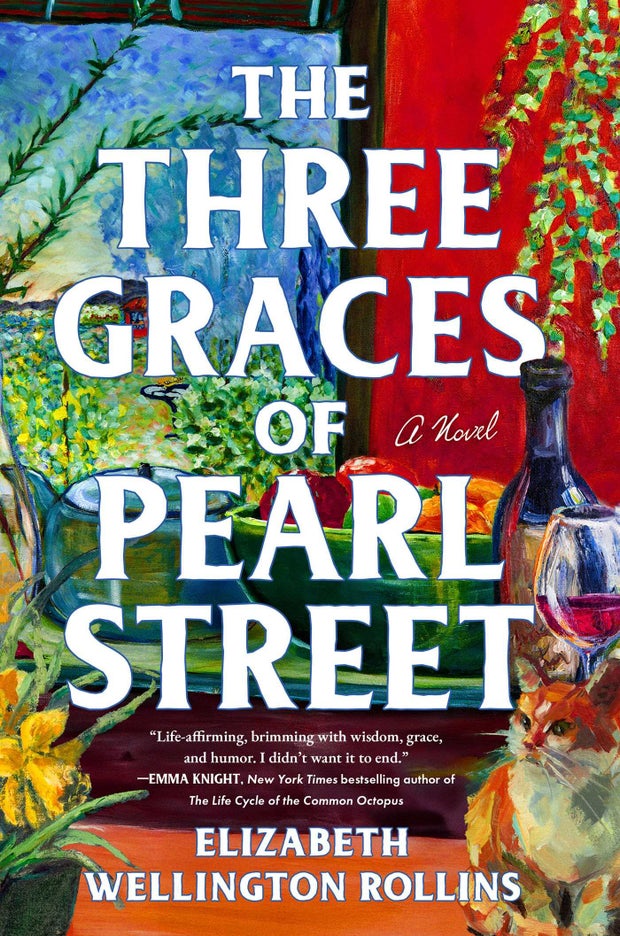
From the publisher: Graziella, a ninety-six-year-old former nun, spends her days running the parish's food kitchen, convinced it is her responsibility to keep everyone fed in their working-class New York neighborhood. Her daughter, Grace, a respected psychology professor, appears accomplished and composed, yet finds herself unmoored as her personal life falters. Ella—Graziella's granddaughter and Grace's daughter—is weary of defending her vegan diet and anti-capitalistic lifestyle; blind to her own brilliance, she longs, above all, for a place to belong. Living together again, the three Graces reckon with the distances that have shaped them, and with what it means, at last, to be fully known.
Elizabeth Wellington Rollins lives in Vermont.
"The Three Graces of Pearl Street" by Elizabeth Wellington Rollins (ThriftBooks) $23
______________________________________________________
Excerpt: "The Three Graces of Pearl Street" by Elizabeth Wellington Rollins
CHAPTER ONE
Christmas Eve
Arriving at 125 Pearl Street, Ella paused and then knocked on the door, which felt odd, given that she had spent every day of her childhood here. Her ninety-six-year-old nonna, who stood at four feet two inches tall, took one look at Ella and slammed the door shut.
Graziella Valentini had never been more disappointed in a person, a feeling she almost always reserved for men. Not when she found out Pope Pius XI had cooperated with Mussolini; not when her neighbor across the street installed sixty-seven garden gnomes in his front yard; not when her late husband dropped dead of a heart attack while making wine in the basement. The heart attack was not his fault, after all, but their granddaughter was. She had to be, because Grace was his fault too.
The connection between the three Graziellas, once as vital as an umbilical cord, had lost its pulse. For the past five years, Ella had only acquiesced to seeing them on Easter and Christmas Eve, which for an Italian-American family was equivalent to a declaration of war. Ella had first grown distant during her last year of college. She knew that visiting her grandmother's home today was likely to turn into a diplomatic incident.
"Nonna. Are you going to let me in?" Ella yelled, banging on the door.
"No," Graziella yelled back.
"No wonder she doesn't invite us to Brooklyn," Grace whispered to Graziella before opening the back door with a glass of red wine in one hand. Ella walked into the kitchen, and Grace hugged her. "How was the train, honey?"
Ignoring them both now, Graziella picked up two hot platters from the stove with hand towels.
"Fine," Ella said, her body rigid in Grace's grip. Grace let go, as though letting her daughter go was the most natural thing in the world.
"I'm sorry your dad couldn't be here," she added reflexively. Ella's father lived in Bermuda and commuted "home" once a month. Ella never saw him, and he didn't seem to mind, which racked Grace with a double dose of guilt despite her having no responsibility for either of them.
"I'm not sorry," Ella replied, taking off her puffer coat.
Grace's eyes took in her daughter's brittle frame—as delicate as the bony fish on the stovetop—and despair washed over her. Ella's loose, cropped shirt hung off the sharp edges of her collarbones and revealed the top of her insulin pump above her right hip. Grace softened her face, focusing on the light in Ella's chestnut eyes, knowing that her gaze would be felt by her daughter.
Graziella had no such sensitivities for her granddaughter's feelings. Unable to contain herself at the sight of such dire neglect, she put down the platters with a clang and grabbed Ella's hands, not out of warmth but to monitor their chill.
"Mostriciattola!" Graziella yelled in frustration. Ella's childhood nickname meant "little monster." It was supposed to be endearing, although it rarely felt that way.
Graziella ran so hot, she burned Ella to touch. She shook herself free. It was as if they thought her body was theirs rather than hers. It wasn't a new phenomenon. When Ella was diagnosed with type 1 diabetes at age five, the endocrinologist taught Grace and Graziella to recognize the clinical signs of dangerously high and low blood sugar.
In practice, avoiding both was a near to impossible challenge for Grace and Graziella, who were charged with balancing Ella's volatile blood sugar. Early mistakes in either direction meant an ambulance was called at home or at school. Much to Ella's benefit and regret, their knowledge of her condition soon surpassed the limitations of science and the boundaries she now wanted to have as an adult. The two older women developed a sensitivity to Ella's blood sugar the way a cat feels the weather change in its inner ear. Before Ella exhibited any symptoms of a blood sugar rise, Grace and Graziella were chasing her with a finger prick and an insulin pen—backstage before a choir performance, through a haunted house on Halloween, at a middle school dance.
Grace had tried to turn off this extra sense once Ella turned eighteen. It hadn't worked. Sometimes, she woke up in the middle of the night certain Ella's blood sugar was too low, despite her firm belief against superstition. Her profession as a psychologist forbade such magical thinking. Still, how else to explain the time she had tripped on the Upper West Side, sensing a blood sugar drop, and later discovered that Ella had fainted in a library nearby when her levels had bottomed out?
Graziella muttered something unintelligible and turned back to preparing the seven dishes she summoned from memory every year for the Feast of the Seven Fishes, an act of commemoration for her mother who had passed them on. Regardless of what anyone said about Christmas, Graziella believed it was a holiday for women—particularly women giving birth in dire circumstances, of which there were infinite variations. Ella did not understand, or she would take better care of herself. It had not been easy for the Valentini women to bring children into the world, let alone keep them alive. The problem was that Graziella's daughter, a renowned psychologist and Columbia professor, had overlooked the innate in favor of the intellectual. Grace spoke of parenting as if it were a philosophy. Parenting had failed Ella, and the girl had folded in on herself like thin paper bending into origami. This was how she'd become the empty shape that had arrived at Graziella's back door.
Excerpted from THE THREE GRACES OF PEARL STREET by Elizabeth Wellington Rollins. Published by Atria Books/Simon and Schuster, an imprint of Simon & Schuster, LLC. Copyright © 2026 by Elizabeth Wellington Rollins. All rights reserved.