NYC ready to transform low-lying area on Brooklyn-Queens border into "Jewel Streets" neighborhood

In a low-lying neighborhood at the Brooklyn-Queens border, residents say chronic flooding and neglect are facts of life.
But now, the city says it's time to transform the area.
"There's no sidewalks. There's no sewers."
Surrounded by East New York, Ozone Park and Lindenwood, the area is identified even on maps as "The Hole."
"This is like the land that time forgot. There's no sidewalks. There's no sewers," longtime resident Bart Aclin said.
Officials say the area was never connected to the New York City sewer system, and rainfall drenches the sunken streets with overflow from septic tanks.
"You see the water start to rise up, and the water comes inside the house, and there's nothing you can do," neighbor Monti Ehume said. "Even if you have a pump — sometimes I use two, three pumps — it's still not enough."
What's more, locals are left to navigate mounting construction debris and abandoned trucks.
"We were totally shocked at how people were living back there," advocate Debra Ack said.
As part of the East New York Community Land Trust, she helped residents file a demand letter urging the city to address quality-of-life issues.
"People are thriving and living back there as best as possible," she said. "We really need to help them make their lives easier."
"We need to right the wrong"
Now, change may finally be coming for "The Hole." The city is rebranding it the "Jewel Streets" neighborhood, in honor of streets named Sapphire, Amber, Ruby and Emerald. It's part of a new plan to overhaul housing, sanitation and sewage.
"This part of the district has been left behind, and we think that it has been a grave injustice," Council Member Chris Banks said. "We need to right the wrong."
Along with sewers and sidewalks, the Jewel Streets Neighborhood Plan promises to raise the area's elevation, improve transit access and build affordable homes.
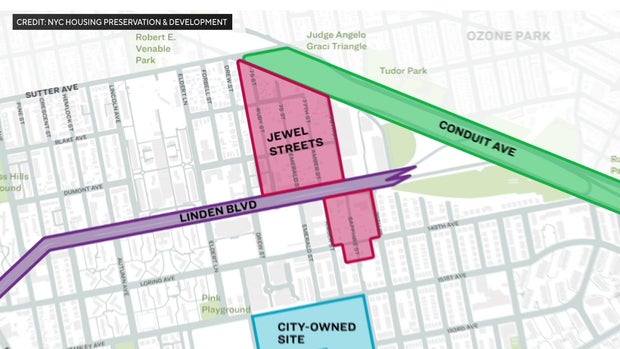
NYC Housing Preservation and Development acting commissioner Ahmed Tigani calls it a partnership among residents, leaders and multiple city agencies.
"We have a build-out date of 2040, which is why it's critically important that we work in phases," he said.
Department of Environmental Protection commissioner Rohit Aggarwala says green infrastructure, including the transformation of a vacant lot into a park with a lake, will help control flooding and pollution.
"Ten years from now, when this is completed, this will actually be a state-of-the-art sewage system and water management system," he said. "We are building for the storms of the future, not the storms of the past."
Some residents optimistic about plan, others are skeptical
Amid the transformation, homeowners will have a choice to stay in their homes with flood-resilient retrofits or voluntarily relocate through the "Resilient Acquisitions" buyout program.
"We want as many of these residents to be able to stay in their homes, but if some of them would rather not, this gives them the option," Aggarwala said.
Some residents say the plan brings the hope they've been waiting for.
"More is being done that's ever been done before," Aclin said.
"I just want a prosperous neighborhood. I just want the neighborhood to look like every other neighborhood across New York City, which I do believe is going to happen. I have a lot of faith," Moses Edouard said.
But others say they've been let down before.
"To say 'skeptical' is an understatement," Walter Basdeo said. "We don't believe the city, that they will do anything."
You can email Elle with Queens story ideas by CLICKING HERE.