CBS News New York sports producer Joe McLaughlin shares his journey with Parkinson's disease and DBS

More than 1 million people in the United States are currently living with Parkinson's disease.
Everyone's story is unique and has some degree of struggle that comes with it. That's something their friends and family live with, too.
CBS News New York sports producer Joe McLaughlin shared his Parkinson's journey with Kristine Johnson.
"It's an unbelievable mental battle every day"
McLaughlin is feisty, funny and smart. He works hard, but there's also a "living the dream" aspect to his job for the admitted former jock.
But for the last seven years, he's been struggling with Parkinson's disease. He was in his 40s when he was diagnosed, so it's classified as early onset.
He tried to hide his tremors at work by keeping his hand in his pocket.
"Which became my signature look for many years," McLaughlin said. "Or sitting on my hand. Every time I'd sit down, I'd [sit on my hand] and just lock it in there for years."
But colleagues noticed.

Then he was in the newsroom less and less, withdrawing from friends and colleagues.
"Look in the mirror, and I was just, man, what happened to me? And I hated it. I hated it," McLaughlin said.
"What happens to people is you don't socialize, you become isolated," said Dr. Susan Bressman, head of neurology at Mount Sinai. "It's not healthy emotionally, cognitively, physically. That's a key part ... of keeping people active and out there."
"It took everything for me for a number of years," McLaughlin said. "Not only is it a brain disease, it's an unbelievable mental battle every day. A lot of days are worse than others and also it's a very visual disease, you know. It's easy to hide something when nobody can see it."
McLaughlin said he struggled to just button his shirt or take his credit card out of his wallet at a cash register.
"There was always a plan I had for everything," he said.
McLaughlin said he couldn't use a knife and fork together when eating.
"One time, we were out at dinner, and the maître d' just kind of casually, I mean, he did it very smooth, but it was, at the same time, borderline emasculating, he came over and cut my steak on my plate, little cube steak. And that hurt," he said.
"You're not doing this alone, man"
At the time McLaughlin was diagnosed, he was in the early stages of a relationship with Tracy, who later became his wife. They have now been married for about six years.
McLaughlin was smitten from the start, but with a new Parkinson's diagnosis hanging over a possible future together, he wasn't sure if he should continue to pursue the relationship. He knew he had to tell her.
"I remember he was sitting on the couch, and ... he was so upset and, you know, [said,] 'We need to talk,'" Tracy said. "And I didn't know if he was breaking up with me ... I just saw pure terror and emotion in [his] face."
She took a no-nonsense approach to what life had in store.
"I never considered walking away. I had to process what it meant for us because, you know, I was just starting to think about ... what a future together would be like, and now all of a sudden, there's this huge blindspot where we just didn't know what to expect," Tracy said.
Tracy said once McLaughlin let her in, it was easier to get through the dark moments together.
"I think one thing that we struggled with early on is that he didn't want to concern me or scare me, so he wouldn't be completely open with me," Tracy said. "And that was something that we would talk about, that he needed to let me share that journey with him."
She said it was incredibly difficult to see him struggle when medicine didn't work and when he received test results confirming the diagnosis.
"I remember that was an extremely emotional night," Tracy said. "Crying together, you know, being together and understanding that this really was a part of our life."
"I was still kind of wanting to protect her from what I was going through. I still felt like she didn't need to fight the battle yet," McLaughlin said. "Then at times I just couldn't help but kind of just spill my guts out ... And then I started realizing, like, dude, you're not doing this alone, man. You can't. You got your rock over here, just lean into it. And that's what I started doing, and it helped me mentally more than anything, and then, you know, it helped us."
At their wedding, McLaughlin described how he had to hold his left hand still with his right hand as Tracy also held his left hand in hers and slid the ring on his finger with her other hand.
"So we had my hand and your hand on my left hand, which is, I hate this hand, for the most part," McLaughlin said.
"Your life revolves around taking your meds"
McLaughlin tried medications, trials and treatments, but nothing was really helping, and the progression of Parkinson's marched on.
"I think I was taking 22 pills a day," he said. "Some days the medicine worked great, other days it didn't work at all, and you had no idea when it was gonna be like that."
McLaughlin said there was one day where he didn't experience any symptoms.
"That day I felt like myself. I was bouncing around the newsroom and hanging out. And then I was like, what did I do? I was trying to relive the day and see if I could repeat it," he said.
He said during that time, he was constantly adjusting his meds.
"It just becomes untenable," Bressman said. "Your life revolves around taking your meds and hoping they work."
McLaughlin first went to see Bressman in 2019, and Bressman said over time, he developed more of a tremor and his symptoms became more intrusive in his life.
"So when we raised the idea of surgery, his eyes lit up. It was like, 'Really?' I said, 'Yeah,'" she said.
"Your brain is stuck"
DBS is deep brain stimulation. It's not a new surgical procedure. In fact, the Food and Drug Administration cleared it for Parkinson's treatment nearly 30 years ago, but even with significant medical advances, implanting electrodes into your brain is a delicate complex treatment.
"You can conceive of our normal brain state as like a marble rolling on a track. And it just kind of rolls and does its thing. And if you took a shovel and you dug a little hole in one of the tracks, what would happen to that marble when it hit the hole?" Mount Sinai neurosurgeon Dr. Brian Kopell said. "It would get stuck, right? And that stuck state, that's the disease. Your brain is stuck. And so what DBS does is it kind of jiggles the ball out of the hole and allows the ball to continue its resumption."
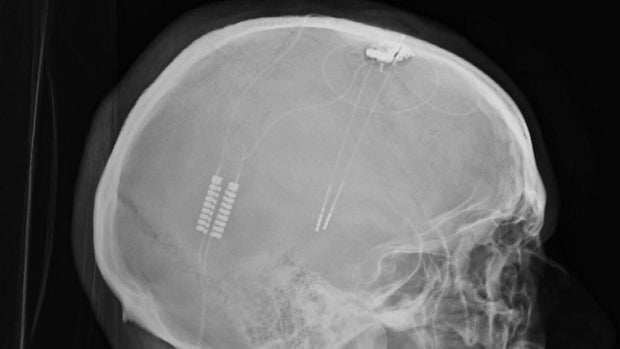
McLaughlin said despite learning about the risks of the procedure, he didn't hesitate for a second.
"Because I knew what it can do," he said.
"Some people have an intuition about themselves. They just know something's gonna work or not work, and he does," Bressman said.
Bressman said one of the debates regarding the surgery is when to perform it.
"Maybe we should be doing this earlier with everybody. Why do we even wait to make somebody kind of miserable on the oral meds when we've got surgery for them?" she said.
"There was an opportunity if we were to intervene very early, that we would be able to give many more people much more normal lives in the sort of ultimate goal of one day somebody curing this thing," Kopell said.
"My fighting chance"
DBS required three separate surgeries. Electrodes were precisely placed deep into McLaughlin's brain, on the left side first. Four weeks later, electrodes went into the right side. A week after that, a device – think of it as a controller – is implanted into his chest that connects to the electrodes.
"I was just ready to go. There was one thing that I kept repeating in my head all the time," McLaughlin said. "I keep it on my nightstand, this little card, it says Psalm 31:24. It says, be of good courage, and he will strengthen your heart, you know, all who have faith in the Lord. And I would always say to myself, be of courage, be good courage, be of good courage."
McLaughlin said he knew what was at stake.
"This is my only chance here, man. I said I'm going downhill, and I'm too young to be going downhill. I've got a great, great, wonderful wife and a great family that I still want to be my best around. And this was my fighting chance," he said.
"Joe is obviously optimistic. He's all in, there's no doubt in his mind," Tracy said.
Tracy said she was relieved when the three-hour surgery was done.
"Oh gosh, it was so exciting, and it was like finally letting go of a breath that I had been holding for months," she said.
Post-op photos show the reality of what McLaughlin went through - his head shaved, then bandaged, and him smiling. He started to see the effects of the surgery after he woke up.
"It took about 45 minutes and then I realized, I'm like - man - nothing going on here. I'm just not shaking," he said. "It was kind of like all right, all right, and then once I just started get using my hands again."
"I called my mom afterwards ... she's like how are you doing? I'm like, you know, nothing shaking. And that was my corny joke, and she laughed," he said.
A new outlook
McLaughlin said the more people who know that DBS is an option, the better it will be for them.
"That's what I just want people to know, how this can change so many lives if more people know about it," he said.
He said the procedures "re-energized" several aspects of his life, most notably his relationship with Tracy.
"We're excited to travel again, excited to go out to dinner. I love steak houses. And I'm so excited that now we can go to steak houses again. Again, it's a silly little thing, but it's things that we used to take for granted," McLaughlin said.
The change in McLaughlin after the surgery was profound, but familiar. He was back to the Joe so many in the office knew. Colleagues say it was like he ripped a sad old mask off his face, and revealed the person everyone remembered. He welcomed conversations about his Parkinsons journey.
"I feel mentally and emotionally and energy-wise, I feel like I'm in my 30s again," McLaughlin said.
"I always said, I had the perfect life if it wasn't for that stupid disease, and I still have it, but I don't really have it now. So now I'm just kind of in the zone of like, I tell myself, remember what you said. You said you had the perfect life if it was not for the disease. So now I guess I have a perfect life," he added.


