A NYC firehouse was first to respond on 9/11. 25 years on, Sal Argano is the last still on staff
Sal Argano got lucky. When the World Trade Center was struck by hijacked jets on Sept. 11, 2001, the New York City firefighter was in Brooklyn, on loan to another station, rather than at his usual post at the small Manhattan firehouse just across an intersection from the twin towers.
He rushed downtown to find his firehouse badly damaged but still standing. Six of its members, he'd later learn, were among the 343 New York City firefighters killed in the World Trade Center's collapse.
"If I wasn't sent out on rotation there would have been a good chance I would not be here today," Argano says. "I think about that all the time."
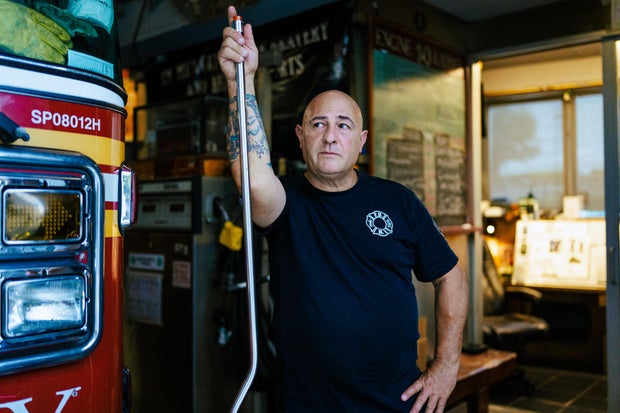
Almost 25 years later, Argano, now 65, is still on duty at the firehouse — the last of the firefighters assigned there in 2001 who still works there.
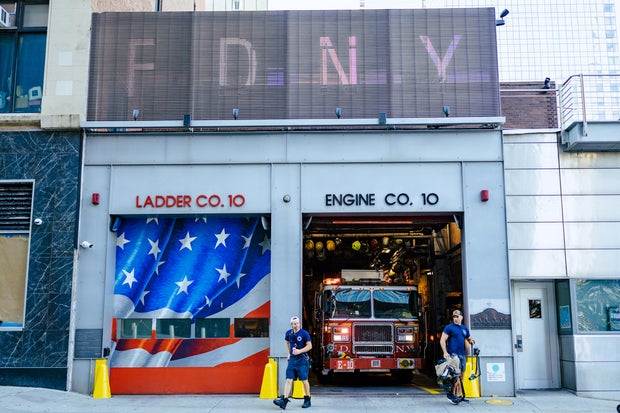
Today, the crews at the firehouse respond to emergency calls but also serve as a de facto part of the 9/11 memorial, visited by crowds of tourists daily.
Some visitors come specifically to see the large bronze relief along the side of the building listing the names of the firefighters killed on 9/11.
Others pause to take selfies as they pass by on their way to the National 9/11 Memorial plaza across the street, drawn by the sight of Engine 10 and Ladder 10, the gleaming trucks sitting in the garage that give the station its nickname: Ten House.
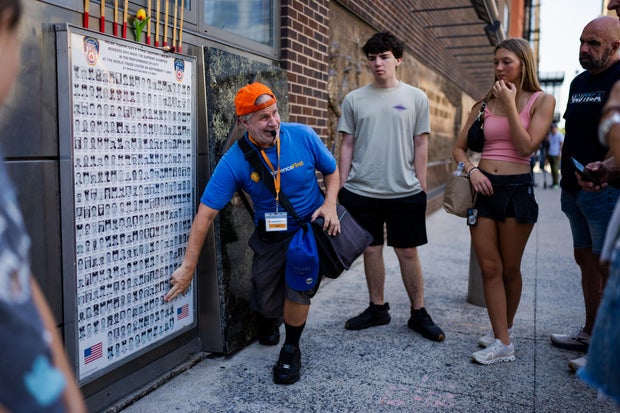
"This is definitely one of those companies where if you don't want to ingratiate yourself to the public, it's definitely not the right place," said Capt. Terence Brody, who commands Ladder 10 and has worked at the station since 2016. "People around the world know this firehouse. They're going to come by and say hello."
Brody, now 55, was still in the fire academy on 9/11. Cadets grabbed their gear and were bused to ground zero.
The debris hung so thickly in the air around the fallen towers that it looked like it was snowing, he said.
"It was a beautiful sunny Tuesday, and then you're in this kind of apocalyptic atmosphere," Brody said. "It was a little overwhelming, to say the least."
In the days after the attack, Ten House served as both command center and safe space for weary first responders, he said. As the years passed, its crew had a front-row seat to the area's rebirth.
Robert Favata joined Ladder 10 in 2008, fresh out of the academy.
In those early years, he worked beside a giant hole teeming with construction activity. Now 46, he looks out at a transformed landscape.
A pair of waterfall pools sit in the footprint of the old towers, ringed by parapets etched with the names of nearly 3,000 victims. Below ground, the 9/11 Museum houses mangled steel beams, a destroyed fire truck and other artifacts. New skyscrapers ring the memorial.
"When I got here, there was nothing," Favata says. "I never thought they were gonna finish."
Argano can be found most days perched near the station's open bay doors, patiently answering questions, shaking hands and posing for photos.
He says Ten House firefighters have a unique charge: they're both living testimonials to the events of 9/11 as well as public faces of the centuries-old FDNY.
Argano says he tries to impress on younger firefighters — many increasingly not even born before the attacks — the importance of treating every visitor with respect.
"This is not like any other firehouse," he said. "We have our fire duty, we have our responses, and then we have a responsibility toward the people outside."
He acknowledges the task is not always easy. The packs of gawking tourists can be relentless. Their questions can sometimes come across too personal, too insincere or just simply too out there.
Many of the younger firefighters tend to keep a lower profile for that reason, he said.
After responding to an early morning call this particular day, most of the crew heads to the back of the station to stow their gear or upstairs to help prepare lunch.
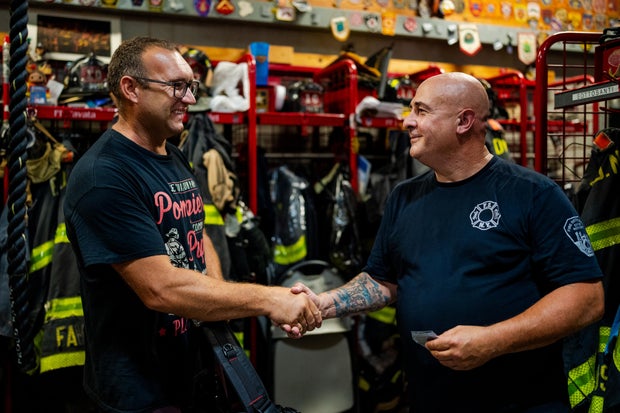
Argano meanwhile chats up a firefighter from France and his wife and then invites them into the station.
He points to a wall of patches from fire departments across the world that have been gifted over the years, as well as the well-worn helmets hanging in the rafters.
At another point, though, a lady asks — perhaps a bit too flippantly — what's so special about Ten House.
Argano shrugs: "It's just a fire station." After she departs, he says it simply wasn't worth the effort.
"If I need to explain to you all of that, then it's like, 'Pull up a seat'," Argano said. "Let me get another cigarette. It's gonna be a long one."
Favata considers the approaching 25th anniversary as likely one of his last before retirement. He worries, though, if he's done enough to keep the memories of Ten House alive.
"When I got here, so many of the guys worked 9/11 and they told me their stories of that day," Favata said, choking on tears. "I just hope I can give like a percentage of what they've told me to the younger guys."
Brody, meanwhile, handed in his retirement papers Tuesday. His last day will be in October.
"It's interesting to think that my first day in the field was right across the street, and this is where I'm gonna end my career," said Brody, who writes screenplays in his spare time and has already had two of them turned into Hallmark Channel movies.
But Argano, who drives Engine 10, isn't quite ready to pack it in. He fears something will be lost when no one is there who still remembers.
"I'm not done. I'm gonna be here as long as I can," Argano said. "I'm going to keep telling them what I know, what I saw, what I've been through. Telling them the history of this firehouse. Everything I can remember."


