Bestselling Author Michael Connelly on his new Harry Bosch novel, "The Hollow"
Please consider joining our Facebook group by CLICKING HERE.
Listen to the Club Calvi Podcast by CLICKING HERE.
Find out more about the books below.
After nearly 35 years, and 92 million books sold, number one New York Times bestselling author Michael Connelly is taking his popular character, Harry Bosch, back to the beginning. Mary Calvi talked to Connelly about his latest Bosch novel, "The Hollow," in which the retired LAPD detective investigates a death from a dark period of his life. The book became an instant New York Times bestseller. You can listen to Mary and Connelly's entire conversation on the Club Calvi Podcast.
"The Hollow" has been called the knockout return for Bosch.
"It's a book [that] I can sort of say I've been waiting to write for 35 years," Connelly said. "I don't want to act like I consciously thought someday I'll write this book. It really kind of comes to me in inspirational forms. There's a lot in this book that is based on true things that have happened in Los Angeles. So it seemed appropriate that Harry would look back at this time in his teenage years where he was basically a ward of the state and was in a place that was not a good place to be. It's a real place. It's a place that has been controversial for decades. For some reason, which we get into in the book, he decides to go back and look at the unexplained death of another kid that was in the MacLaren Children's Center way back in the 60s when Harry was there."
In the book, Harry's friend was found dead at MacLaren.
"In a way he feels guilty about it," Connelly said. "I think he put it away, like most people do."
Connelly explained that MacLaren Children's Center was a facility in Los Angeles county where foster children said they were abused. Connelly was familiar with MacLaren through his work as a reporter in Los Angeles.
"MacLaren was like a way station for kids that were either orphaned or they're taken from their parents because of difficulties," Connelly said. "It was kind of a way station where the kids were waiting to be taken in by foster families. And that didn't always happen. Sometimes, in Harry's case, he would be taken by a foster family and then for whatever reason, sent back, rejected, essentially. So he was in and out of there for a number of years. And it was a real place. I was a reporter in Los Angeles in the 80s and early 90s. There were constant government investigations of allegations of abuse. Finally, the place was shut down in 2003. Last year, the L.A. County commissioners agreed to a very high monetary settlement to people that had been there and abused as children. That was a big news story last year. And that's what sparked me. I said all along from my very first book that Harry grew up in MacLaren. This is an opportunity to go back and explore that part of his life."
Connelly said that while Harry Bosch has appeared in his other recent books, this is the first that the character has carried in a number of years.
"I really enjoyed it," Connelly said. "It brought [Harry] back to his roots, and I came back to my roots as a writer."
You can read an excerpt from "The Hollow" below.
Club Calvi books may contain adult themes.
________________________________________________________________________________________________________
"The Hollow" by Michael Connelly
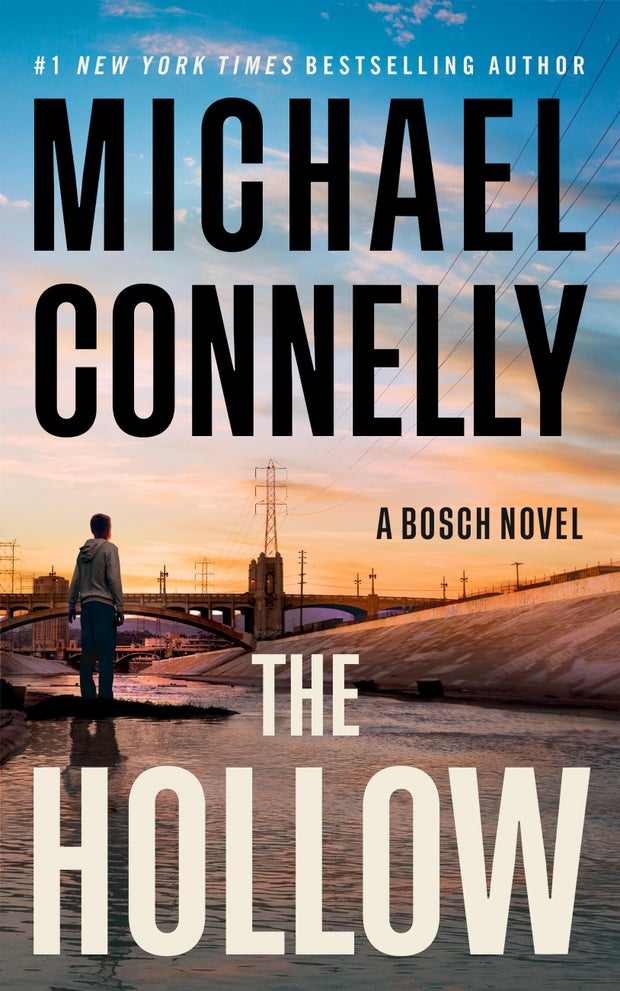
From the publisher: When Harry Bosch was eleven years old, his mother was murdered and he became a ward of the state, housed in MacLaren Children's Center, a notorious facility where abuse was rampant. Decades after its closure, a massive class action lawsuit has resulted in a multibillion-dollar settlement for former residents. But when Bosch's half-brother, defense attorney Mickey Haller, brings him the news that Harry is entitled to $400,000, Bosch says he doesn't want the money. He wants justice.
News of the settlement awakens his memories of a place he had hoped never to revisit, and a boy named Chops, a fellow inmate who wound up dead. Chops's body was found in a hidden space under a staircase that the staff used to discipline their charges. The kids knew it only as "the hollow." But Chops's death was covered up and never solved. Now Bosch knows he must reopen the investigation and learn the truth, even if the killer is long dead.
As Bosch digs into the files, he picks up the trail of a predator who not only survived, but went on to a life of vicious crime. Forced to face a history that both scarred him and launched him on his mission as a cop, Bosch must bring down a sadistic criminal and finally put to rest the demons of his past.
Michael Connelly lives in California and Florida.
__________________________________________________________________________________________________________
Excerpt: "The Hollow" by Michael Connelly
BOSCH WALKED BETWEEN the headstones, checking names as he passed. These days he suspected that he knew more people belowground than above. He moved slowly, using the cane for support.
He saw Talbot up ahead, standing at the foot of his first wife's grave. It had been a while since Bosch had seen him. He had less hair and a thicker waist. As expected, he wasn't happy to see Bosch approaching with his vase of fresh tulips.
"What the f*** are you doing here, Bosch?" Talbot said.
"I could ask you the same thing, Talbot," Bosch said.
"She's my wife."
"Was your wife."
"F*** you. Do you even still have a badge?"
"Lucky for guys like you, I hung it up a long time ago."
"Then what the f***? You bringing my wife flowers? You got a thing for dead women, Bosch?"
"Twenty- fifth anniversary. I didn't expect anyone else to be here. Least of all the guy who put her in the grave."
"F*** off, Bosch. You're a loser. And guess what — I come every year."
"To gloat."
"To mourn."
"I'm sure she appreciates it."
Sarcasm delivered, Bosch looked down at the grave. The marker was simple and inexpensive.
TALBOT
1962– 2001
Her husband hadn't even put her first name on the stone.
"It's under your skin, isn't it?" Talbot said. "All these years . . . the case you couldn't solve."
"Nobody bats a thousand in homicide work, Talbot," Bosch said. "But this one I did solve. I just didn't make the arrest. There's a difference."
The two men held each other's eyes in a serious stare- down. Talbot looked away first. The guilty man always does.
There was something different about him but Bosch couldn't place it. It wasn't the hair or the potbelly.
"You know, this is harassment," Talbot said. "You and your baseless accusations. I had nothing to do with it, so why don't you just get the f*** out of here and leave me alone."
"Yeah. I'll go. I'll just leave the flowers. I remember the tulips in the house that day. Never figured out where they came from."
Bosch bent over and put the vase down in the grass in front of the granite stone. He adjusted the angle so it offered the best display of the yellow and red flowers. When he straightened up, he was hit with a jolt of vertigo. He leaned heavily on the cane till it passed.
"You okay, old man?" Talbot asked. "That would be something, huh? You dying in a graveyard."
"Yeah, something," Bosch said. "I'll leave you to it."
It was the absence of glasses. Talbot used to wear eyeglasses. He must've gotten contacts or had his vision surgically corrected.
"That's right," Talbot said. "Take your cane and your slow a** back to the old folks' home."
"Catch you later," Bosch said.
Bosch made his way back to his car, which was parked on one of the cemetery's narrow access roads. He thought about how, twenty-five years before, he'd come within minutes of getting a confession out of Talbot. His estranged wife, Jennifer, had been found beaten to death in the apartment she had recently moved into. The scene was staged to look like an intruder had broken in and waited for her to come home from work. She had been sexually assaulted with an unknown, never recovered foreign object, but at autopsy it was determined that some of the assault had occurred postmortem. It was part of the staging. So were the tulips — left to help sell the misdirection that whoever delivered the flowers had seen the recipient as vulnerable and come back later to break in and commit the crime. All of that made Bosch focus on the husband, Gregory Talbot. In the interrogation room, Talbot waived his rights and agreed totalk. They went two hours in a cat- and- mouse interview, Bosch slowly closing in, using inconsistencies and a leaky alibi to back him into a corner. But then Talbot ended it by playing the lawyer card. Bosch left the room knowing the killer was Talbot but with nothing to charge him with.
By the time Bosch made it from the grave site to his car, his left leg was burning with pain. It was the longest he had walked and the longest he had stood since getting the knee replacement four weeks before. His recovery had been without incident but he had pushed it going to the cemetery to confront Talbot.
He took the bottle of Tylenol out of the glove box and downed two pills without water, first crunching them in his teeth so that they might hit his bloodstream sooner. The taste was acrid. He started the car and drove through the main gate of the cemetery to Santa Monica Boulevard.
Excerpted from THE HOLLOW by Michael Connelly. Copyright © 2026 by Hieronymus, Inc. Used with permission of Little, Brown and Company. New York, NY. All rights reserved.