"Lessons in Chemistry" author Bonnie Garmus discusses her new novel "Peck & Peck"
Please consider joining our Facebook group by CLICKING HERE.
Find out more about the books below.
Listen to the Club Calvi Podcast by CLICKING HERE
Author Bonnie Garmus is back and she talked with Mary Calvi about her new book, "Peck & Peck." It follows the breakout success of her debut "Lessons in Chemistry," which was released in 2022 and has since sold 9 million copies worldwide. "Peck & Peck" is filled with intrigue, suspense and self-discovery for a man who works at a poetry journal in New York City. You can listen to the entire conversation between Mary and Garmus on the Club Calvi podcast.
Mary asked Garmus how she is feeling with the release of her first book after the monster success of "Lessons in Chemistry."
"I'm really excited," Garmus replied. "For me, the book was really important to get done while I was on tour for 'Lessons in Chemistry.' And it was a definite hurdle."
But Garmus says she didn't feel added pressure while writing "Peck & Peck."
"I'm really embarrassed to say this, but I never even considered that pressure while I was writing 'Peck & Peck,'" Garmus said. "The success of 'Lessons in Chemistry' has never felt quite real. And so I just wrote as I would have written anyway, not considering that maybe there would be more expectation. And I think, in a way, it was smart that I did that."
Garmus says "Lessons in Chemistry" spent 99 weeks on the New York Times Bestsellers list. Mary remarked that "Lessons In Chemistry" helped readers understand that women need to be comfortable with who they really are, while in "Peck & Peck," we find a character who isn't quite comfortable with who he is.
"I wrote a character like this because I think that so many of us feel this way, that we don't quite fit in and that we're not really sure, especially people in the arts, whether they should be going into the arts at all," Garmus explained. "I would argue that now is the time to really go into the arts. We need artistic people creating original work more than ever. I really wanted to reassure generations, including past generations. I know a lot of people my age are thinking, 'Why did I have that career? Why didn't I follow my heart and really do what I wanted?' And I think it's just a very common feeling. Elizabeth Zott really knew who she was. My character isn't sure who he is until we reach the end of the book."
Mary said that while the main character is very good at math and accounting, whether his parents like it or not, he's a poet.
"He is a poet," Garmus agreed. "But you know, like so many people, he doesn't feel like he's good enough to be a poet."
Mary remarked that in "Lessons in Chemistry" and in "Peck & Peck, her takeaway was that Garmus is inspiring people to change, to be true to oneself, but also showing them that your story can be changed and that can change your life.
"My main character starts out the book telling you he's in prison," Garmus said. "Now, this is a guy that he doesn't seem at all prison-bound once you get to know him. But what does it take to make a statement? For him, it takes a lot, and hopefully none of us have to go to prison to stand up for what we believe in. But sometimes making a big change like that and instilling this idea of integrity back in the world is probably one of the most important things anyone can do. When you stand up for integrity, you stand up for yourself. You also stand up for a host of other people around the world who can't speak for themselves."
Club Calvi books may contain adult themes.
________________________________________________________________________________________________________
"Peck & Peck" by Bonnie Garmus
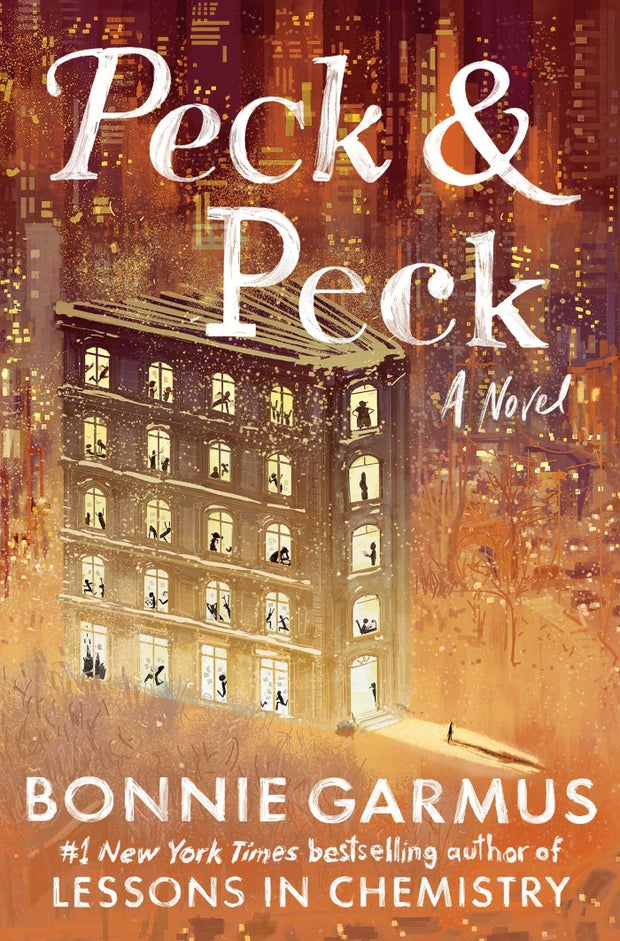
From the publisher:
Find originality. Reward creativity. Burn the rest.
It's 1982, New York City. Crime is on the rise, muggings are in the streets, and Batter Gray, recent college graduate with a skill that no one wants—an "ear" for poetry—is worried about his future. While all of his friends have real jobs, he's folding T-shirts at the Gap. As for love? No. Not unless you count Sallie Mae, the student loan tyrant. He hears from Sallie all the time.
But when Batter gets a dream job at Peck & Peck, the most prestigious poetry quarterly in the world, his life moves into the literary fast lane. Soon Batter is knee-deep in the secret war between the two Editors in Chief, the famous Peck brothers—twins and enemies—as well as being privy to the private affairs of their thirty-nine editors, whose professed mission is the same: Find originality. Reward creativity. Burn the rest.
And by burn, they mean incinerate. Because at Peck & Peck, "good" isn't good enough, "interesting" doesn't cut it, plagiarists aren't tolerated, and parolees run the mailroom. Still want to submit your poem? Go with God.
Bonnie Garmus lives in England.
"Peck & Peck" by Bonnie Garmus (ThriftBooks) $23
__________________________________________________________________________________________________________
Excerpt: "Peck & Peck" by Bonnie Garmus
1.
I've been called a thief, a rebel, an upstart, a traitor, and—maybe this one won't come as a surprise based on the others—Prisoner 83A0956.
But mostly I go by Batter, a good family name passed down like a cherished ring, although not from my father or grandfather or even an important distant relative, but from a dog.
I never met the dog I was named for; he died just before I was born. But I've always wondered if he would have preferred a different name. King, Spot. Maybe Rex. The problem with being named Batter is that it's not really a name; it's a word. Some assume it's preppy, like Banks or Bennett; others insist it must have foreign roots. Still others ask (cautiously) if my dad was "really into baseball" or if my mom "enjoys baking."
Besides my name, I'm unusual in one other way. I'm an identical twin. I don't bring it up much and for good reason: my brother was stillborn. Before you feel sorry for me, just know that the same thing happened to Elvis Presley; his brother didn't make it either. There are things in life you can't control; it's nobody's fault. Still, whenever I hear "I'm So Lonesome I Could Cry," I know why Elvis recorded it.
As for what I'm in for, I'm not really supposed to say without my attorney present, but I can tell you this: whenever a fellow prisoner asks me about my crime and I tell them, they're visibly unimpressed. It's not until I mention that this was actually my second crime—my first was back in the sixties and involved drugs—that I get any respect at all.
2.
In the spring of 1967, I was ten years old, and according to the news, things were going to hell in a handbasket; Vietnam raged, hippies smoked, pastels languished, neons blazed, and the radio was full of people screaming and banging on drums.
The one person who didn't think the world was going to hell in a hand-basket was my mother, Rainey Gray, age forty-two, a professional type de-signer. She was married to my father, John Gray, age forty-six, a historian at the local community college and hell-in-a-handbasket enthusiast.
"What the hell are they thinking?" I can remember my dad shouting at the TV as Agent Orange spewed, Detroit burned, and astronauts died. "Stop it," he'd demand as each new televised tragedy revealed that human-kind was neither human nor kind, his eyes taking in another monstrous event he'd had no ability to stop but would be forever burdened to explain to future generations. Such is the fate of historians—no one seems to take their lessons of the past seriously.
"It's revolting," my mother would agree. "But at least people are out there protesting. At least they're making their voices heard. And from a professional standpoint, the protest signs aren't half bad. You can read END THE DRAFT from a mile away. That's because of Geoffrey Lee, though. He designed that typeface. It's called Impact. Offers excellent readability at long distances."
My mother knew everything about type.
"Type," she'd often explain, "is as fundamental as physics, each letter-form as basic as the atom. All written communication depends on it. To make a difference, put the letters in the right order. First a word, then a sentence. Letters—in the right order and typeface—are the best way to inspire people to make better choices. Make a choice. Act."
My mother was big on both choice and action. As it turns out, morality requires both. But so does crime.
"Hi, honey," she called as I arrived home from school. I was a fourth grader at Franklin Elementary School in Yuba City, California, a small town in the hot-as-hell Central Valley about forty miles north of Sacramento. Yuba City is home to the Sutter Buttes, the world's smallest mountain range. I have always been proud of that fact.
"I'm in here," she added.
I dumped my stuff in the front hall and walked in to find her, head down at the kitchen table, surrounded by a pile of capsules.
"I can get them uncapped," she was saying as she demonstrated pulling a capsule apart. "And I can dump them out," she said, shaking the contents into the trash. "I can even refill them," she said, pointing at a box of powdered sugar. "But what I can't seem to do is get them back together. I think they changed the design." She glanced up at the clock, then shoved her bangs off to the side and kept at it.
"What is all this?" I asked uncertainly. "It's my medicine."
My mother suffered from something called nerves. I wasn't sure what nerves were, but hers were a problem.
"But aren't you supposed to take it?"
"Yes, but I don't like it. It makes me feel awful." "So why not just tell the doctor you don't like it?"
"I have, but doctors think they're God. They never listen. Tell me about school," she said. "Learn anything?" She was wearing a bright orange dress, which, in the right light, made her red hair look like a mass of glowing em-bers. It fell just slightly above her knee and featured two large, bright concentric circles—one purple, one pink; she called it her "moving target" dress, commenting that while the other mothers hadn't quite embraced 1967 style with the same gusto she had, she appreciated that not everyone felt comfortable diving into the deep end of anything, food, fashion, or otherwise.
"But won't you get in trouble for not taking your medicine, Mom?" "Why would I get in trouble, honey?" she said, standing up. "It's my body."
I put the capsule down. "But isn't this your nerve medicine?"
"It is," she said, "but my nerves are fine. A lack of nerve—that's where the trouble starts. Here," she said. "See if you can't connect these two ends." She watched as I tried. "Oh—good work!" She smiled at me as she made her way to the sink. "Anyway," she continued, "the medicine isn't for me; it's for your father. I take it, he feels better. Your father suffers from anxiety, Batter. Most historians do. This is because they've seen the past and know the future is going to be a repeat."
Excerpted from PECK & PECK by Bonnie Garmus. Copyright © 2026 by Bonnie Garmus. Reprinted by permission of Scribner, an imprint of Simon & Schuster, LLC.