Author Jo Piazza talks to Club Calvi about her new book "The Parisian Heist"
Please consider joining our Facebook group by CLICKING HERE.
Find out more about the books below.
Listen to the Club Calvi Podcast by CLICKING HERE.
Mary Calvi talked to bestselling author Jo Piazza about her new book that blends intrigue, secrets, a heist, and the famous artist Vincent van Gogh. You can listen to their entire conversation on the Club Calvi Podcast.
"The Parisian Heist" is a dual-time line story. One involves an American art student in Paris who works for a billionaire family who made their fortune dealing art. The other takes place 100 years earlier with Vincent van Gogh's sister-in-law, who was left with hundreds of his paintings during a time they were considered worthless. Jo van Gogh created the legend behind the artist that made him famous.
Mary said that while reading "The Parisian Heist," she thought that Piazza must have spent a lot of time in Paris researching.
Piazza said she took two trips to Paris to work on the book.
"I started writing in Paris at a friend's 50th birthday," Piazza said. "Then I spent so much time in the Louvre, the Musee D'Orsay, and also Auvers, where Vincent van Gogh spent his last last few months and created his last paintings."
Mary said that while van Gogh is one of the names in the book, the main character is one that few people know about.
"Jo van Gogh was Vincent's sister-in-law and she inherited hundreds of his paintings when her husband, Theo, died shortly after Vincent," Piazza explained. "At that point, I think Vincent had sold maybe one of them and not for very much money. She had no idea what to do with them. She essentially committed her entire life to elevating Vincent's art to making him famous, to making him essentially the genius that we know today, by organizing shows, and by releasing his letters with Theo. She created a mythology and a story around him that would make people, first, interested in him and, then, interested in the art. Jo van Gogh is truly the reason that that we've heard of Vincent, and that his art is some of the most most famous in all of the world."
The other story line in "The Parisian Heist" is set about 100 years earlier, during the 1990s, centered on an art student who works for a wealthy family in Paris who made their fortune by selling art. Mary asked Piazza about the links between that storyline and the one about van Gogh.
"I knew I wanted to tell the story of Jo van Gogh," Piazza replied. "I also wanted to package it with a dual timeline with female artists today, thinking through the storyline for women artists. I love a heist. I truly love a heist movie, a heist story."
Mary asked Piazza if she reserached the brazen, daylight robbery in 2025 at the Louvre museum where, authorities say, men dressed as construction workers stole pieces of the French Crown Jewels. The robbery took less than eight minutes and the stolen items have not been recovered.
"I had actually completely finished the book before. But the Louvre heist really made me feel good about my heist because it felt simple. It felt kind of basic. I wrote a heist that feels grounded in reality. If these guys could essentially steal a cherry picker, dress up like a construction worker, and break into the Louvre, my heist is going to be good."
You can read an excerpt and get the book below. Club Calvi books may contain adult themes.
________________________________________________________________________________________________________
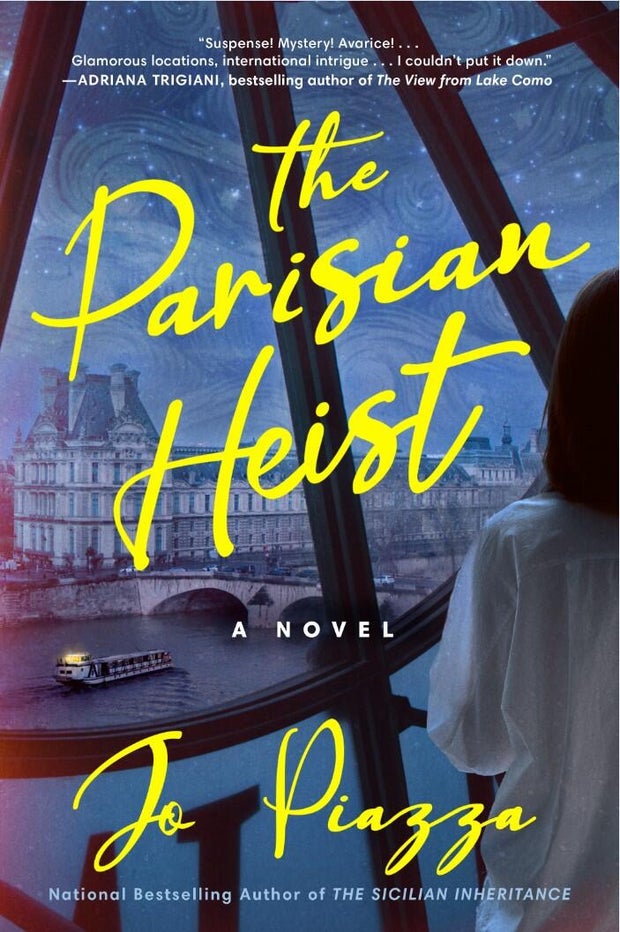
"The Parisian Heist" by Jo Piazza
From the publisher: Emma, a struggling American artist in Paris, thought she had left her dreams behind when she took a job cleaning for the city's wealthy elite. Then she meets Stella Swanson, the widow of one of the most notorious art dealers in the business. The Swansons move in a world where billionaires, oligarchs, and heads of state pay fortunes for masterpieces. Drawn in by their dazzling wealth and the pull of a dangerously charming grandson, Emma becomes both a player and a pawn in a family battle to protect their empire and conceal its crimes.
In the late 1800s, the young widow Jo van Gogh inherits hundreds of paintings from her brother-in-law Vincent that the art world deems worthless. Determined to prove their genius, and to secure a future for herself and her young son, she becomes consumed by Vincent's legacy. As her devotion deepens, a vanished painting and a thwarted love affair leave her unsure who she can trust and how much of herself she's willing to lose in the process.
From glittering auction houses to the idyllic canals of Amsterdam and the grand museums of Paris, the lives of these two women converge as Emma uncovers the Swanson family's darkest secrets and agrees to mastermind a daring heist inside the Musée d'Orsay. The stakes have never been higher, and these women refuse to be written out of history, no matter the cost.
Jo Piazza lives in Philadelphia.
"The Parisian Heist" by Jo Piazza (ThriftBooks) $23
Excerpt: "The Parisian Heist" by Jo Piazza
EMMA
EACH TIME I walk through the doors of the Musée d'Orsay I greet my favorite paintings like old friends. My happiest memories as a kid are from visits with my mom to the Philadelphia Museum of Art on Sundays when it was free. We walked through the galleries giddily saying good morning to all the art. Looking back, I realize those paintings were our only friends.
I repeat the tradition as I wind my way through the Orsay's galleries, except I say bonjour, out of respect for them and my adopted city. I still have my student membership and I intend to visit as often as I can for free until it expires.
"Bonjour, madame," to the iconic Woman Bitten by a Serpent sculpture splayed out just beyond the entrance. A small snake dangles from her arm by its fangs. Her body is hideously contorted, her hair disheveled and her head thrown back. She's tortured and ecstatic and some days my entire face flushes with shame and I need to look away from her. On others I'm reminded of Pascal, my lover and my professor, in ways that shatter my insides but still make my skin heat up with desire. I think about him often in this museum. It would be impossible not to. He molded how I think and feel about everything in here. I used to parrot him like an obedient little pet. His guttural whisper still tickles my brain when I gaze down on the woman and the serpent. Do you think she's in danger? Do you think she likes it?
But if I want to enjoy my day, I can't let him in, so I pass the woman and her snake and I carry on. For the record, I think she f****** loves it. I also think she's in danger. What woman in the nineteenth century wasn't? What woman today is completely safe?
Bonjour to Olympia, Édouard Manet's nude courtesan gazing directly at the viewer with a bored stare, a taut ribbon tied at her throat like a dog collar. The painting once scandalized Parisian society. A guard had to be posted next to it to prevent the public from vandalizing it. Look at nearly any wall label next to a painting of a young woman in a museum, and part of the text will usually explain how it scandalized men.
Bonjour to Whistler's mother. I'd love to know what is going on behind that placid stare of hers. The brushstrokes are smooth as glass. Whistler often said that paint should always appear "like breath on the surface of a pane of glass."
You have to wander through many, many galleries just to stumble onto the few women artists here, Mary Cassatt, Rosa Bonheur, and Berthe Morisot. I greet Morisot's woman rocking a cradle with the same dreamy and exhausted expression of every new mother I've ever met.
Since starting work cleaning for Stella Swanson, I'm even more keenly aware of certain things in the museum than I was before. The first is the constant presence of plaques that read: Et la collection Swanson. They're on practically every wall. The family must own half the art in this museum. I can't imagine how one family even acquires so much. I also pay extra attention to the Van Goghs because of Stella's interest in them.
Visitors flock to the popular ones, the self‑portraits, the painting of his bedroom, The Starry Night. My favorite is the portrait of an Italian woman who ran a restaurant Vincent used to frequent. It's simply titled L'Italienne, The Italian Woman, but I've done a little research on her. I've done research on many of the models who posed for the great men back then. They fascinate me. Agostina Segatori owned a little café called Café du Tambourin on Boulevard de Clichy in the Montmartre section of the city. Back then it was a bohemian enclave on the outskirts of the city, a place where artists and writers could get cheap rent. Similar to where we live now outside the ring road of the city. As places get more popular, the riffraff always gets pushed further and further toward the periphery. Agostina became a muse for painters from Corot to Manet. Modeling, and sometimes becoming their mistress, served her purposes. She kept all the money she made from them and invested it into her successful restaurant.
Even though most of history remembers her as only the Italian woman, Agostina was also an art dealer and supporter of artists during a time when women weren't allowed to play that game. She exhibited the artists she liked on the walls of her restaurant. It's said that many of them, including Vincent van Gogh, exchanged paintings for her food. She enabled exhibitions for the wealthy patrons who came slumming in Montmartre to visit the bars, dance halls, and brothels, the men who wanted to immerse themselves in the mixture of pleasure and poverty and then return to their gilded lives.
I love looking at her. She stares slyly out at the viewer and is clearly a woman who takes no bulls***. In one of Van Gogh's paintings she's smoking a cigarette and drinking a beer, sitting in the restaurant she owns in front of paintings she is championing. I say hello to her as I pass through the gallery to my favorite bench on the fifth floor, the one in front of the grand old glass clock window. It's one of the two remaining massive clocks from the original Gare d'Orsay railway station that the museum was carved out of. From here I can stare down at the Seine, the Louvre, and on a clear day all the way to the white dome of the Sacré‑Coeur. I sketch here for hours.
Excerpted from "The Parisian Heist" published by Dutton, an imprint of Penguin Publishing Group, a division of Penguin Random House, LLC. Copyright (c) 2026 by Jo Piazza.