Harlem businesses face ups and downs amid storefront vacancies

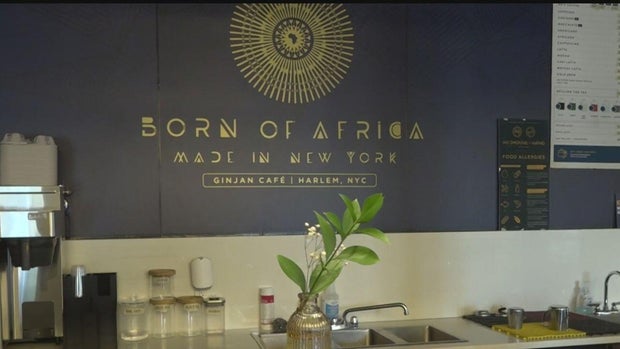
You have to arrive early most days to get a seat at Ginjan Cafe, but lately the African juice and coffee shop on 125th Street in Harlem has been packed with boxes instead of people because the business was temporarily closed due to city fines dating back to the coronavirus pandemic.
"The permit is less than $300, so that's not the issue. We had about $12,000 worth of fines," said Mohammed Diallo, who owns the shop alongside his brother Rahim. "The business has been going steadily for years, and for the first time since we launched, we're actually almost at break even ... So, it's just very heartbreaking."
The duo have been documenting their journey to reopen Ginjan on social media, a process Diallo describes as "when it rains, it pours." Around the same time Ginjan closed its Harlem doors, the brothers had to shut down their Brooklyn location as well for renovation after a car crashed into its Bed-Stuy shop in mid-July.
In the following weeks, the community would come together to raise more than $25,000 on GoFundMe for the business. Yet even after paying back the money, the owners say they still cannot reopen until the city completes inspections.
"The fines and the permits, we thought that was the biggest hurdle. We [were] waiting for service providers, whom we have no control over, to come in and do some of the inspections." Diallo said. "We could be open right now."
Diallo says administrative tasks and unnecessary red tape are some of the biggest challenges facing business owners. He says that, for some, being unable to operate a business can make a temporary closure permanent. In June 2026, the Office of the New York City Comptroller found that in Harlem, more than 1 in 10 storefronts that were previously occupied by a small business are now vacant, above city average.
For other business owners, it's a matter of getting lenders and property owners onboard. Tammeca Rochester, the owner of Harlem Cycle, says when she sought to open the fitness studio, investors assumed there wasn't an audience for it in Harlem.
"If you look at traditional marketing, it wasn't marketed towards people of color who traditionally live uptown. And so that, I think, was what the disconnect really was," Rochester said.
Despite the naysayers, Harlem Cycle now has two locations and survived the pandemic by expanding to other forms of fitness and using the Department of Small Business Services (SBS) to find a lawyer. She says the rising cost of rent continues to be a challenge for businesses.
"When you're a business owner, you're like, 'Oh my God, I cannot pay for anything else,'" said Rochester. "It's more important for us to make sure the local mom and pops, who are sustaining the economy right now, make sure that we have some kind of protection to keep us here."
Commissioner Kenny Minaya told CBS New York that the Department of Small Business Services works alongside business owners at every stage of ownership, from first-time entrepreneurs to those looking to grow and expand. When asked about how the department helps businesses looking to reopen like Ginjan, Minaya said business owners can get one-on-one support through its Business Express Service Team (BEST).
"That is precisely the type of assistance we provide. We lay out for you the entire process and help them go through the entire process so that there aren't any delays. Our interests, similar to the business owners, making sure that you are able to open the doors as quickly as possible," Minaya said.
The team at Ginjan says it has been in touch with SBS, but the owners said they believe the services focus too much on educating business owners on how to navigate the system, but it's the system itself that needs repair. Ginjan first opened in 2015, built from the ground up by brothers who immigrated to the U.S. from Guinea. Originally making traditional West African juices, they would eventually open their Harlem location in 2019 and their Brooklyn location in 2022.
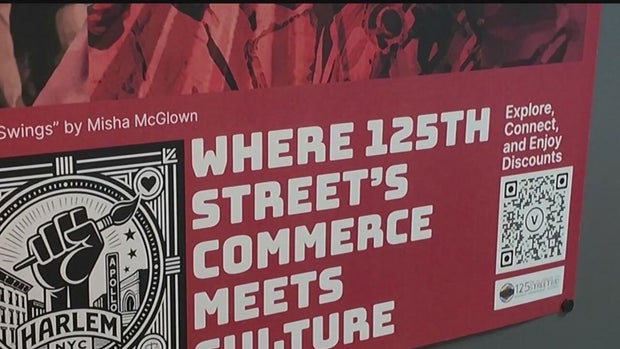
Another tool for business owners is the local 125th Street Business Improvement District (BID), which recently received a public realm grant, allowing the organization to create the Harlem Main Street passport. By scanning a QR code, you'll be connected to local businesses and cultural institutions in the neighborhood. The codes are displayed on digital passports around the neighborhood like on a mural near The Apollo Theater and inside various local businesses such as Settepani Restaurant.
Leah Abraham has owned Settepani with her husband, Antonino "Nino" Settepani, since the 1990s, making the Italian restaurant and bakery one of the neighborhood's longest-running businesses. The couple's son and daughter are involved in the family affair, too. Abraham recalls ups and downs over the years, one of the most notable being a time she was robbed at gunpoint. She would later add security temporarily to the business, but she says that experience, albeit rare, is an example of how business owners often end up grappling with the larger social issues in a neighborhood.
"We carry a lot of the burdens that government should. If somebody throws something on my street, I get the fine." Abraham said.
As a member of the BID, Abraham says the coalition allows business owners to lean on each other too, like through its sanitation program.
"The BID is really on top of it. We're doing everything we can to to find a solution for all those issues," Abraham said. "It's a platform for us to exchange ideas, to share any information that we may have."
Have a story idea or tip in Harlem? Email Noëlle by CLICKING HERE.


