Vote now on which new novel will be the new book for Club Calvi
Please consider joining our Facebook group by CLICKING HERE.
Find out more about the books below.
Listen to the Club Calvi podcast by CLICKING HERE.
Club Calvi needs your help in picking its next book. You have three choices. Vote now by CLICKING HERE.
"Peregrine Hill" is set in Gilded Age New York. It's about a mother who forces her daughter into a marriage to hide a family secret and the daughter's fight for freedom.
"The Cursed Diamond" by Anna Rasche is a dual-timeline mystery about two New York City women and the dark legend of "The Midnight Diamond," said to bring ruin to its owners.
"Upstate" by Kim van Alkemade is about a Manhattan woman grieving during the COVID pandemic who buys a bookshop in upstate New York to start anew, and she discovers a secret love story.
You can read excerpts below and VOTE NOW for Club Calvi's next read. Voting closes Sunday, Nov.15 at 6 p.m. EST. Club Calvi will announce its new readers on Tuesday, Nov. 17.
Club Calvi books may contain adult themes.
________________________________________________________________________________________________________
"Peregrine Hill" by Nina de Gramont

From the publisher: At the dawn of the 20th century, widow Isabelle Bishop still believes in love—but she knows only money can save her. After losing her husband and three of her children in a shipwreck, she has one chance to rescue what remains of her family: her daughter Mariah and her elderly mother. When Isabelle captures the attention of John Whitten, one of New York's wealthiest men, she dares to hope that fortune might finally favor her.
But Whitten's interest is not in Isabelle—it's in eighteen-year-old Mariah, still reeling from a romantic but disastrous scandal. When Whitten discovers the secret mother and daughter have tried to keep buried, he uses it to his advantage, threatening to expose them unless Mariah accepts his proposal. For the sake of their survival, Isabelle makes a devil's bargain: She will urge her daughter into a marriage she knows could destroy her.
Mariah quickly realizes her husband's home is a gilded cage. Yet even under his watchful eye, she begins to carve out passions of her own, finding an unexpected ally in her ambitious maid, Hetty, and daring to imagine a life beyond her constricted world. Together, she and Hetty risk everything to claim a measure of power and self-determination in a world that attempts to deny them both.
Nina de Gramont lives in North Carolina.
"Peregrine Hill" by Nina de Gramont (ThriftBooks) $21
"The Cursed Diamond" by Anna Rasche
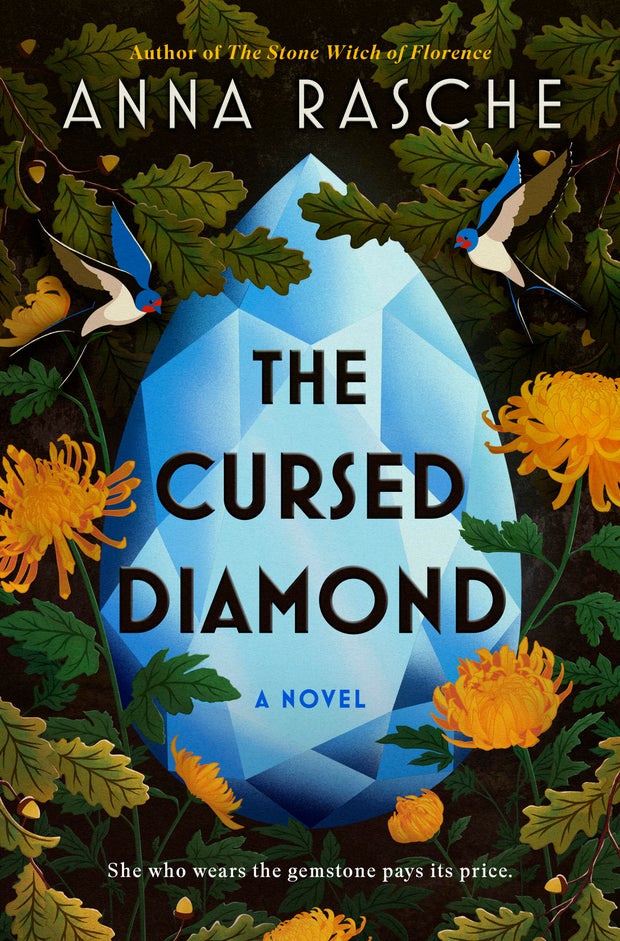
From the publisher:
2010.
Jennie is working as a runner in the Diamond District when a friend's sudden death leaves her with a cryptic note: "Not Safe." Her search for answers leads her to an antique jewelry box, a clue to a century-old mystery and the legend of the Midnight Diamond—a rare blue gem rumored to bring ruin to all who possess it. As Jennie is pulled deeper into a world of secrets and danger, she realizes she is not just chasing a lost treasure; she is uncovering a story that was meant to stay buried.
1910.
On an ocean liner bound for New York, heiress Marcella Porter returns home after being disgraced by scandal in London. Her path collides with a charismatic nobleman and the magnificent Midnight Diamond, which she unknowingly smuggles into the city. Mesmerized by its brilliance, Marcella feels an irresistible pull toward the diamond, and when the glittering façade of her charmed life begins to crack, Marcella must decide whether the Midnight Diamond is her salvation—or her doom.
Anna Rasche lives in Brooklyn, New York.
"The Cursed Diamond" by Anna Rasche (ThriftBooks) $23
"Upstate" by Kim Van Alkemade
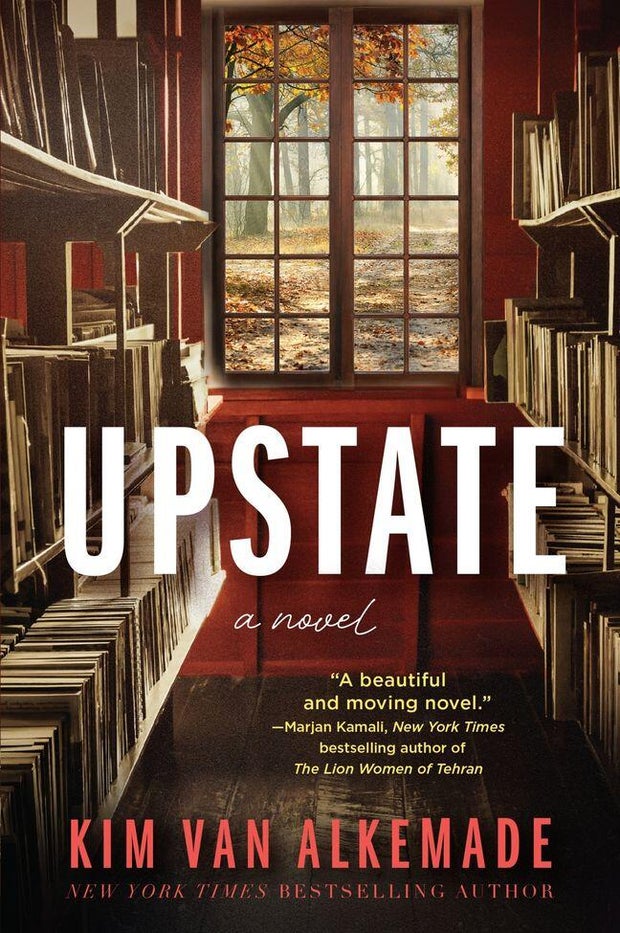
From the publisher: Thirty-four-year-old writer Audrey Beacon is grieving alone during lockdown when a post about a bookshop for sale in upstate New York pops into her social media feed like a lifeline. Enthralled by the historic house and the massive barn bursting with books, Audrey impulsively makes an offer. Soon, she's cashing out her savings, loading her possessions into her dead husband's van, and fleeing Manhattan for the village of Schuywich, determined to outrun the ghosts of her past.
In 1956, it's love at first sight when Schuywich librarian Hazel McIntyre meets dashing magazine writer Evelyn Cabot at a summer camp in Maine that discreetly promises a "different vacation for professional women." By summer's end, Evelyn has left Greenwich Village to move into an old farmhouse she's bought in Hazel's hometown. In her new column, "A Woman's Place," Evelyn writes about her adventures renovating a house, tending to sheep, and opening a bookshop in her barn with help from the woman readers know only as her "roommate." Privately, Hazel chronicles their six-decade love story in a series of letters that abruptly end when they're forced to abandon the bookshop in 2015.
Reopening the bookshop in the summer of 2020 attracts a quirky community of villagers who continuously interrupt Audrey's solitude: An unemployed Broadway set designer. An ambitious teenage entrepreneur. A story-telling Adirondack grandmother. Then there's Sam Rensselaer, the distractingly handsome representative of the agriculture extension. Past and present begin to converge when Audrey finds "A Woman's Place," in a stack of old magazines, but it's the discovery of Hazel's letters that brings hidden love and long-buried family secrets to light. Will Audrey find the courage to heal the wounds of the past—including her own?
Kim Van Alkemade lives in Saratoga Springs, New York.
"Upstate" by Kim van Alkemade (ThriftBooks) $17
________________________________________________________________________________________________________
Excerpt: "Peregrine Hill" by Nina de Gramont
Part ONE
After the Morrigan
1.
John Whitten was not a handsome man. He was not charming, unless you counted as charm a certain sort of gusto. In New York it was famous, the way he relished everything his limitless dollars could buy.
Was he kind? He did have an affability about him, a wide and toothy smile behind unkempt whiskers. That might be an indication of kindness. Isabelle had no real way of knowing. But she waited for Mr. Whitten with the same wishful fervency that had characterized her first courtship, with her late husband, who had been handsome, charming, and boundlessly kind. Look where that landed her. Charm never saved a single human being, no more than kindness, or beauty.
Money, though. That was an unflagging lifeboat.
In this family, we marry for love. Isabelle's father used to say it in his native French, smiling, as if the sentiment exposed a delightful quirk. Her mother would repeat it in English with fervency. Isabelle always regarded the motto as a virtue even as her parents' fortunes rose and fell. Even as her husband's and so her own did the same.
Once upon a time, love had answered all Isabelle's prayers. This time, money would do the same. She had enchanted Mr. Whitten at the Ranfords' dinner party; days later he sent a note promising to call at her rented house in Hoboken, a trek that would require a carriage to lower New York, a steamboat ferry across the Hudson, and another carriage, this one hired, to Isabelle's doorstep.
Any moment, having completed his suitor's journey, John Whitten would walk through the warped front door to rescue what remained of Isabelle's family. The dead could not return from their graves. But bills could be paid. Even better, they could disappear. A sound and permanent roof could be placed over her head. The future could be secured, the endless frightened knocking in Isabelle's chest finally quieted.
She refrained from standing in the window to watch for Mr. Whitten's arrival. It would not do to have him glance up and see her waiting. Because they had no servants, Isabelle released Mariah from her bedroom and inspected her clothes to make sure she looked neither dingy nor ostentatious.
From upstairs, a faint yap, Mariah's dog longing for his constant companion. Also exiled upstairs was Isabelle's mother, who had one foot in this world and one on the celestial plane, which resulted in a tendency to expose excess emotion and confide too much in strangers. Isabelle was tired of being the only one with sense—her mother and daughter both retaining a wisp of airiness, even cheer, despite all that had happened.
Her heart rattled at an unhealthy clip. She willed it to slow. Money and love were not natural antagonists. They could get along. She and Daniel got along far better in the fat years than the lean ones. But she would not think of Daniel today. The time for sorrow had passed. Now was the time to be what she had never been in all her life. Practical.
Outside, at last, the clattering of hooves. Carriage wheels on cobblestones rolling to a stop. Isabelle straightened her spine and folded her hands in her lap. She didn't need to pinch her cheeks. Fair skinned, at thirty-six she was still given to blushing. Her complexion betrayed every emotion. Daniel had always found this endearing.
A knock, followed by Mariah's footsteps and the front door creaking open. Mariah's voice, husky and effusive, and then the rumble of a man answering. The parlor door swung open. Mariah's posture was almost too good, reaching with the crown of her head toward the ceiling. Her dark hair was pulled back in a tight braid, meant to be modest, but instead accentuating her cordate face and the golden saucers of her eyes. She looked apologetic, as if Isabelle might blame her for the coming disappointment.
"Mother," Mariah said. "Mr. Robert Smythe is here to see you."
Isabelle stood and took the calling card from her daughter's hand. Mariah nodded to Mr. Smythe, then—aware she was being watched—kept her eyes on the floor as she exited.
"Mrs. Bishop," the man said, in a voice thin and reedy as his figure. "How do you do. I'm Mr. Whitten's personal secretary."
Isabelle recovered. "Mr. Smythe," she said. "I'm well, thank you. Please sit down."
Mr. Smythe did not sit down. "That was the daughter?"
"Yes," Isabelle said. "That's my eldest, Mariah." The word, eldest, still so automatic. Never, ever would she accustom herself to saying only. Lest Mr. Smythe overestimate her age she added, "I was seventeen when I married."
Mr. Smythe drew a notebook from the inside pocket of his jacket and scribbled on its pages. Still fertile, Isabelle imagined him writing, then breathed in sharply to stifle a nervous giggle. She sat with her hands folded in her lap, knees pressed together, ankles crossed, smile bright and fixed—exactly as she'd been taught the one year her parents had been able to afford Miss Porter's.
Mr. Smythe finally took his seat but kept his notebook on his knee, fountain pen in hand. Perhaps it implied a seriousness of purpose for Mr. Whitten to send his personal secretary. And—except for Mariah—Isabelle's background was unassailable. An interview did not frighten her.
Mariah returned carrying a tea tray, piled high with pastries from the German bakery, an optimistic extravagance. She poured tea and handed a cup to Isabelle. When she held out a cup to Mr. Smythe he did not react. Not a natural servant, Mariah placed the cup back on the tray and looked to her mother for what to do next. While Mr. Smythe's gaze remained upon his notepad Isabelle flicked her fingers in a shooing gesture.
Mariah tiptoed out of the room, closing the door behind her.
Excerpted from PEREGRINE HILL by Nina de Gramont. Published by Simon and Schuster LLC. Copyright © 2026 by Nina de Gramont. All rights reserved.
Excerpt: "The Cursed Diamond" by Anna Rasche
Paris, 1792
Prologue
Guillot was not nervous. That would come later. Even though the prize was the greatest in all of France, taking it would be easy. He looked across the silent expanse of the Place de la Revolution, as it was now called, from his position on the shadowy edge of the Tuileries Garden. The night was dark. The rope coiled around Guillot's shoulder was strong and knotted by skilled hands. And in the chaos of war, treasures had been left unguarded.
"Right," he said. "Let's go."
Guillot and several other men stepped out from the garden and cut across the stone plaza to the long, porticoed façade of the Garde-Meuble building. They tossed the rope and looped it easily around a second-story column. With this guideline, they scaled the building's corner in minutes, landing lightly on the balcony. Somebody pulled out a glazier's knife and, with a soft screeee-pop, cut a wobbly circle out of the correct window. A hand through the hole, a latch unclicked, and they were in. The iron bars designed to prevent such a thing from happening were not in their place, just as the thieves had arranged. After weeks of careful scouting, they also knew that the guards were stationed at the other end of the sprawling building and would remain there if nothing drew their attention.
"Take what you will," whispered Guillot.
Quietly they padded across parquet floors, opening drawers in ormolu armoires, lifting crystal domes from their stands, pocketing the crown jewels of France. Loose diamonds and rubies, gold snuff boxes, and pearl pendeloque earrings were dropped into fraying pockets of homespun linen. Hair combs of tortoiseshell inlaid with turquoise that had decorated the deposed queen were folded into handkerchiefs and stuffed inside vests. They worked until the smallest hours of the morning, until the coming daylight forced them to quit their task. Once in the cover of side streets, they began to talk.
"So many rooms still to explore," whispered one.
"They won't even know what happened until the galleries reopen next week," said another.
"I think," Guillot smiled, "we should discuss the details over a very nice breakfast."
The next night, they returned to the treasury and found everything as they had left it. No one had so much as opened the door to peek at the galleries. One of the thieves laughed out loud at their luck. Guillot lit a candle. No longer worried about drawing attention, they pried open drawers with loud cracks and smashed glass vitrines with cloth-covered fists to get at what lay inside.
On the third night, they brought along their lovers and bottles of wine, and laid out a picnic on the floor, passing around bread and pearls. Guillot and his girl left their friends sitting in a candlelit circle and found their way to a dark corner in the next room. She laughed as he picked her up, wrapping her legs around his waist. Guillot kissed her neck and fumbled to lift her skirts. His roving hand came across her pocket, and he felt something hard and heavy inside it. He stopped kissing her.
"What's this?"
"It's mine!" she said too quickly, unwrapping her legs and wriggling away from him.
He caught her wrist and twisted it a little so she sank onto her knees, and took the thing she was guarding. He held it up to the window to examine. It was a magnificent brooch. So large it draped over the palm of his hand, so heavy it strained his wrist. Guillot swore quietly. He'd heard of this jewel. It was the Order of The Golden Fleece, made for Louis XIV. At the top, a red ruby was carved as a swirling dragon, with tail and wings rendered in hundreds of brilliant-cut diamonds. At the bottom, a draped fleece of glittering yellow stones. And in the center, suspended from the ruby dragon's teeth, was a gigantic, shield-shaped diamond of purest blue.
As Guillot stared into the dark stone, it seemed to suck the air out of the room around him. The Blue Diamond of the French Crown, the government called it. But Guillot had heard its other name: the people called it the Idol's Eye, for it had been stolen from a holy statue in far India, plucked by a merchant from its golden socket and sold to the Sun King more than a hundred years ago. The merchant was torn apart by wild dogs soon after, they said.
Suddenly the midnight picnic was of no interest to Guillot. Nor was the girl, nor were any of the treasures still waiting to be plundered. This was the prize of prizes, and he needed to get away with it. Now.
"I found it," his girl whimpered, pulling at his stockings. "I found it, so it is mine."
Guillot looked back at the brooch. The blue stone stared at him like an unblinking eye and said "Are you sure?"
"I am sure," he answered.
"The Sun King who purchased me is dead. Beggars scatter his bones in the Seine. Are you sure?"
"I am sure."
"Who are you speaking to?" asked the girl.
"His grandson who wore me rots in prison with his wife and children. It will not end well for them. Are you sure?"
Guillot tucked the brooch away. He was sure. He emptied his pockets of the lesser jewels he'd pilfered earlier and threw them at his girl. The value of the brooch would be enough to support him for many lifetimes. She wiped her nose on her sleeve and began to pick up the small gems he had dropped. Guillot walked briskly into the other room and through the open window, ignoring his comrades' inquiries. He did not stop walking until he was settled in a fishing boat bound for England.
Excerpted from THE CURSED DIAMOND by Anna Rasche. Copyright © 2026 by Anna Rasche. Reprinted with permission from Park Row Books, HarperCollins Publishers.
Excerpt: "Upstate" by Kim van Alkemade
One bleak morning, a post pops up in which a friend has shared a link to an article in an online literary magazine. There's a gorgeous photograph of an old barn sporting a weathered sign that reads red barn books. Beneath it, my friend has commented:
Can you believe this? A hundred acres upstate is cheaper than a two-bedroom Brooklyn apartment!
I click on the article. Have you ever wanted to own a bookshop in a barn?" the title reads. "Now's your chance!" It tells the story of a woman named Evelyn Cabot who started a business selling used books out of a barn on the farm she bought back in the 1950s. The bookstore closed five years ago, it says, when Evelyn went into a nursing home. She passed away over the winter and the bookstore is now for sale. The article has a link to a real estate listing. Desperate for a few more moments of distraction, I follow it.
I'm not taken to Zillow or Redfin or any of the other slick sites. Rather, I land on the clunky webpage of a small-town real estate agency. The commercial listing for "Red Barn Bookshop on Ridgetop Road in Schuywich, New York" contains a series of photographs of a simple nineteenth-century Greek Revival farmhouse surrounded by fields and woodlands with a sunrise view of blue hills across a misty valley. There are dimly lit images of a big barn filled with shelves of books. Mesmerized, I scroll through the pictures on a loop—house, field, woods, hills, barn, books—until the images seem like photographic evidence of a fantasy world, as if a roll of film has been smuggled back from Narnia.
"Enough," I say, shutting my laptop. Instead of catching virtual glimpses of the outside world, what I ought to do is get out of this tomb of an apartment. I lace up my sneakers and walk to Central Park, entering through the Artists' Gate. It's cooler today than it was on campus a month ago, the air fresh and the squirrels frisky. Picnickers are scattered across the Sheep Meadow, their blankets spaced six feet apart. Along the Mall, pedestrians give one another a wide berth as cherry blossoms swirl like out-of-season snowflakes. My stiff knees ache as I roam the looping paths of the Ramble. Crossing the Oak Bridge, I rest against the railing and gaze at the lake's still waters. It's a pretty scene, but Olmsted's illusion of nature is shattered by downtown skyscrapers that serrate the horizon.
What the hell am I doing here? I wonder. Not here in the park but in this city. It seems like all the people I know have fled to Hudson Valley cabins or family farmsteads in Vermont. If my dad were still alive, he'd have welcomed me home to Kenosha, where I could sit on the bluffs overlooking Lake Michigan, miles of blue water melting into a distant horizon. But the house I grew up in belongs to someone else now, my inheritance nothing more than numbers in a bank account.
"What the hell am I doing here?" This time I say it out loud. I never intended to make Manhattan my home. The job that brought me here was temporary, at first, a lecturer position meant to last a year, two at most. The only reason I applied for the tenure-track position was to appease David. My husband was a Dubliner, a New Yorker, a city boy through and through who couldn't imagine living anywhere else in America. But I grew up under the prairie skies of Wisconsin, loved the years I spent among Iowa's endless fields, missed hiking the Sierra Nevada's wild canyons. I could have compromised on a fixer-upper in one of those artsy towns along the Hudson, but David flat-out refused to consider moving north of Inwood Hill Park. "If I wanted to live in the middle of nowhere," he'd say, dramatically exaggerating the distance to Tarrytown or Irvington, "I'd have stayed home and taken over the sheep farm as my da wanted me to."
My husband is no longer here to help me see the magic in Manhattan. The city where we met is the epicenter of the pandemic that killed him. The four walls of the apartment we called home have become a solitary confinement. Trapped within them, all I see are the empty places where David ought to be, constant reminders that I'll never again feel his touch or smell his scent or hear the scrape of his key in the lock. Instead, I'm left to dread the day when a box containing his ashes will be delivered to my door. [...]
Back home on my couch with a glass of gin, I pull up the property listing for Red Barn Books. I envision myself walking across that wide lawn between the house and the barn, strides longer and arms spread wider than is possible in my tiny, tragic apartment. I hear the rusty squeal of the barn door rolling open. I smell the intoxicating scent of foxed paper. I feel my fingers brush dust from embossed leather covers. I imagine the hoard of words amassed like the treasure of a slumbering dragon, waiting for my sad eyes to bring them back to life. Or maybe it's the other way around, I think. Maybe there's a story in that barn full of books that will teach me how to live again.
From UPSTATE by Kim van Alkemade. Used with the permission of the publisher, William Morrow. Copyright © 2026 by Kim van Alkemade.