Charles Lachman discusses his nonfiction WWII thriller "They Shall Not See the Dawn"
Please consider joining our Facebook group by CLICKING HERE.
Find out more about the books below.
Listen to the Club Calvi Podcast by CLICKING HERE.
Mary Calvi talks to Charles Lachman about his latest nonfiction thriller, "They Shall Not See the Dawn," which he says is the untold story about the greatest manhunt in history. You can listen to the entire conversation on The Club Calvi Podcast.
The book follows a little-known unit of the U.S. Army called the Counter Intelligence Corps, the so-called "G-men in khakis," in a race against time during World War II to track down Adolf Hitler's Nazi henchmen before they vanished or raised a new resistance.
"They were remnants of Nazis called 'Der Wehrwolfs,'" Lachman explained. "In German folklore, werewolves are kind of revered figures – half human, half wolf. They called themselves that because they were planning on guerrilla warfare. Germany was on the verge of being defeated. It was only weeks away from an unconditional surrender. And these remnants of high-level Nazi SS and Gestapo had gathered in the Bavarian Alps organizing resistance to the U.S., British, and Soviet Union occupying forces."
In "They Shall Not See the Dawn," Lachman details the efforts of the Counter Intelligence Corps agents who were college students, linguists and refugees, determined to bring the notorious war criminals to justice at the Nuremberg trials.
"There were 24 defendants at Nuremberg, top Nazi leadership. I'm doing the research and I'm trying to figure out, how did they end up on the dock at Nuremberg. We know that Hermann Göring surrendered basically, it was a pre-arranged surrender," Lachman said. "But what about these other characters? These were the top Nazi leadership. It turned out they did not surrender. They were tracked down."
Mary asked about a story in the book about one CIC agent in Munich, Germany.
"He was a private from Brooklyn," Lachman said. "His name was Henry Senger. He saw these two skeletal figures coming up to him. Why they came up to him is a mystery. Was there some divine being at work? Who knows? But they spoke rapid-fire German, which he barely understood. But he understood enough to know that they were pointing out these two well-dressed civilians who were across the street. What followed was this realization on his part that [one of the men] was the commander of Dachau. They called him the 'demon of Dachau,' and his adjutant. Henry Senger put up his carbine and demanded that they surrender. They said no, they would only surrender to an officer of equal rank. [Senger] was only a private. He said, 'OK, I'll arrange that, in the meanwhile, hands up.' He told the two survivors from Dachau to search them, to give them a body search looking for weapons. Bear in mind, they had been through years and years of a terror-filled existence. The idea of touching a SS officer, never mind the commandant of Dachau, was something that they couldn't even fathom. Then [Stenger] took them to CIC headquarters where they were taken into custody. And later they were hanged at what was called the Dachau trials."
Lachman is the executive producer of Inside Edition, which has the same parent company as CBS New York. You can read an excerpt from "They Shall Not See the Dawn" and get the book below.
Club Calvi books may contain adult themes.
________________________________________________________________________________________________________
"They Shall Not See the Dawn" by Charles Lachman
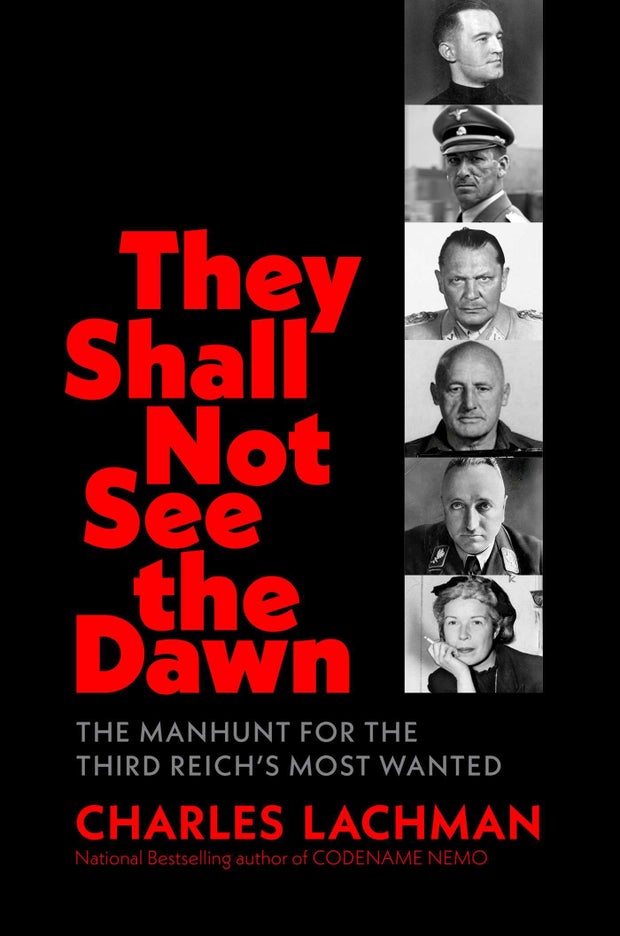
From the publisher: May 1945. The Reich is in ruins. Hitler is dead. Yet for the US Army's Counter Intelligence Corps, the real war has just begun.
They Shall Not See the Dawn is the true historical thriller following a secret unit of American agents, drawn from every walk of life, hunting Hitler's inner circle—the dangerous henchmen still at large and feared to be carrying their Führer's final political testament, orders for a guerilla resistance, and plans for rocket and nuclear programs hidden in mountain strongholds. It was a race against time to capture World War II's most notorious Nazis before they could vanish or rally a new resistance.
The CIC men leading the greatest manhunt in history were scholars, motivated college students, an actor, linguists, young draftees and refugees—men like Henry Kissinger—armed not just with guns, but with intellect, intuition, and sheer daring. Their quarry included Ernst Kaltenbrunner, the monstrous Gestapo chief; Julius Streicher, Hitler's notorious "Jew-baiter"; Robert Ley, master of slave labor; and other high-ranking war criminals desperate to escape justice. Against all odds, the CIC brought them down, ensuring their places in the dock at Nuremberg.
Charles Lachman lives in New York City.
"They Shall Not See the Dawn" by Charles Lachman (Thriftbooks) $26
______________________________________________________
Excerpt: "They Shall Not See the Dawn" by Charles Lachman
Chapter One
THE WEREWOLVES
The werewolves are gathering.
Up there in the Bavarian Alps, diehard Nazi Party big shots. Waffen-SS troops. The Gestapo. Adolf Hitler's army has been shattered, but thousands of Nazi fanatics are prepared to engage in an epic last stand. A fanatical fight to the end. Hitler's Götterdämmerung—the twilight of the Gods.
The capitulation of Germany is at hand, the Third Reich's unconditional surrender just days away. But up there in the Nazis' National Redoubt at the German–Austrian border, Hitlerism is alive.
They call themselves Der Wehrwolfs, and they swear to devour the Enemy and never lay down their arms "even if we have to fight at the North Pole." Hit the Allies by surprise, in the weak spots—the flanks, the rear. Disrupt the lines of communication. Make mayhem. Sabotage. Murder the Americans. Kill collaborators but avoid direct confrontation. Deploy cunning and operate in darkness, like those shapeshifting, half-human, half-wolf creatures revered in German folklore. Resist the forces of occupation "noiselessly, mysteriously."
US Army Lieutenant Robert Matteson stands at the foothills of the Alps in the Austrian village of Vorchdorf, feeling overwhelmed as he scans those rugged mountains. He's alarmed by the intelligence reports and the aerial reconnaissance photo. The Nazis appear to be constructing bunkers and fortifying machine gun nests here at the border. The terrain is a natural fortress, and bombing is of limited effectiveness. Schools for young Werewolves are said to be in operation, staffed by SS officers who are teaching the students the tactics of ambush mobility. One zealous teenage Werewolf could, in theory, hold off a hundred Americans. There may be as many as 200,000 in this army, waiting for orders to launch a guerrilla war.
Allied victory in Europe is about to be announced, but Matteson wonders if the Nazis really are finished.
Matteson is a CIC agent assigned to General George Patton's Third Army, Eightieth Infantry Division.
CIC—that's Counter Intelligence Corps.
Also known as G-Men in Khakis.
Matteson has been handed one hell of a mission: take down the top Werewolf, dead or alive. His name is Ernst Kaltenbrunner, an SS general who two weeks earlier was named commander-in-chief of all German forces in southern Europe. Kaltenbrunner believes that Hitler has been sent by God to rule over Germany.
Kaltenbrunner is now said to be somewhere in Upper Austria, organizing the Army of Werewolves with his protégé and childhood friend, a little-known Nazi functionary, Colonel Adolf Eichmann.
Problem is, it's like chasing a phantom, because Matteson doesn't even know what the inscrutable Kaltenbrunner looks like—they can't find a single photograph of him. Despite his lofty status, Kaltenbrunner has maintained a low public profile. As far as the Allies can tell, he has never appeared in the Nazi newspapers. Unlike many Nazi chest-thumpers,the crafty obergruppenführer never blew his own horn.
What to do? Matteson wonders. What to do and where to start?
It's the same question nagging at Matteson's sidekick, Private First Class Sydney Bruskin. Like Matteson, Bruskin is a CIC special agent, who certainly never dreamed he'd find himself on a mission like this.
This son of Russian Jewish immigrants grew up in New Haven, Connecticut, where his father, Louis, owned a barbershop on Oak Street. His mother, Bessie, was a dressmaker. The parents spoke Yiddish at home. In 1932, when Bruskin applied for admission to Yale University, he faced a big hurdle. Yale's dean had decreed, "Never admit more than five Jews, take only two Italian Catholics and take no blacks at all." Even against those odds, Bruskin got in. He studied French, German, and Italian, and lived at home on York Street, walking to campus. No dorm living. No fraternity life. Mostly he hung out with the other Jewish students. Not exactly outcasts, but definitely outsiders.
Two of his fellow Jewish students changed their names upon graduation from Yale, just to make life go more smoothly. David Shapiro became Dave Shepard. Seth Bickoff became Seth Bickford. But Bruskin stayed Bruskin and taught French for a year at a private all-girls school in Miami. Then he moved back to New Haven, couldn't land a job, and ended up renting bikes to keep a few bucks coming in. That morphed into a bike store. Business was brisk because, in those days, owning a car was a luxury.
The call didn't come immediately, and when it did in 1943, Bruskin was surprised. By this time he was twenty-nine years old, with a wife and a newborn, but no matter—Uncle Sam wanted him. One year later, he was in the thick of it in France, on D+30. Then the Army figured that, since he was still alive, Bruskin could put his Ivy League education and language skills to better use, and he was transferred to military intelligence.
Bruskin's uniform is unlike any in the Army. It bears no rank—just a simple gold-colored key on the lapel, symbolizing the unlocking of secrets. There is no way of telling from his uniform that he is a humble private.
Matteson is a little higher up the Army food chain. He studied German history at Carlton College in Minnesota and at Harvard University and then enlisted as a private, but he's been promoted to lieutenant. In any event, rank means nothing to either soldier. In private conversations, Bruskin is "Syd" and Matteson is "Bob."
The CIC operates on a funny set of rules. Like all CIC agents, Matteson and Bruskin have authorization to bypass the normal chain of command and issue orders to any American officer they encounter, up to full colonel. They've been told that if their authority is ever questioned, they are to display their gold badges, which are inscribed "War Department Military Intelligence." And if that doesn't work, and there are further inquiries about their rank, CIC agents are instructed to respond: "My rank is confidential."
It's a shrewd way of concealing the fact that most CIC agents are noncommissioned officers, that is, the rank of sergeant or below. Their real status in the Army has to be kept under wraps, for what captain, major, or colonel would take orders from GI Joe?
A first-generation bicycle salesman with a wife and kid, and the handsome jock from Minnesota who won seven letters in college playing football, baseball, hockey, and boxing. An unlikely pair of Werewolf hunters, to say the least.
Excerpted from THEY SHALL NOT SEE THE DAWN by Charles Lachman. Published by Diversion Books. Copyright © 2026 by Charles Lachman. All rights reserved.