Iowa caucuses still up in the air
Iowa Republicans on Tuesday night will be the first voters in the nation to weigh in on the GOP presidential nominating contest. Yet even after months of an intense campaign season, the outcome of the Iowa caucuses remain as unpredictable as ever.
"I don't think anybody knows who is going to get what right now," Newt Gingrich said on CBS' The Early Show Tuesday, when asked whether he expects to come in first or second place.
Gingrich's ambivalence demonstrates the wild ride his campaign -- like many others -- has taken in the past month: In early December, he sat at the top of the polls and declared, "I'm going to be the nominee."
By Monday, his popularity down nationally and in Iowa, Gingrich said, "I don't think I'm going to win" in Iowa.
Tuesday morning, after being taken to task by his own supporters for his pessimistic remarks, Gingrich acknowledged it's anybody's game at this point: "I think anybody could come in first," he said on The Early Show.
Indeed, the last poll from the Des Moines Register, conducted Dec. 27-30, showed a tight race: Mitt Romney led with 24 percent, Ron Paul followed with 22 percent support, and Rick Santorum surged to 15 percent. Gingrich came next with 12 percent support, followed by Rick Perry with 11 percent and Michele Bachmann with 7 percent.
Critically, as many as 41 percent of likely caucus-goers said they could be persuaded to support someone other than their first choice. Their peers will get a chance to persuade them one way or another when the caucuses begin at 7 p.m. CT tonight.
On the ground in Iowa: Many still undecided
Iowa's bad track record for picking GOP winners
Full CBSNews.com coverage: Election 2012
Technically speaking, the caucuses are largely symbolic -- the results will represent the viewpoints of just a fraction of the American population. Iowa will send just 28 delegates to the Republican National Convention in Florida, where a candidate will need the support of at least 1,143 to win the presidential nomination. On top of all that, the Iowa delegates aren't officially chosen on caucus night -- they're selected at a state convention in June.
That said, the caucuses have the potential to change the race. A strong showing from Romney could solidify the notion that the former Massachusetts governor is the inevitable nominee. Or Santorum could gain the momentum to expand his appeal beyond Christian conservatives, siphoning support from other candidates.
And a poor showing could cast serious doubts about how much longer Bachmann or Perry can last, providing new pools of potential supporters to other not-Romney candidates.
Romney's strong standing in Iowa defies the low expectations he set early in the year by paying the state little attention, but he has campaigned there vigorously in the past week. If he can win Iowa, Romney will have greater momentum -- but also higher expectations to meet -- in New Hampshire, where he already holds a double-digit lead.
Video: Iowa GOP chair on importance of caucuses
Video: Inside the Iowa caucuses
No non-incumbent Republican has ever won the Iowa caucuses and the New Hampshire primary, which falls this year on January 10, so back-to-back victories would be a significant symbolic score for Romney. After finishing second in Iowa four years ago, Romney is prepared for a drawn out nominating contest with strong organizations in several states this year, but he's also looking ahead to the general election.
In the final days of Iowa campaigning, Romney's rivals have sought to derail his lead. Gingrich unequivocally called Romney a liar on CBS' The Early Show, while Paul launched an aggressive radio ad calling Romney a liberal.
Paul has attracted an ardent base of supporters with his libertarian views and has the organization to carry his campaign beyond Iowa.
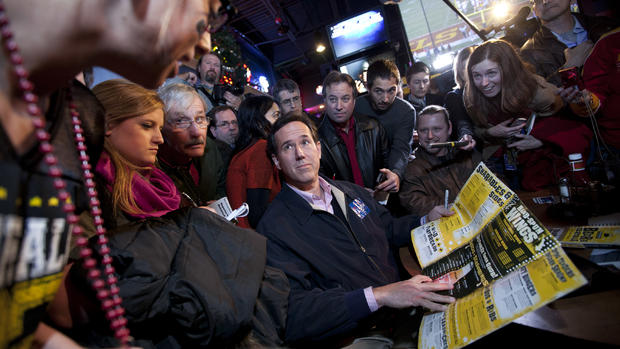
Santorum, meanwhile, is finally reaping the benefits of more than 100 days of campaigning in Iowa. He was swarmed by press from all over the world Monday, CBS News political director John Dickerson reports.
Perry and Bachmann have been busy making a final appeal to Iowans, both arguing they are authentic conservatives -- unlike the frontrunners.
Perry compared his presidential bid on Tuesday to the great battles of World War II. Bachmann on Monday implored supporters not to "settle" for one of her rivals, telling reporters she would govern "in the image and likeness of a Ronald Reagan of a Margaret Thatcher, and that's what I will do."
Romney has been plagued throughout the campaign by charges that he isn't conservative enough.
Earlier this month, a video from 2002 surfaced showing Romney calling his views "progressive." On Fox News today, Romney acknowledged, "That was 10 years ago, and I'm more conservative than I was 10 years ago."