"Family of Spies": Christine Kuehn discovers her grandfather's Nazi past

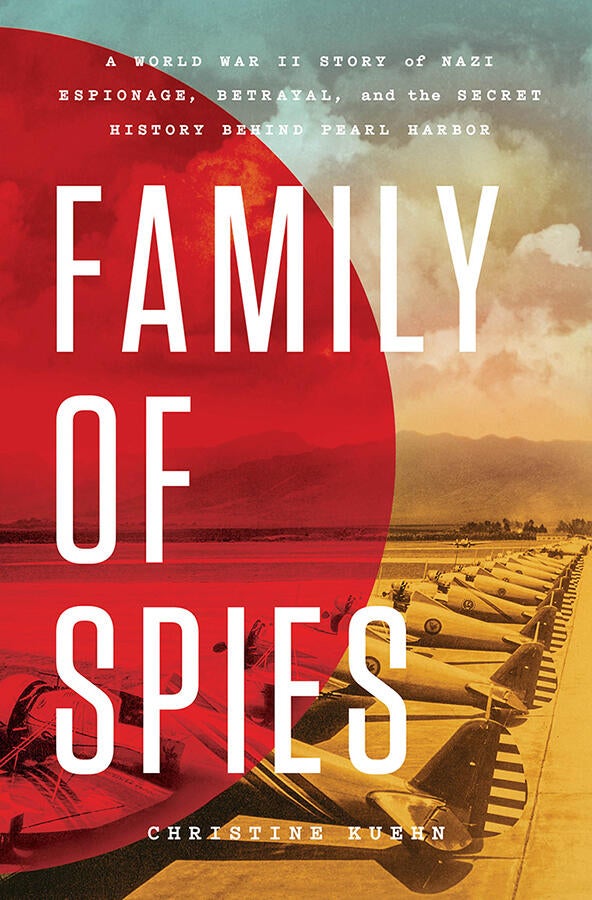
Christine Kuehn and her husband, Mark, kept what they were learning hidden in a basement closet until she finally decided to write a book about her "Family of Spies." "I stopped and started so many times because, you know, I was having trouble accepting what I was learning," she said. "My grandfather was the only person tried and convicted for the bombing of Pearl Harbor."
Kuehn's father tried to shield her from this not-to-be-believed family saga. "He wouldn't talk about his past," Christine said. "He always really skirted the issue."
And her Aunt Ruth warned her to stay away from it: "She said, 'You have a good life. Don't ruin it with the past.'"
But the past landed on her doorstep in 1994, when a letter came out of the blue. "Kind of turns your life upside-down," she said, "when you think your life was one way and then you find out that it wasn't the truth."
A Hollywood screenwriter had come across the Kuehn name in histories of Pearl Harbor, and wanted to know if she was related to the family of Nazis who had spied for the Japanese. "I called my dad, and I was like, 'Hey Dad, I got this letter,'" Christine said. "Talked to him about it. And he was like, 'Oh no, that can't be our family. They must be thinking about someone else.' Ten or fifteen minutes later, he called me back, and he was sobbing."
A family transformed by the Nazi Party
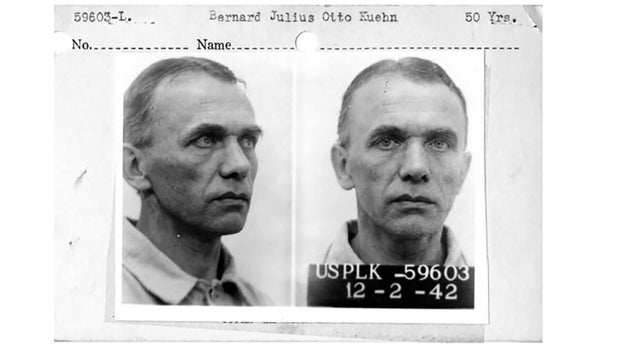
Christine spent the next 30 years documenting the story her father told her, beginning with her grandfather, Otto, and his family in Hitler's Germany. "The whole family just was transformed by the promises that were being told by Hiter and the Nazi Party," Christine said.
Her Uncle Leopold was a stormtrooper, proudly wearing a swastika in his wedding photo. Aunt Ruth, the woman who had told Christine to leave the past alone, was sleeping with Hitler's minister of propaganda, Joseph Goebbels. "She met him when she was only 19," Christine said.
It didn't last, and in 1935 Goebbels shipped the family half-a-world away to Hawaii, and the U.S. Naval base at Pearl Harbor, to spy for the Japanese.
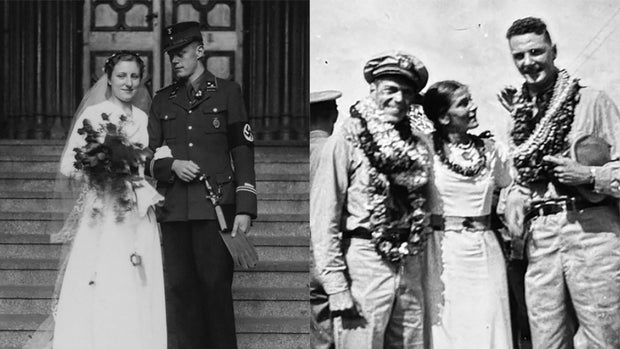
Her grandfather lived large, throwing parties that made the society columns. "He would invite Naval officers to come in and enjoy the party while he was trying to glean information about, you know, troop numbers and information like that," said Christine.
He took pictures of American airplanes lined up wing tip-to-wing tip – just asking to be bombed – while Aunt Ruth played the femme fatale. "She was young and beautiful. She would be wined and dined by the Navy officials, and she would talk with them and silently glean information about when the boats were in," Christine said.
To get the information to the Japanese, Otto would walk into the Japanese consulate with a satchel and give them everything he had collected.
In 1939, FBI director J. Edgar Hoover ordered an investigation "to determine whether the Kuehns are in fact espionage agents."
Christine says her grandfather likely knew about plans to attack Pearl Harbor: "When they were asking him to create the signal system to communicate to Japanese subs off the coast of Hawaii, I think he probably had an idea," she said. That system was comprised of putting a lantern in the dormer window of his home between 9 and 10 o'clock, which would mean battle cruisers had left the harbor.
War was coming, but for her father, Eberhard, then a gangly teenager, life in Hawaii was an endless summer. "My father and his younger brother, Hans, were just normal kids enjoying life on a beautiful island," said Christine. "It was kind of like paradise for them."
That is, until December 7, 1941.
"I'm an American. I'm staying here"
On December 8, in the middle of the night, there was a banging on the Kuehns' door. The FBI came in and arrested the whole family. Christine's father was held at a place called Sand Island, while Otto was hauled before a secret military tribunal.
She found the tribunal's transcript in the National Archives. It read: "… upon secret written ballot all of the members present at the time the vote was taken concurring, sentence the accused TO BE SHOT TO DEATH WITH MUSKETRY" – the firing squad.
That death sentence went all the way to President Franklin Roosevelt, before it was commuted to 50 years at hard labor. But after only four years, Otto Kuehn was released and ordered deported to Germany, an act of leniency J. Edgar Hoover found "astounding."
Christine's father was released from Sand Island – and turned his back on the family. "He ended up writing a letter and saying, 'Germany is not my home; I'm an American. I'm staying here,'" said Christine, "and he refused to return to the family. I don't know that I could have done that at 15."
When he turned 18, Eberhard joined the Army and fought on Okinawa, the last great battle of the war that had begun at Pearl Harbor. He never found out why his father spied for the Japanese.
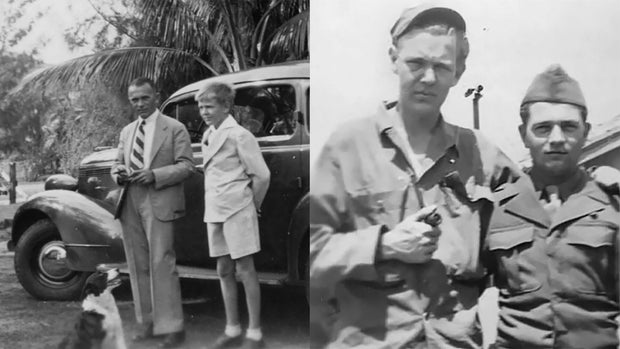
"He actually asked his dad, 'Did you do this and why did you do it?'" Christine said. "And Otto never answered him. And so, my dad got up and he walked out and he never saw his father again."
It was all so long ago. But the memory of Pearl Harbor is forever, and the U.S.S. Arizona Memorial over the battleship sunk on December 7th is an indelible part of the American landscape – which Christine could not bring herself to visit.
"I didn't think I deserved to be there," she said, crying, "because my family had been involved."
That was 10 years ago. Today, she says, "I don't think I carry that same shame that I was carrying back then."
Her father, who wanted to shield her from the shame, finally showed her the way to escape it. "My father made the decision to walk away from his family," she said. "He was a true American, and I'm a result of him and his decisions, not my grandfather's decisions."
READ AN EXCERPT: "Family of Spies" by Christine Kuehn
GALLERY: Pearl Harbor - Day of Infamy
For more info:
- "Family of Spies: A World War II Story of Nazi Espionage, Betrayal, and the Secret History Behind Pearl Harbor" by Christine Kuehn (Celadon Books), in Hardcover, eBook and Audio formats, available via Amazon, Barnes & Noble and Bookshop.org
Story produced by Mary Walsh. Editor: Chad Cardin.
See also:
- Next U.S. Navy aircraft carrier to be named after African American Pearl Harbor hero ("Sunday Morning")
- An "unknown sailor" no more ("Sunday Morning")
- Almanac: Pearl Harbor ("Sunday Morning")