Senate votes to end ban on mining in Boundary Waters after Sen. Tina Smith's hourslong speech


The U.S. Senate on Thursday voted to end a mining ban near the Boundary Waters in northern Minnesota.
The measure passed on a 50-49 vote.
Minnesota Sen. Tina Smith spoke for hours on the Senate floor Wednesday night in an attempt to block the vote.
It was a fight that had been building for months before Smith took it to the Senate floor. She spoke for nearly five hours to try to stop this resolution before the vote.
"The Senate and House should follow the law they should follow the laws they wrote. About how public land orders are treated in this country and I do not believe that happened here," Smith said.
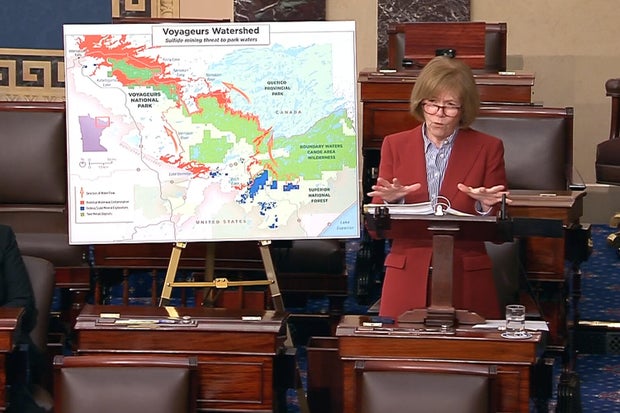
The measure in question would use the Congressional Review Act to reverse a 20-year mining ban that was put in place in 2023. The resolution opens up 225,000 acres of land, on the doorstep of the Boundary Waters, to copper sulfide mining.
"When it comes to protecting this precious place, you are choosing the wrong side because you aren't protecting this place that needs our support and needs our protection," Smith told lawmakers.
Environmental groups warn a mine in this water-rich area could lead to contamination. There are also concerns about long-term pollution in the area known for hiking, camping and canoeing.
"This is focused on northern Minnesota today, but where will it be next time?" said Sen. Amy Klobuchar, who also spoke out against the resolution.
Smith said the proposal also ignores tribal treaty rights and the government's responsibility to consult Indigenous communities.
"These are tribal nations, Indigenous people that have lived in northern Minnesota, on the borderlands of northern Minnesota, for time immemorial, and they have treaties with the federal government," Smith said. "And yet this CRA before us today completely abrogates those tribal treaty rights. It ignores the responsibility of the federal government to consult with tribes, which has not been done, and that is why so many of the tribes across the country have come together to oppose this."
Smith also read part of a message from a Lakeville, Minnesota, resident.
"When making the decision to move to Minnesota, a huge draw for us was outdoors. We visit the Boundary Waters Canoe Area every year, and my kids know the feeling of a great hike and the beautiful scenery to go with it," Smith quoted. "If this resolution passes Congress, not only will my grandchildren not be able to enjoy this beautiful place, but my kids will watch it disappear before their eyes. Please protect this land, protect beauty and protect the feeling of a great hike."
Supporters argue lifting the ban could bring in hundreds of jobs, billions in economic impact and reduce reliance on foreign materials.
Twin Metals Minnesota supports the legislation, saying in part in a statement earlier this year, "Minnesota is fortunate to have both world-class mineral deposits and a stringent regulatory framework that ensures mining projects are held to the highest environmental and labor standards."
Twin Metals also said it is "committed to moving forward with the responsible development of our mineral resources for the benefit of Minnesota communities while also contributing to a stronger nation."
"There is no other way to say it than today is hard," said Pete Marshall with Friends of the Boundary Waters Wilderness. "This is a betrayal of wilderness."
He said he wasn't shocked the resolution passed by a vote, but he said he's gravely disappointed that Republican lawmakers ignored a two-year Forest Service study, and other details.
"They ignored more than 650,000 public comments. The overwhelming majority of which opposed mining in this pristine area," said Marshall.
The group said the fight isn't over. They are now urging Minnesota Gov. Tim Walz and the Department of Natural Resources to cancel Twin Metals' state mineral leases, possibly ending mining near the BWCA, before it even begins.
"While this action is going to place these loved lands and waters at risk, we will not stop fighting," said Mary Blitzer, Sierra Club North Star Chapter.
The resolution already passed the House.


