How the Minnesota Zoo is helping to save one of the world's most endangered butterflies

The Minnesota Zoo, John Ball Zoo in Michigan and Assiniboine Park Conservancy in Canada have received the Association of Zoos and Aquariums' 2025 North American Conservation Award for their collaborative work to save the critically endangered Poweshiek skipperling butterfly.
"We're certainly honored to be recipients of this North American Conservation Award," Erik Runquist, conservation scientist at the Minnesota Zoo, said. "We hope this is a means by which we can collectively raise awareness."
Once common in the tallgrass prairies of Minnesota, the Poweshiek skipperling has suffered a dramatic decline in population in recent decades.
"Considered probably the most Minnesotan butterfly," Runquist said. "Used to be one of the most abundant butterflies in Minnesota's prairies until it remarkably disappeared."
The butterfly is now only found in a few isolated areas of Michigan and Manitoba, Canada. The decline is attributed to habitat loss and degradation.
In 2012, an initiative was launched by the three institutions to refine captive breeding techniques to stabilize the species.
Thousands of zoo-reared butterflies have been released into the wild, and now the entire U.S. population may trace back to just 18 females held at the Minnesota Zoo at the start of the program.
"Most of the individuals that exist currently are derived or related to those original 18 we had here at the Minnesota Zoo," Runquist said. "Conservation requires naive optimism at times."
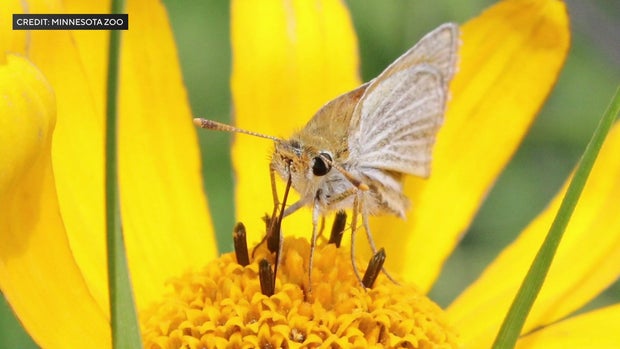
Not much was known about the butterfly, and the team at the Minnesota Zoo had to go through vigorous trial and error to make the correct conditions for these insects to thrive.
"It's taken a lot of work and a lot of blood, sweat and tears," Runquist said.
The initiative allowed Amaya Thomas an opportunity to learn about these butterflies while doing a conservation internship at the Minnesota Zoo.
"I wasn't super interested in insects at first," Thomas said. "I fell in love with these butterflies really quickly. The work we do here is just so important for these butterflies that are often overlooked."
Thomas now works at the Minnesota Zoo to help take care of the Poweshiek skipperling.
According to the U.S. Fish and Wildlife Service, the species was listed as endangered in 2014.
The butterflies can be found with dots on the wings, indicating how the species is being tracked by different conservation groups.
"The world would be a lonelier place and smaller place without this butterfly," Runquist said.
The Minnesota Zoo says the Poweshiek skipperling typically has a life span of one year, and only lives for two weeks as an adult. The season for the butterflies is mid-to-late June.
In the future, as more sites across Michigan are stabilized, the Minnesota Zoo hopes to bring back the butterfly to Minnesota. But for now, they will continue to see how the Poweshiek skipperling impacts prairies.