Minnesota State Fair expands ASL interpretation, sensory-friendly spaces for 2026
The Minnesota State Fair is working to make the Great Minnesota Get-Together more accessible for fairgoers who are deaf, hard of hearing or may need a break from the crowds, lights and noise.
The fair offers American Sign Language interpretation throughout its run, including roving interpreters available daily from 9 a.m. to 6 p.m. Fair officials also schedule ASL interpretation for certain shows and events.
For Aaron Gutzke, CEO of ThinkSelf, that access is about making sure deaf Minnesotans can experience the fair in the same way as everyone else.
"It's important to provide access to ASL, giving every person in Minnesota access to the fair that we all know and love," Gutzke said.
ThinkSelf is a nonprofit organization established in 2017 that serves deaf people across Minnesota. The organization provides adult education and domestic violence and sexual violence advocacy services.
Gutzke said Minnesota is facing a shortage of ASL interpreters, but he believes that should not prevent organizations and venues from finding ways to provide access.
"Even though there is a shortage of interpreters, there should be a provision of access at all times, regardless of what the venue is," Gutzke said. "Yes, even though there is a shortage of interpreters in Minnesota, that doesn't mean it's okay to say, 'Sorry, we can't find you an interpreter.' Everyone deserves equal access to info in entertaining events just like State Fair."
Minnesota State Fair Spokesperson Maria Hayden said the fair's goal is to make the experience enjoyable for anyone who wants to attend.
"We have roving interpreters that are able to help out guests if they need assistance throughout the day or if there's certain things that they wanna do that they may need an interpreter for," Hayden said.
The fair also offers a schedule of programs with ASL interpretation already planned, meaning guests do not have to request an interpreter for those events.
For Gutzke, accessibility is about more than entertainment.
"Deaf people encounter barriers to information, entertainment and stories about Minnesota history. What if there's an emergency?" Gutzke said. "Public safety isn't equipped to communicate safety plan information to deaf people if they're not able to communicate with them in the first place."
ThinkSelf brings participants to the State Fair each year.
"We always bring our participants to the State Fair every year because it's the right thing to do and it's very Minnesotan," Gutzke said.
The fair is also offering accommodations for guests who may experience sensory overload.
"We know the fair can be an overwhelming experience for the senses," Hayden said.
Three sensory-friendly locations are available on the fairgrounds, including the Fraser Sensory Building, Momentum Refresh and the KaiBi Family Care Center. Those spaces allow guests to step away from the crowds, noise and other stimulation.
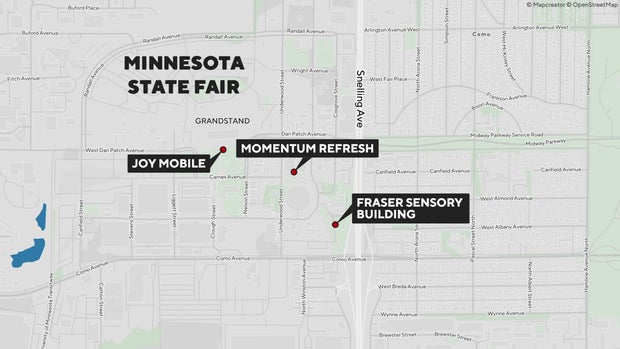
The Fraser Sensory Building includes features designed to create a calmer environment, including sensory tools and support from trained volunteers.
The fair will also hold a sensory-friendly morning on the first Monday of the fair. During that time, sound and light levels will be reduced at the Kidway and Mighty Midway.
"There will be lower sound and light levels for that entire morning for folks who want to experience the Kidway and Midway but without all of the extra lights and sounds that usually come with it," Hayden said.
The State Fair also offers accessibility services for blind and low-vision guests, mobility assistance and other accommodations.
A full accessibility guide, including ASL schedules, sensory-friendly locations and other services, is available on the Minnesota State Fair website.


