Legal scholars raise concerns about internal ICE policy authorizing entry into homes without judicial warrants

An internal U.S. Customs and Immigration Enforcement memo from a whistleblower and obtained by the Associated Press that authorizes officers to enter homes without judicial warrants is raising concerns among legal scholars who say the policy is a clear violation of the Constitution.
The directive from last May states that while the U.S. Department of Homeland Security had not historically relied on administrative warrants to arrest immigrants subject to final orders of removal at their homes, "the DHS Office of the General Counsel has recently determined that the U.S. Constitution, the Immigration and Nationality Act, and the immigration regulations do not prohibit relying on administrative warrants for this purpose."
Administrative warrants are signed by immigration officials, not judges.
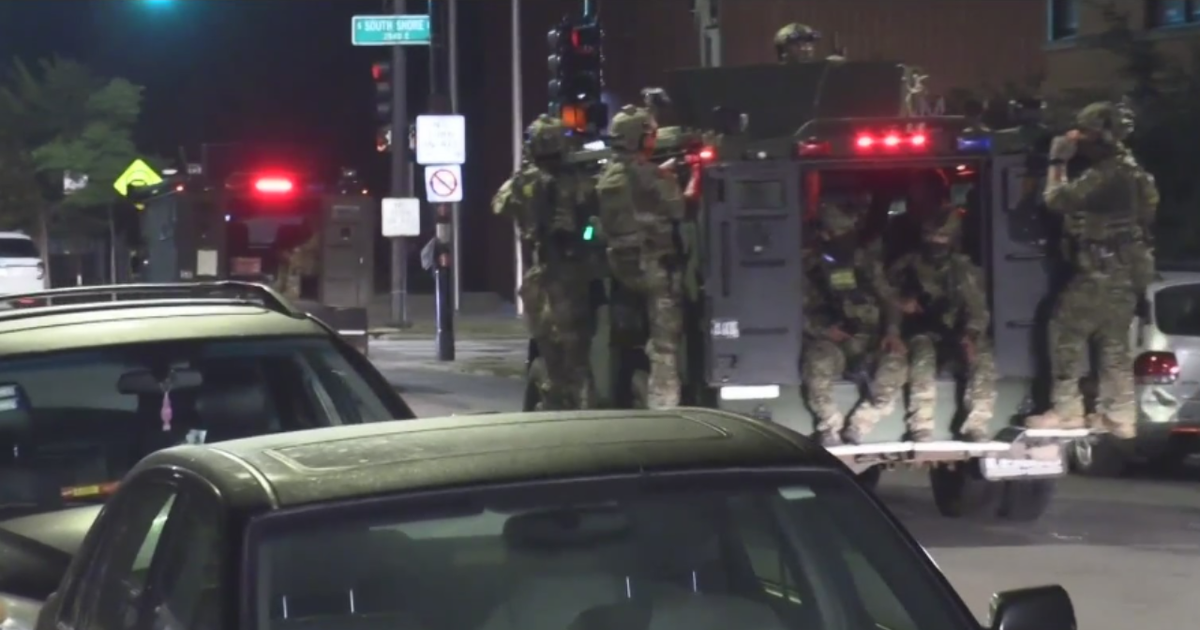
The previously undisclosed memo comes as Operation Metro Surge continues in Minnesota. Authorities call it the largest immigration operation ever in Minnesota with more than 3,000 federal immigration agents assigned to the state. The operation has sparked clashes between ICE and protestors, leading to several violent encounters including the shooting death of Renee Good by an ICE officer on Jan. 7.
Agents on Jan. 11 forcibly entered the home of a Liberian citizen living in Minneapolis to arrest him without a judicial warrant, a federal judge said. Garrison Gibson, the man detained, was in the country legally under terms that he met regularly with immigration authorities, according to the judge's order.
U.S. District Judge Jeffrey Bryan said Gibson's arrest violated the Fourth Amendment, which protects against unreasonable search and seizures.
"To arrest him, respondents forcibly entered [his] home without his consent and without a judicial warrant," Bryan wrote.
That law enforcement would need such a warrant approved by a judge in order to enter a home is well-established legal precedent reiterated by the courts time and again, constitutional experts told WCCO news.
Emmanuel Mauleón, associate professor of law at the University of Minnesota who specializes in the Fourth Amendment, said that administrative warrants authorize arrests, but that does not mean those arrests can happen inside a person's residence without their consent to enter.
"This has been long-standing Fourth Amendment interpretation. There has been no U.S. Supreme Court case ever that has found that an administrative warrant meets this bar," Mauleón said. "What I'll say is the Fourth Amendment probable cause requirement is not a high bar, so that the idea that they can't even meet that is deeply troubling. Or the idea that they're not going to go about the process of seeking a warrant is deeply troubling."
Jimmy Percival, general counsel for DHS, in an opinion piece published by the Wall Street Journal, defended the policy and said it was both reasonable and lawful.
"While administrative warrants may satisfy the Fourth Amendment for any arrest of an illegal alien, ICE currently uses these warrants to enter an illegal alien's residence only when the alien has received a final order of removal from an immigration judge," Percival wrote. "That means the alien has already seen a judge, presented his case, received due process, and been ordered removed from the country."
Mauleón disputed that characterization, again emphasizing that administrative warrants authorizing arrests are not the same as "entry into a constitutionally protected space."
"The best parallel that I could suggest is you could imagine that a police officer is conducting an investigation or wants to arrest somebody, and instead of going to a judge and saying, 'Hey, this is the evidence that I have, do I have probable cause to search their home?' They just go to their typewriter and type up a sheet of paper that says, 'I have a warrant to search their home.' That's essentially what DHS is doing," Mauleón said.
Vice President JD Vance during a visit to Minneapolis on Thursday was asked if he thought the ICE policy violates the Fourth Amendment. He did not directly say if he thought so, but conceded courts could disagree with that policy and vowed to follow an order if they did.
"Our understanding is that you can enforce the immigration laws of the country under an administrative order if you have an administrative warrant. That's what we think. That's our understanding of the law. That's our best faith attempt to understand the law," Vance told reporters. "Again, this is something courts will weigh in on. I won't speak to that, but yes, most immigration law in our country is not done through the criminal system with the judge. It's done through the administrative law system."
David Schultz, a law professor at the University of St. Thomas and political science professor at Hamline University who focuses on the Constitution, called requiring judicial warrants before entering a home an "incredibly well-established principle of American law" that dates back to the country's founding.
"There really is no debate on this one among legal scholars that an administrative warrant gives you no authority to enter houses at all," Schultz said.
The memo on administrative warrants was not shared widely within the agency but has been used to train ICE officers, according to the whistleblower complaint.