Take a journey from pioneer life to present day at Farmamerica

For nearly 50 years, Farmamerica has been sowing agricultural knowledge near Waseca, Minnesota.
Jessica Rollins lives on one farm and works on another.
"I am always surrounded by farm life. I would not have it any other way," Rollins said.
But her day job goes far beyond her regular chores.
"Farmamerica is Minnesota's agricultural interpretive center," she said.
She's the executive director of Farmamerica. The state opened the center in 1978, thanks to a land donation from the Lukken family.
Traveling the Farmamerica path is like going for a stroll back in time.
"This is what it would look like in the 1850s, when folks would've started to call this location home," she said.
There's a dugout on the side of a hill that pioneer families would have lived in before they eventually upgraded to a sod-roof house. And then if they were lucky, a log cabin — giving this part of Farmamerica a "Little House on the Prairie" feel.
On this farm, you can travel from the 1850s to the 1930s by walking a few hundred feet.
"Electricity was the main excitement on the farm in the 1930s," Rollins said. "Farmers in the 1930s were still using horses quite a bit, but they were starting to introduce the tractor."
Each of the buildings on site is an original, though they may have been relocated from other parts of the state. That includes a 172-year-old Baptist church that was carefully brought in from Nicollet County. There's also a blacksmith shop.
"These are horseshoes, and that was the No. 1 job for a blacksmith in this time is providing horseshoes for farmers as well as sharpening plow blades," said program director Kari Wadd.
But the main attraction is the animals. There are a dozen different species of animals at Farmamerica. That includes Ferdinand, a 2-year-old mini highlander.
"He is very shy. Yep, easygoing," Wadd said.
There are goats, chickens, piglets and two famous turkeys named Peach and Blossom.
"They went to Washington, D.C., were pardoned by President Biden, driven back to Farmamerica and they have been here for two plus years," Wadd said.
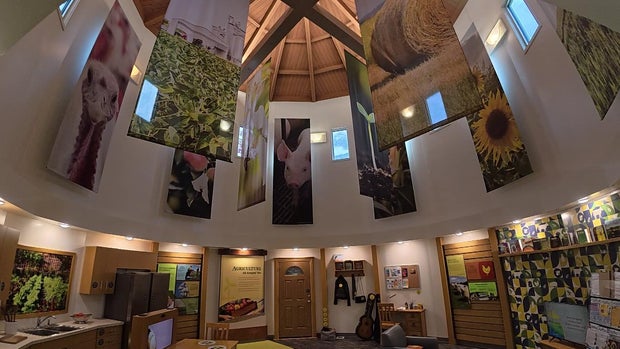
Baby chicks and ducklings can be found inside the Interpretive Center, but the real purpose here is to highlight farming today to show just how far we've come.
It's immersive, interactive and an educational harvest for people of all ages.
"Our goal is to help people understand and respect and be excited about the story of agriculture and all that it can bring into the future," Rollins said.
Farmamerica is a nonprofit and sits on 360 acres of farmland, and they grow their own crops. Over 1,000 Minnesota students visit each year.


