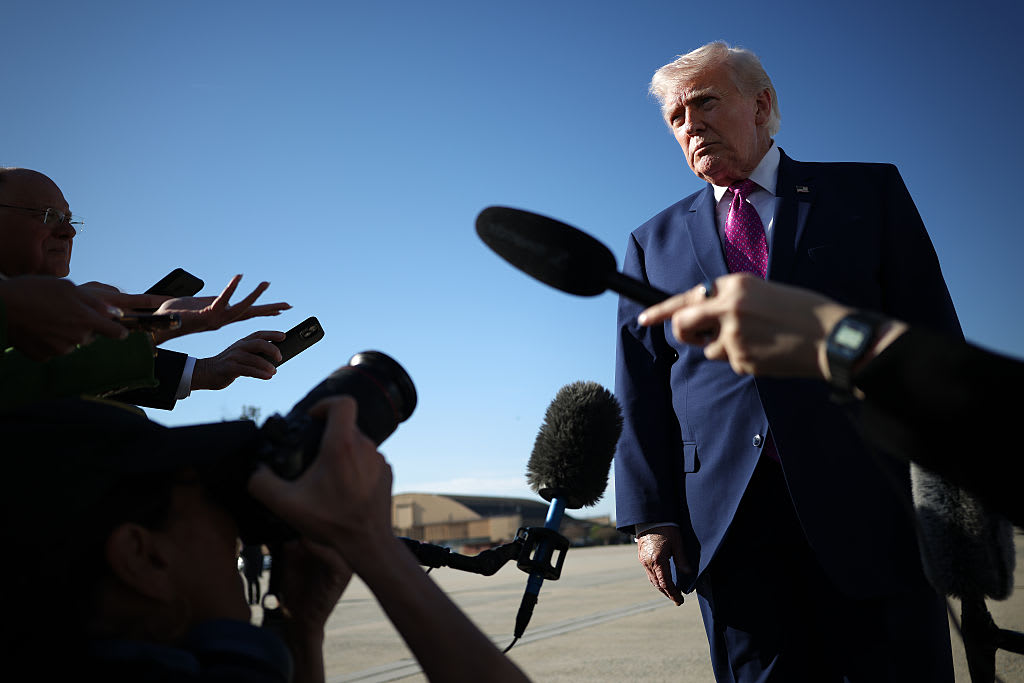
Iran War Latest: U.S. launches more strikes as Trump threatens Iran, Houthis with "major military punishment"
What to know about the Iran war today:
- The U.S. military has begun carrying out a 13th consecutive night of Iran strikes.
- President Trump threatened Iran and its Houthi allies in Yemen with "major military punishment" Thursday if the Houthis launch more attacks on Saudi vessels in the Red Sea, as the war expands to another part of the region.
- There are signs the U.S. is preparing to ramp up military operations in the Middle East, including an increase in the number of refueling aircraft deployed to Israel, American B-1 bombers leaving U.K. bases, and dozens more medics being sent to a sprawling base in Germany.
- The Pentagon continues insisting the Strait of Hormuz is open, but traffic through the vital waterway is at a crawl, helping push global oil prices back over $100 a barrel again Thursday for the first time in over two months.
CENTCOM launches 13th straight night of strikes
The U.S. military's Central Command says it began carrying out a 13th consecutive night of strikes against Iran on Thursday. It said on X it is aiming to "hold Iran accountable and diminish threats from the Islamic Revolutionary Guard Corps to commercial shipping."
Trump says U.S. will use Iranian money to pay for damage to ships
President Trump wrote on Truth Social that "any and all damages" to ships struck by Iran "will be paid for by Iranian Money that the United States has in its possession, and controls."
Mr. Trump did not specify the exact source of money, but billions of dollars' worth of Iranian assets are currently frozen due to U.S. sanctions. The two countries had previously discussed unfreezing those assets if Iran implements the terms of a deal with the United States.
"These damages may be very substantial but, nevertheless, this is the fair and equitable thing to do," the president wrote.
Rapid pace of interceptor and precision-guided weapons use worries Trump administration
The rapid pace at which the U.S. is expending some of its most advanced air-defense interceptors and precision-guided weapons in the Middle East is a point of great tension inside the Trump administration as President Trump's war with Iran ratchets up again, according to U.S. military and intelligence officials familiar with internal assessments. And it's raising broader concerns about America's readiness for a potential conflict in the Indo-Pacific.
The dwindling stockpiles of defensive interceptors and long-range missiles have become a pressure point for top military and civilian leaders who are weighing the demands of the war with Iran against maintaining readiness to deter other adversaries, including China.
The U.S. officials, who spoke to CBS News on condition of anonymity given the sensitivity of the topic, said the U.S. cannot sustain the rate at which it expended precision munitions early in the campaign against Iran.
Kuwaiti army says Iraq border crossing targeted by drones
A border crossing between Kuwait and Iraq was targeted by drones, the Kuwaiti army said on X.
"The Abdali border crossing was subjected, this evening, to repeated targeting by hostile drones," the army said, adding that the attack caused damage but no injuries.
The military later said it was intercepting Iranian drones and missiles.
The Kuwaiti army did not specify the source of the threats to the border crossing, specifically, but Kuwait has come under repeated attack by Iranian drones and ballistic missiles.
U.S. blockade on Strait of Hormuz redirects 3 vessels in past day
The U.S. blockade has now redirected 12 vessels since it was put back in place nine days ago, an increase of three more ships since yesterday, according to U.S. Central Command.
The blockade is preventing all ships from entering or exiting Iranian ports.
President Trump recently called the blockade a "steel wall." Republican Sen. John Kennedy said Thursday he believed boots on the ground would not be necessary due to pressure levied by the blockade.
"I think that through the sanctions and particularly the blockade, we can achieve what we need to achieve," the Louisiana senator said.
He later added, "I really would be very grateful if we could get some support from other people who have a vested interest in seeing the Strait of Hormuz be open."
Kennedy explained his confidence in the blockade, calling it "very effective."
"There's nothing coming in and going out, and Iran, about at least half of Iran's wells are very old," he said. "They can't shut them down. But as they produce oil, if they can't sell that oil, they've got to store that oil someplace. And I think very shortly, Iran will run out of storage, and at that point, they either have to let it run on the ground or shut the wells down."
U.N. maritime agency calls for de-escalation over Houthis attacks in Bab el-Mandeb Strait
The International Maritime Organization, the U.N. maritime agency, is now condemning the Houthi attacks in the Red Sea.
"I unequivocally condemn the latest reported attacks on international shipping in the Red Sea area," IMO Secretary-General Arsenio Dominguez wrote in a statement. "These attacks are indefensible. They endanger the lives of seafarers, while threatening the security of international shipping, the marine environment and the stability of global supply chains."
The IMO has also supported free passage through the Strait of Hormuz, advising ships to use the southern route touted by the U.S. until attacks resumed recently.
This week, the Iran-backed Houthi militia based in Yemen began targeting ships in the Red Sea transiting through the Bab el-Mandeb Strait. At least two Saudi-flagged oil tankers were targeted in the strait on Wednesday.
About 9% of all seaborne oil trade, both crude and refined, travels through the strait. While about 20% travels through the Strait of Hormuz, the apparent closure of the Bab el-Mandeb Strait would still exacerbate the current oil crisis. Oil prices crossed $100 a barrel on Thursday in response.
"The Red Sea is a critical maritime corridor for international trade," Dominguez said. "Continued attacks on shipping in this region risk escalating tensions, further disrupting commercial routes and undermining the principle of freedom of navigation."
"De-escalation is the only solution," he added.
U.K. withdraws remaining diplomats from Iran
Britain's government said Thursday it had withdrawn all remaining diplomatic staff from Iran as the conflict between Iran and the U.S. escalates.
"Due to the security situation, UK staff have been temporarily withdrawn from Iran. Our embassy continues to operate remotely," the foreign office said on its website.
Britain withdrew its embassy staff from Iran in June, following the same move by other European nations as well as Australia and New Zealand. Those withdrawals came as Israel launched renewed airstrikes on Iran, claiming the Islamic Republic was on the verge of developing a nuclear weapon.
The foreign office declined to say Thursday how many staff had been withdrawn.
The office "advises against all travel to Iran. If you are a British national already in Iran, either resident or visitor, carefully consider your presence there and the risks you take by staying," the statement said.
British couple Craig Foreman and his wife Lindsay were detained at the start of 2025 while traveling in Iran during a round-the-world motorcycle trip. They are serving a 10-year sentence for spying – charges they both deny.
Their family said last week that Craig Foreman had been given an extra two years for talking to the media, and Lindsay's son told CBS News he was "desperately worried" about the couple.
House again rebukes Trump over Iran war powers, while similar effort stalls in Senate
The House on Thursday voted to direct President Trump to end the war with Iran, with four Republicans joining Democrats to rebuke the president over his handling of the conflict as fighting ramps up.
Hours later, a similar effort failed to advance in the Senate, where some Republicans who have been critical of the war effort again sided with the administration to prevent a Democratic resolution from advancing.
In the House, the chamber voted 214 to 208 to adopt a resolution introduced by Democratic Rep. Pramila Jayapal of Washington. It would direct the president "to remove the use of United States Armed Forces from hostilities against the Islamic Republic of Iran or any part of its government or military, including potential ground forces in a combat role or used for occupation," without express authorization from Congress.
Republican Reps. Tom Barrett of Michigan, Brian Fitzpatrick of Pennsylvania, Warren Davidson of Ohio and Thomas Massie of Kentucky split from their party to vote in favor of the resolution.
2 China-linked supertankers carrying Saudi oil transit the Bab el-Mandeb Strait
Two China-linked supertankers carrying Saudi crude oil transited the Bab el-Mandeb Strait Thursday, according to MarineTraffic, carrying a combined 4 million barrels of oil.
One of the vessels, the Singapore-flagged Xin Long Yang, "reversed course and paused in the central Red Sea on Tuesday before resuming her southbound voyage late on Wednesday," according to the naval tracking website.
The tanker was followed through the Bab el-Mandeb by the Hong Kong-flagged Cosnew Lake.
The two 333-metre tankers departed Yanbu Industrial Port, on Saudi Arabia's west coast, on July 20 — both were carrying oil.
Before transiting the chokepoint, both vessels updated their destinations to "CHINA CREW & OWNER," according to the website, "replacing previously listed Chinese discharge ports."
Yemen's Iran-backed Houthis, whose coastline makes up the eastern flank of the strait, claimed to have struck two Saudi oil tankers in the Red Sea on Wednesday, and have threatened a naval blockade of all Saudi vessels trying to get in and out of the crucial waterway.
On Tuesday, CBS News tracked at least five vessels, including several laden with Saudi crude oil, making U-turns before reaching the Bab el-Mandeb Strait, not long after the Houthis vowed to block Saudi-linked ships.
Iran flew IRGC commanders and equipment to Yemen ahead of Houthis' attacks on Saudi ships, Reuters reports
Iran flew commanders from its powerful, heavily sanctioned Islamic Revolutionary Guard Corps, and equipment related to missiles and drones, to Yemen this month to help bolster its Houthi allies' ability to threaten global energy supplies in the Red Sea, the Reuters news agency reported Thursday.
Reuters cited four sources for the previously unreported information, which included the date of the flight the Iranian officials purportedly used to get to Yemeni territory held by the Houthis — July 13, about a week before the Houthis declared a blockade of Saudi Arabia and started menacing vessels linked to the kingdom in the Red Sea.
The news agency said the information came from two Iranian sources, Yemen's information minister and a regional security analyst.
Reuters cited the Iranian sources as saying that between 10 and 21 IRGC members, including top commanders, flew into Yemen on a flight operated by the private Iranian carrier Mahan Air.
"The IRGC commanders traveled there to support Houthi operations and provide training on new missile systems," one of the sources told the news agency.
President Trump on Thursday said he was "very disappointed" in the Houthis for attacking two Saudi ships this week, and he warned that if they did it again, both the Yemeni rebels and their Iranian benefactors would face "major military punishment."
Trump tells Axios he's considering a "bigger than ever before" attack on Iran
President Trump said Thursday that he is considering ordering an attack on Iran "bigger than ever before," according to Axios, which cited the president as saying it seemed to him the Iranian regime, "haven't received enough pain yet."
"I am considering a massive attack. Bigger than ever before. I am close to making a decision. We are all set for it," Mr. Trump told Axios, adding that he believed Iran's leaders "want to negotiate," but aren't yet ready to make a deal.
"They haven't received enough pain yet," he told the outlet.
U.S. forces carried out a 12th consecutive night of strikes across Iran on Wednesday, and Mr. Trump warned in a social media post Thursday that the Islamic Republic and its Houthi allies would both face "major military punishment" if the Yemeni rebels repeat their attacks from earlier this week on Saudi oil tankers in the Red Sea.
Axios quoted Mr. Trump as saying that Israel would join U.S. military action "in two minutes if I ask them to," but that "we don't need anybody" to launch expanded operations against Iran. He noted that Israel would likely face "consequences" for helping with strikes.
Mideast oil producers step up plans to bypass Strait of Hormuz
Before the war in Iran, roughly 15 million barrels of Persian Gulf oil were shipped each day through the Strait of Hormuz. Within a few years, much of that oil could bypass the strait.
As Iran's chokehold over the strait drags on and oil prices surge, countries across the Gulf are planning to spend billions of dollars to build pipelines enabling them to redirect more supplies to ports along the Red Sea and the Gulf of Oman.
At least seven major pipeline projects are under construction, in the planning stage or being discussed as possibilities, according to government officials, oil companies and analysts. The war has been a wake-up call for Gulf oil producers, who are determined to become less dependent on a transit point that hugs Iran's coast.
But alternatives to Hormuz are also vulnerable to disruption. Yemen's Iran-backed Houthi rebels said early Thursday they had attacked two Saudi oil tankers in the Red Sea, a key alternative route to the strait for Saudi oil exports, and the Houthis have previously attacked a Saudi Arabian pipeline connecting production hubs in the east to Red Sea ports.
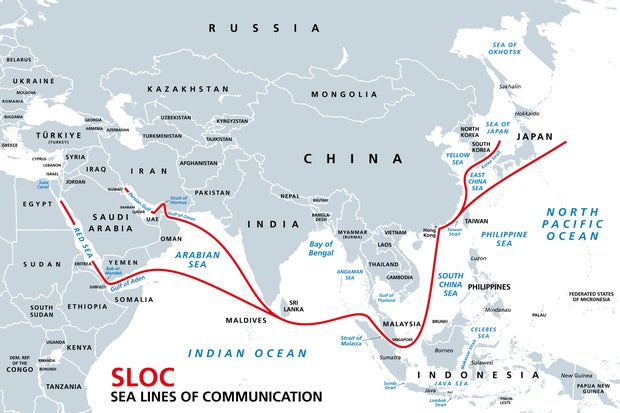
Some alternative routes will take the oil on longer, more expensive paths to market. Regardless, producers have realized that relying so heavily on the Strait of Hormuz "is no longer a prudent long-term strategy," said Victoria Grabenwöger, senior research analyst at data firm Kpler.
CBS/AP
Iran hit a dining facility on the air base in Jordan where 3 U.S. soldiers were killed, sources say
A dining facility at the Muwaffaq Salti Air Base in southern Jordan was among the targets hit during Iranian strikes last week that killed three American soldiers, according to a source familiar with the attack and an intelligence official.
The air base hosts American forces. It's not clear if the strike on the dining facility in particular killed U.S. forces, but the Pentagon has identified three American soldiers killed on July 17 and 18 at the base.
Netanyahu says Saudi Arabia joining Abraham Accords would be "historic leap forward for peace"
Israeli Prime Minister Benjamin Netanyahu said Thursday that Saudi Arabia joining the Abraham Accords to normalize relations with the Jewish state would be "an historic leap forward for peace."
The statement from Netanyahu's office came quickly after President Trump, in a Truth Social post, declared Saudi Arabia joining the accords a condition for a newly-announced nuclear business deal between the U.S. and the kingdom.
The U.S. Department of Energy announced Wednesday that the U.S. and Saudi Arabia had signed a commercial nuclear deal that could see the kingdom develop a civilian nuclear program in coordination with American companies.
President Trump said Thursday that the deal with Saudi Arabia was contingent on the kingdom joining the accords, a multilateral pact that has already normalized relations between Israel and several Muslim-majority nations in the region.
"The joint American and Israeli military action against the genocidal regime in Teheran and Israel's crushing of Iran's terror axis have created the possibility to expand the circle of peace," Netanyahu said in the statement from his office on Thursday.
Global oil prices hit $100 a barrel amid attacks in Red Sea
Global oil prices hit $100 a barrel on Thursday as the conflict in the Middle East escalated, with Iran-backed Houthi rebels in Yemen targeting shipping in the Red Sea.
Brent crude, the international standard, briefly topped $100 before retreating to $99.48 at 9:30 a.m. ET, data from FactSet showed. West Texas Intermediate, the U.S. benchmark, hit $90.74 a barrel, up $3.91, or 4.50%.
Gas prices are also climbing higher, with the national average hitting $4.09 a gallon on Thursday, up from $3.94 a week earlier, AAA data shows.
Houthi rebels claimed they struck two Saudi oil tankers in the Red Sea on Wednesday. The attacks threatened shipping in the Bab el-Mandeb Strait, which carries around 7% of the global oil supply, according to Oxford Economics. The strait, which connects the Red Sea with the Gulf of Aden, is a hub for sea trade.
U.S. military surging dozens more medics to Germany base where forces wounded in Iran war are treated
The U.S. military is surging medical personnel to Germany, according to a U.S. official and a source familiar with the force posture. The U.S. official confirmed Wall Street Journal reporting that more that 150 medics additional medics have been dispatched to the country.
U.S. service members wounded amid operations against Iran are being flown out of the Middle East to the Landstuhl Regional Medical Center, the largest American military hospital outside the U.S.
Preparations to receive additional patients are also underway at Walter Reed National Medical Military Center near Washington D.C., the source familiar with the measures told CBS News.
EU condemns attack on Saudi oil tanker by Yemen's Houthis as "unacceptable"
The European Union's top diplomat condemned a Houthi attack on an oil tanker in the Red Sea as "unacceptable" on Thursday, and called the Iranian proxy group's threat to impose a naval blockade on Saudi Arabia "a dangerous escalation."
"The attack on an oil tanker in the Red Sea is unacceptable, illegal, and further inflames an already volatile situation in the region," Kaja Kallas, the EU's High Representative for Foreign Affairs, said Thursday in a statement.
Yemen's Houthis said they struck two Saudi oil tankers in the Red Sea on Wednesday.
Saudi Arabia's state news agency reported a Saudi-flagged ship called The Encelia was "targeted while sailing in the Red Sea," causing "a fire on the vessel's bow." All crew members were reportedly safe.
U.K. Maritime Trade Operations (UKMTO), a British military agency, said Wednesday that a tanker was "struck by an unknown projectile which has caused a fire onboard," in an incident 70 nautical miles southwest of the Saudi coast.
These "recent threats … pose a direct threat to regional stability and constitute a dangerous escalation," said Kallas. "Navigation must be unimpeded, in the Strait of Hormuz as well as in the Red Sea."
Trump threatens "major military punishment" of Iran and Houthis for any new attacks on Saudi ships in Red Sea
President Trump threatened "major military punishment" on Thursday for Iran and its Houthi rebel allies if the Yemeni rebel group launches further attacks on Saudi vessels in the Red Sea.
"During our conflict with Iran, they [Houthis] have acted very responsibly. Unfortunately, now they are starting up again, shooting at two Saudi Arabian ships last night," Mr. Trump wrote on his Truth Social platform. "Please let this TRUTH serve to represent that if they do this again, the U.S. will hold Iran responsible, in that the Houthis are a Surrogate and/or Proxy of Iran, and major military punishment will be inflicted upon Iran and, of course, the Houthis."
Mr. Trump said he was "very disappointed" in the Houthis, a powerful Yemeni rebel movement that has controlled much of the impoverished country for over a decade, with support from Tehran.
The Houthis claimed Wednesday to have struck two Saudi tankers. So far, Saudi authorities have only confirmed that one, the Encelia, was struck.
Trump says Saudi nuclear deal is subject to the kingdom joining the Abraham Accords
President Trump said Thursday that a newly-signed nuclear deal with Saudi Arabia is dependent on the kingdom joining the Abraham Accords, a pact to normalize relations with Israel, and will not give the Saudis a domestic enrichment capacity.
The U.S. Department of Energy announced Wednesday that the U.S. and Saudi Arabia had signed a commercial nuclear deal that could see the kingdom develop a civilian nuclear program in coordination with American companies.
Mr. Trump said the deal with Saudi Arabia would not include domestic enrichment of uranium or other nuclear materials in the kingdom, which was left unclear by Wednesday's announcement.
That indicates that fissile material for energy production and other civilian purposes would have to be brought into Saudi Arabia from outside the kingdom.
"There will be no enrichment of material!," Mr. Trump wrote in a post on his Truth Social platform, adding that the deal "will be approved, but is totally subject to Saudi Arabia joining the very respected and successful Abraham Accords."
The accords, first signed in 2020, have so far normalized economic and diplomatic relations between Israel and the United Arab Emirates, Bahrain, Sudan and Morocco. Kazakhstan agreed to join in November.
Oil price nears $100 amid new attacks around Persian Gulf, and in Red Sea
Main oil contract Brent North Sea continued climbing toward $100 a barrel Thursday as Tehran-backed Houthi rebels targeted Red Sea shipping, raising fears that the Middle East war is widening.
Most Asian stock markets were buoyed by a much-needed bounce for regional tech firms as investor appetite for artificial intelligence (AI) see-saws. European markets were weaker, with London, Paris and Frankfurt all falling in midday trading.
The dollar firmed against its main rivals.
International oil benchmark Brent soared as much as 5% to above $98 a barrel after Houthi rebels claimed to have struck two Saudi oil tankers in the Red Sea.
Iran vowed to keep striking the region so long as it remains under attack by the U.S., which has launched 12 consecutive nights of strikes on targets across Iran.
"Investors are in a wary mood... as fresh jitters of worry about the ongoing energy crunch hit sentiment," said Susannah Streeter, chief investment strategist at Wealth Club. "With both the Strait of Hormuz and the Red Sea now under increasing pressure, markets are bracing for the possibility that the conflict could disrupt key energy routes, (and) keep oil prices elevated."
The prospect of higher oil prices also raises the prospect of higher inflation and interest-rate hikes, adding to weak sentiment, analysts said.
CBS/AFP
Iran fires four missiles and six drones at Jordan
Iran fired four miles at Jordan Thursday morning, three of which were intercepted, according to the Jordanian army, as Tehran continued targeting the close U.S. ally after a 12th night of American airstrikes on targets across Iran.
In a statement shared by Jordan's National Center for Security & Crises Management, a military source said that, over the past 24 hours, the Jordanian military had "dealt with four missiles and six Iranian drones that targeted the Kingdom's territory."
The country's air defenses shot down three missiles, "while the fourth missile fell in an area empty of residents," the bulletin read, causing no casualties or material losses.
The six drones were downed on Wednesday evening, the center said.
Air raid sirens sounded again in Bahrain, meanwhile, according to the small Persian Gulf nation's interior ministry.
U.S. adds military capacity in Middle East, but strikes on Iran remain limited for now
The U.S. has increased the number of refueling aircraft deployed to Israel after drawing that number down just weeks ago, and open-source flight tracking data show American B-1 bombers leaving U.K. bases - both indicators of a possible looming intensification of U.S. military action in the region.
B-1s have the largest weapons capacity of any U.S. military aircraft, with all models capable of carrying at least 70,000 pounds of bombs. They can deliver multiple "bunker buster"-type bombs, which could be needed if President Trump makes good on his threat to attack Iran's Pickaxe Mountain, a suspected nuclear site buried deep under rock.
The redeployment of the B-1s, which The Wall Street Journal reports is part of a wider U.S. troop surge to the region, would be the first known appearance of the aircraft since fighting resumed on July 8.
U.S. Central Command declined to comment on troop levels, citing operational security, but officials told CBS News there has been no significant reduction at any time since the war began on Feb. 28, meaning roughly 50,000 U.S. forces remain in the region.
While the U.S. carried out a 12th consecutive night of airstrikes on Iran Wednesday, so far the attacks have remained relatively limited, targeting weapons and military infrastructure. There has been no indication yet, in other words, of the kind of wider retaliation President Trump has vowed for Iran's killing of U.S. soldiers in Jordan, or a return to full combat operations.
Trump's policy on Iran is "a head for an eye," says Rubio
President Trump's policy on Iran is "a head for an eye," Secretary of State Marco Rubio said Thursday, adding that Yemen's Houthi rebels had been "suckered" into attacking Red Sea shipping by Iran.
"The president's policy is 'a head for an eye.' I mean, honestly, that's what it's going to be," Rubio said on the sidelines of a Southeast Asian summit in Manila, the capital of The Philippines.
Iran's foreign minister recently described his country's "defense doctrine" as "an eye for an eye."
Referring to Houthi claims to have hit two Saudi oil tankers in the Red Sea on Wednesday, Rubio said: "The Houthis largely were smart and stayed out of all this throughout the conflict … but they now apparently have gotten themselves suckered into this, going after Saudi Arabia and their ships."
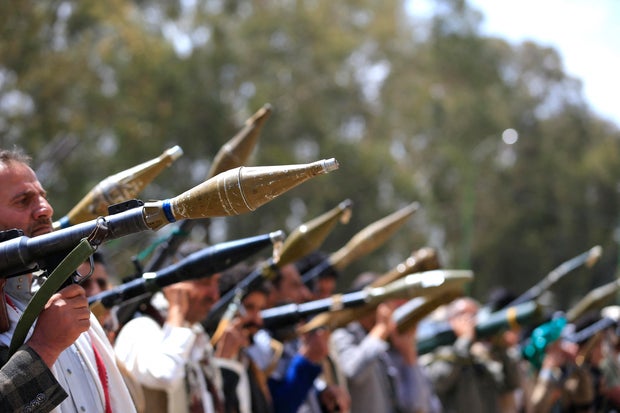
"I hope they will de-escalate, because I think the Houthis, frankly, got snookered into this thing by the Iranians," he told reporters.
"Iran is begging us, both directly and indirectly, let's do a deal, let's talk," Rubio added. "Iran is begging every day."
"The problem with Iran is every time they make a deal, the people who are in charge there, they either break it, or they want to change it. So it looks like they're not ready to make a deal, so they're going to continue to pay a price."
"Every night the price gets higher and higher and higher," he said "Right now, apparently, they haven't come to their senses, and so the president doesn't see a lot of utility in responding to their overtures at this point."
"Iran is clearly not ready to make a deal – at least, not one they're willing to live by," Rubio added.
CBS/AFP
Iran says it targeted 3 U.S. bases in Kuwait with drones
Iran's army says it "launched heavy strikes" with drones at three U.S. bases in Kuwait on Thursday.
Tehran said it aimed for ammunition depots and logistics storage facilities at Camp Doha, fuel storage tanks at Ali Al Salem Air Base and an ammunition depot at Camp Arifjan.
There was no confirmation any of the claims or word on any casualties or damage at the bases from the U.S. military.
Earlier, Kuwait's army said it was working to intercept Iranian drones.
Meanwhile, Iran's Revolutionary Guard Corps said it had a message for the people of Kuwait. "It is the United States that has violated your territorial integrity and sovereignty, not us," the corps said. "We are striking territory occupied by the U.S. military, an army that knows nothing but committing crimes."
Saudis confirm vessel hit in Red Sea
A vessel belonging to a Saudi company was hit while transiting the Red Sea, Saudi state media reported Thursday citing an official source, after Yemen's Houthi rebels claimed it struck tankers in the waterway.
The source, quoted by state-run Saudi Press Agency, said "the vessel ENCELIA, belonging to a Saudi company, was targeted while sailing in the Red Sea, resulting in a fire at the bow of the ship," but it said all crew members were safe.
The Houthis had threatened to blockade Saudi ports on the Red Sea -- a key route for oil shipments -- while the five-month war had already led to the effective closure of the vital Strait of Hormuz.
CBS/AFP
U.S. wraps up 12th straight night of strikes against Iran
U.S. forces completed a 12th straight night of strikes against Iran at around 10:30 p.m. ET, U.S. Central Command said.
The targets included "maritime capabilities, missile and drone storage facilities, coastal surveillance sites, and air defense assets," CENTCOM said. "The strikes further degrade Iran's ability to attack civilian mariners and commercial vessels."
CENTCOM said that, since resuming its blockade of Iranian ports, it has redirected nine commercial vessels and disabled another.
Iran's Revolutionary Guard says it stopped 3 oil tankers in Strait of Hormuz
Iran's Revolutionary Guard said Thursday morning local time that it stopped three oil tankers from passing through the Strait of Hormuz.
In recent weeks, Iran has hit tankers using a route hugging the Omani coast to traverse the strait, in a bid to strongarm vessels into using its own waters and pay for safe passage.
"Three oil tankers, provoked and tempted by the child-killing American army, were trying to pass through the mine-laid route south of the Strait of Hormuz, but after one of them exploded and caught fire, the other two quickly turned around and turned back," the Guard said in a statement quoted by Iranian state media.
The statement did not say when the incident happened.
"The powerful IRGC Navy emphasizes that the Strait of Hormuz is under our control... and any ship that is deceived by the US and intends to pass without coordination with the Islamic Republic of Iran will suffer the same fate," the Guard added.
CBS/AFP
Kuwait says it's intercepting Iranian drones
The Kuwaiti army says it is working to intercept Iranian drones. The U.S.-allied Gulf state has come under frequent Iranian attack, particularly after rounds of U.S. strikes on Iran.
U.S. launches 12th straight night of strikes against Iran
The U.S. military's Central Command said it has begun a 12th consecutive night of strikes on Iran, intended to "further degrade Iran's ability to threaten civilian mariners and commercial vessels transiting regional waters."
Houthis claim responsibility for strikes on tanker in Red Sea, marking another threat to global shipping
Yemen's Iran-aligned Houthi rebels claimed to attack two commercial oil tankers in the Red Sea on Wednesday, a move that could further snarl shipping.
The U.K. Maritime Trade Operations Centre said Wednesday it received reports of a tanker being hit by an "unknown projectile" off the coast of Saudi Arabia in the Red Sea, causing an onboard fire. No casualties were reported.
At around the same time, a spokesperson for the Houthis said on social media that the group carried out an operation to attack two Saudi oil tankers. Days earlier, the Houthis threatened a maritime embargo against Saudi Arabia, which has fought the Yemeni group for years.
The apparent strike could pose further problems for a shipping industry that is already struggling with Iranian threats to attack unapproved ships in the Strait of Hormuz, a crucial waterway that connects the Persian Gulf to the world's oceans.
Yemen is adjacent to another vital strait on the other side of the Arabian Peninsula, the Bab al-Mandab. That strait connects the Indian Ocean to the Red Sea, serving as a route to the Suez Canal and onward to the Mediterranean. Asia-bound oil tankers also sail through the Bab al-Mandab after departing a Saudi oil export terminal on the Red Sea that has been used as an alternative to Persian Gulf ports during the Strait of Hormuz's near-closure.
In recent days, at least four ships that were headed toward the Bab al-Mandab have appeared to take U-turns and avoid the waterway, analytics firm Kpler said earlier Wednesday.
The Houthis have a history of attacking ships in the Red Sea, including in 2023 and 2024.
Trump administration signs civil nuclear cooperation deal with Saudi Arabia
The U.S. and Saudi governments have signed a commercial nuclear deal that could allow Saudi Arabia to have a civilian nuclear program on its soil in cooperation with American companies, the U.S. Department of Energy announced Wednesday.
Energy Secretary Chris Wright and Saudi Minister of Energy Prince Abdulaziz bin Salman signed what the Trump administration calls a peaceful nuclear cooperation agreement, along with a safeguard agreement. The deal could set the stage for a nuclear program for energy and other civilian purposes, but not for military purposes.
CBS News had previously reported the expected signing of the deal, which would create the potential for uranium enrichment on Saudi soil, though that would be controlled by a contracted corporation and only after a lengthy study is completed.
The landmark deal signifies the strengthening alliance and trust between the U.S. and the Saudis. But it is likely to irritate Iran, Saudi Arabia's chief rival, which has long insisted on its right as a signatory of the Treaty on the Non-Proliferation of Nuclear Weapons to maintain a civilian nuclear program.
Trump says U.S. doesn't need Strait of Hormuz
Speaking to supporters in Marietta, Georgia, President Trump said the U.S. doesn't need the Strait of Hormuz because the U.S. already has so much oil.
"We don't need straits. We don't need anything," Mr. Trump told the crowd. "We don't need the Hormuz Strait but we do it because we have to do it, because we cannot let Iran have a nuclear weapon."
The U.S. is the world's top oil producer, but instability in the Gulf region has still affected oil prices, and many other countries are supplied by oil from Iran or Arab states that rely heavily on the Strait of Hormuz.
Family of fallen soldier receives standing ovation in Georgia
The family of Army Lt. Tyler Feehan traveled with President Trump on Air Force One from Dover Air Force Base to the president's speech on Trump Accounts in Marietta, Georgia. Feehan was among the soldiers killed in action during attacks in Jordan.
During his remarks in Georgia, Mr. Trump said Feehan's family, whom he spoke with during a dignified transfer in Dover and on the plane, is "heartbroken."
"When I go to Dover, I read charts on all of the young people. And some are unbelievable. Some are a little bit you know, they've got a … couple of little bad things put in," Mr. Trump said, before describing Feehan as a "flawless, perfect person."
"Beautiful, beautiful son. Handsome in every way. Brilliant. Respected by everybody," he continued. "This sheet read so beautifully and I told them that. Their beloved son. His name was Lt. Tyler Feehan. And he was a person that was going all the way. He was going to be a general. He would have been a general very quickly. He was headed on that path."
The president thanked Feehan's father, mother and uncle. He said dignified transfers are "very tough" to watch, but praised Feehan's family.
Feehan's family received a standing ovation from the crowd.
Trump says Iran is "not ready" for a deal
Speaking to supporters in Georgia, President Trump said Iran is "not ready" to make a deal, but will be "very soon." The president called the war a "skirmish."
"They want to make a deal," he said of Iran. "But I say they're not ready to make a deal. Because every time they make a deal they want to change it and everything. They're not ready. They'll be ready very soon."
482 U.S. service members wounded in Iran war, 18 killed, new figures show
The Defense Department has released updated casualty figures for the U.S.-Iran war, indicating that 18 American service members have died and at least 482 have been wounded in action.
The new figures appeared Wednesday on the Pentagon's Defense Casualty Analysis System website. Earlier this week, the site showed as many as 427 casualties and 14 deaths.
Four Americans have been killed in recent days, including three in an Iranian strike on a Jordanian air base and one who died during a controlled demolition of an Iranian drone in Iraq, the military has said. Nearly 100 U.S. service members have been injured this month, CBS News has reported, most of whom have returned to duty.
Ancient Lebanese city of Tyre added to heritage danger list
Tyre, an ancient Phoenician city in southern Lebanon hit in recent months by Israeli bombardment, was added on Wednesday to the UNESCO list of world heritage sites in danger.
"The site has been directly hit and has sustained damage. Furthermore, its state of conservation is a cause for growing concern, particularly given the possibility of further impacts," the organisation said.
"Optimal conditions are no longer in place to ensure the conservation and protection of the property's outstanding universal value," said the UN body, adding that it was the Lebanese government that requested its inclusion on the list.
The ruins in Tyre, around 50 miles south of Beirut but only about 12 miles from the Israeli border, were placed on the UNESCO heritage list in 1984 and contain mainly Roman-era archaeological remains.
The coastal city was caught up in recent months in the conflict between Israel and Hezbollah, and tens of thousands of its residents fled after the Israeli army issued evacuation orders covering districts including some archaeological areas, though most locals have since returned.
Iran's Parliament leader, foreign minister angrily respond to Trump's threats
The leader of the Iranian Parliament warned "no infrastructure will be safe" in the Middle East if President Trump carries out his threat to bomb a bridge or power plant for each vessel Iran targets in the Strait of Hormuz.
"In the region where we do not sell oil, no one else will sell oil either," Mohammad Bagher Ghalibaf, speaker of Iran's Parliament, said on X. "If our security is not guaranteed, no infrastructure will be safe."
Traffic through the strait has ostensibly been halted by Iran targeting vessels traveling through the waterway.
"The security of the Strait depends on the absence of American forces," Ghalibaf said. "We have repeatedly stated that the situation regarding the Strait will not return to the pre-war status quo."
"The equation for this war is clear: it is all or nothing," he said.
Iranian Foreign Minister Abbas Araghchi offered similar words, saying, "Our defense doctrine is clear: eye for an eye."
"Any aggression against Iran, including our infrastructure, will compel a powerful and decisive response," Araghchi, a key member of the ceasefire negotiating team, wrote on X. "Those who contribute to such aggression, whatever the kind of support, will also be considered as legitimate targets."
U.S. has intercepted 9 vessels since blockade restarted, military says
The U.S. has intercepted nine commercial vessels either trying to enter or leave Iranian ports since the blockade was restarted on July 14, according to U.S. Central Command.
In the last 24 hours, the blockade redirected one commercial vessel, per the military.
President Trump touted the blockade's effectiveness before a meeting with Lebanese President Joseph Aoun on Tuesday.
"The blockade is up, and fully," he said. "I mean, nobody gets through. Nobody gets through the blockade. It's like a steel wall."
Iraq lost over $40 billion in revenue during war: Gov't official
Iraq has lost more than $40 billion in revenue since the start of the Middle East war, mostly due to a sharp decline in its oil exports, a government official said on Wednesday.
The conflict and Iran's blockade of the Strait of Hormuz choked off shipments and prompted production cuts in key oil-producing countries including Iraq, shaking world energy markets.
Before the war, which began with U.S.-Israeli strikes on Iran in late February, Iraq produced around 4 million barrels per day, and exported an average of 3.5 million barrels per day, mostly via the Strait of Hormuz.
But the OPEC founding member was forced to halt production in most of its oil fields as reservoirs filled up, limiting its exports to routes via neighboring Turkey and Syria.
Iraqi Oil Minister Bassem Mohammed Khudair said during a TV interview on Tuesday that his ministry "used to put between $7 to $8 billion a month" into the state's coffers.
"Today, we do not exceed $1.5 billion," he added.
GOP Sen. Rand Paul criticizes war: "The Iran war has not been a success"
Republican Sen. Rand Paul offered an unqualified criticism of the war with Iran on Tuesday.
"The Iran war has not been a success," Paul told reporters on Capitol Hill. "I've been opposed to the Iran war from the beginning. I think by any objective measure, we're worse off than we were before the war."
When asked what can be done about the war, Paul pointed to the War Powers Act, which he has long supported, saying, "the Constitution is pretty clear that we should always ask for the people's approval through the Congress."
But Paul said the practical aspect of asking if we are better off is more clear-cut.
"If you look at the militarization of the Strait of Hormuz, that's never happened before," Paul said. "There's not an easy way to unmilitarize the strait, and so far continues to be militarized."
"So, from that point of view, I think we're in worse shape," Paul continued. "You could argue we have some leverage because we've defeated them militarily to maybe get a better negotiated settlement, but so far we haven't seen the advantage play out in negotiations."
"Nothing is going through" the Strait of Hormuz, despite U.S. insisting it's open, shipping insider says
The U.S. military's Central Command repeated an assertion on Tuesday evening that has been made by the Trump administration many times over the last two weeks, insisting that "despite Iranian aggression, the Strait of Hormuz remains open for commercial vessel traffic."
CENTCOM acknowledged in the same statement that Iran had launched more than 30 attacks on commercial vessels since the war began, which it said had "endangered hundreds of innocent mariners and undermined freedom of navigation."
Despite the U.S. president and military continuing to urge vessels to use a southern route through the strait, in defiance of Iran's threats, few shippers seem willing to risk it.
The Joint Maritime Information Center in Bahrain, a military partnership that includes the U.S., said commercial traffic in the Strait of Hormuz fell to a three-week low on Tuesday amid ongoing Iranian attacks.
"Owners and operators — and crews, predominately — are really not feeling the safety they would need in order to have their vessels transit, and now we're seeing the same thing in the Bab el-Mandeb, which is absolutely horrendous," Maniatis told CBS News.
U.S. strikes have killed 53 people and injured 592 in a month, Iran says
U.S. strikes on Iran have killed 53 people and injured 592 over the past month, according to the Iranian Ministry of Health.
The death toll, which was counted from June 27 to July 22, includes six women and three children, according to Hossein Kermanpour, the head of public relations for the ministry.
"Among the injured are 39 women and 23 individuals under the age of 18," Kermanpour said in a post on X.
Italy to host another round of talks between Israel and Lebanon
Italy is to hold a further round of talks between Israel and Lebanon on Aug. 4, the Italian foreign minister said Wednesday. It will be the seventh round of direct talks between the two countries, which do not have formal diplomatic relations.
Italian Foreign Minister Antonio Tajani said the next round would be "an important result led by a patient action of foreign policy that builds bridges and never walls."
Israel and Lebanon began U.S.-brokered negotiations in April to reach a peace deal and end the war between Israel and the Iranian-backed Hezbollah group.
Hezbollah, which was not directly involved, has described the Lebanese government's involvement in the talks as "appeasement." Hezbollah has rejected the conditions of previous agreements.
After the previous round of negotiations in Rome last week, the Israeli army started withdrawing forces from "pilot zones" in southern Lebanon, to allow Lebanon's army to assume control.
Iranian official calls Trump's assertion that Tehran requested negotiations "completely unfounded"
President Trump's assertion that Iran has asked for a meeting to resume negotiations is "completely unfounded," an Iranian official said Wednesday.
"The claim by Trump that Iran has requested negotiations is completely unfounded," Hasan Ghashghavi, spokesperson for the Iranian parliament's National Security Commission, said in a post on X.
"It appears that, to escape the quagmire in which he is trapped, Trump should be looking for better options," Ghashghavi said. "His repeated falsehoods no longer even provide short-term reassurance to the markets."
Mr. Trump said Tuesday that Iran wanted to "desperately meet," but added: "Until they're ready to meet in a meaningful way, we have no interest."
Oil prices jumped more than 4% early Wednesday amid the escalating conflict between the two country's, with the price of a barrel of Brent Crude touching $95 - a $20 increase since attacks resumed on July 7.
Trump attends dignified transfer for fallen soldiers at Dover Air Force Base
President Trump is attending the dignified transfer for U.S. Army soldiers killed during the ongoing war with Iran.
U.S. Army Lt. Tyler James Feehan, 25, of Ewa Beach, Hawaii was killed in action on July 18, and Pvt. Isabella Gonzales, 19, of Carrollton, Texas, was killed in action on July 17 during an attack on the Muwaffaq Salti Air Base in southern Jordan, according to the Pentagon.
Sgt. Angel S. Rampersad, 28, of Ozone Park, New York, is also believed to have been killed in the same attack. She had previously been listed as missing in action.
The incident is under investigation, and President Trump told reporters Wednesday that the administration would share the results of the probe.
The third soldier whose remains are being transferred Wednesday is 30-year-old U.S. Army Sgt. Michael Emmanuel Swinton of North Carolina, who was killed at Erbil Air Base in northern Iraq during a controlled detonation of an Iranian drone. Swinton was a father of two.
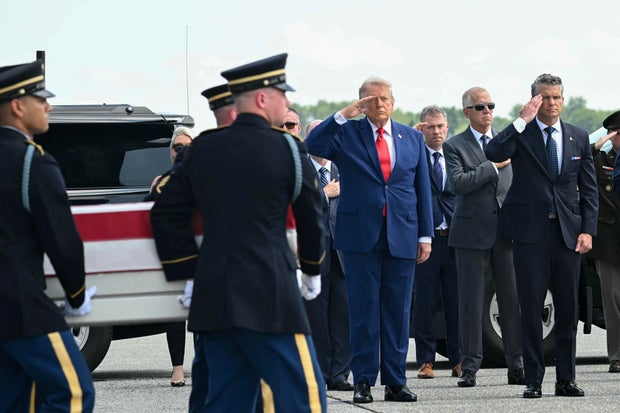
A dignified transfer is a non-ceremonial movement of a fallen U.S. service member killed in a theater abroad back to the United States. The fallen are moved in flag-draped cases and carried by members of the military.
"We're going to Dover," the president told reporters ahead of the trip. "Some of you are going with us, to honor our heroes, and they are indeed great heroes, actually. They said, and they — all of them said very strongly — we can't let, we cannot let Iran have a nuclear weapon. They won't have a nuclear weapon. So we're going to honor them. And it's one of the hardest things to do. For me, it's one of the hardest things to do as a president. But, has to be done."
EU aviation agency adds Jordan to list of Mideast airspace to avoid as Iran targets the kingdom
The European Union's Aviation Safety Agency on Wednesday warned airlines against flying in Jordanian airspace, after repeated Iranian attacks on the kingdom in recent weeks.
"Since the middle of July 2026, the security situation has deteriorated rapidly, with a sustained increase in kinetic military activity affecting Jordanian airspace," EASA said in a statement.
The agency had already urged airlines to avoid the airspace over Bahrain, Kuwait, Qatar, the United Arab Emirates, Iran, Iraq and Lebanon amid the U.S. war with Iran.
Iran matches Trump's threat, says it will hit "infrastructure and bridges across the region" if U.S. attacks Iran's
Iran replied quickly Wednesday to President Trump's latest threat, matching his social media rhetoric with the regime's own dire warning.
The semi-official Tasnim news agency cited an Iranian military source as saying that if the U.S. targets Iranian bridges or power plants, Iran will respond by "striking infrastructure and bridges across the region, including energy facilities in which the United States has interests."
The report by Tasnim, which is closely linked with Iran's powerful Islamic Revolutionary Guard Corps, came soon after Mr. Trump said in a post on Truth Social that any new attack by Iran on a ship in the Strait of Hormuz would see the U.S. "bomb and destroy ONE BRIDGE OR POWER PLANT, including those located next to, or in, the Capital City of Tehran."
Tasnim cited the unnamed military official as reiterating Tehran's stance that the passage of ships through the strait "would be safe if coordinated with Iran and conducted within the framework of Iran's regulations. Otherwise, Iran will not abandon its firm resolve to control the strait, viewing such control as essential to its long-term security."
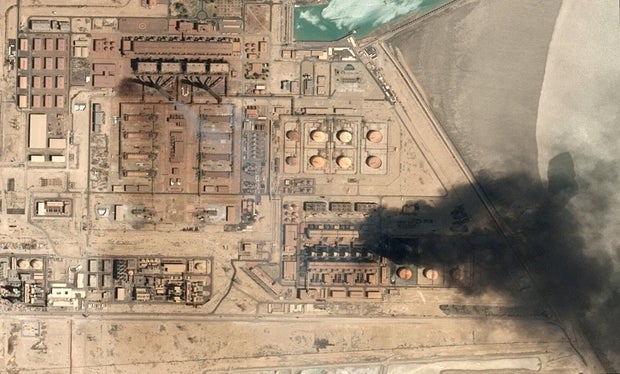
Iran's Revolutionary Guard claims "invading forces" killed in multiple strikes on Jordan
Iran's Revolutionary Guard said Wednesday that it had struck U.S. bases in Jordan and that a number of "invading forces" were killed or wounded.
Iran, which is known to exaggerate its military gains, said missile and drone strikes on the King Faisal and Prince Hassan bases in Jordan hit an F-15 fighter jet "preparation hanger" and destroyed eight MQ-9 drones.
"In a subsequent strike on a helicopter maintenance hangar, two U.S. heavy helicopters sustained major damage," the IRGC claimed, adding that "a strike on a housing facility for the invading forces resulted in a number of them being killed and wounded."
An Iranian attack Friday on another base, the Muwaffaq Salti Air Base in southern Jordan, killed three U.S. soldiers.
Neither the U.S. nor Jordan immediately commented on the new claims. Jordan's army said earlier that it had intercepted four Iranian missiles Wednesday, while two others landed in uninhabited areas.
A spokesperson for Eilat, an Israeli Red Sea coastal city near the Jordanian border, said Wednesday that explosions heard coming from the nearby Jordanian city of Aqaba were "missiles fired from Iran."
U.S. to sign deal today enabling Saudis to enrich uranium
Washington — The U.S. and Saudi Arabia have reached a commercial agreement for U.S. companies to run nuclear power for the Saudis on Saudi soil, a regional official familiar with the agreement told CBS News.
The agreement is expected to be signed Wednesday at about 1:30 p.m. The commercial deal would have U.S. companies running, not giving, the Saudi government nuclear power on Saudi soil for the nation's use, for purposes like supporting AI data centers.
The deal may allow the Saudis to enrich their own fuel for nuclear reactors.
The corporations involved have not yet been disclosed. Although it's a private-sector deal, Congress would need to be consulted. The Wall Street Journal was first to report the nuclear deal.
Trump threatens to bomb bridges or power plants if Iran keeps attacking ships in Strait of Hormuz
President Trump said Wednesday that the U.S. would "bomb and destroy" one bridge or power plant in Iran for every new Iranian attack on a ship in the Strait of Hormuz.
"From this point forward, any time the Islamic Republic of Iran shoots at a ship in the Strait of Hormuz, whether it be by Missile, Rocket, Drone, or any other device or weapon, the United States will bomb and destroy ONE BRIDGE OR POWER PLANT, including those located next to, or in, the Capital City of Tehran," Mr. Trump said in a post on Truth Social.
Iran has continued to attack vessels in the Strait of Hormuz, even as the U.S. military insists the crucial waterway is open. U.S. Central Command said Tuesday that Iran had attacked more than 30 commercial ships transiting the strait over the past three months.
Iran media report U.S. strike on Larak island in Strait of Hormuz
A U.S. missile strike hit the Iranian island of Larak in the Strait of Hormuz on Wednesday, according to Iran's semi-official Tasnim news agency, which is close to the Islamic Revolutionary Guard Corps (IRGC).
"At 2:48 pm, the island of Larak was targeted by an American missile," Tasnim reported, saying residents heard a loud explosion there.
"The competent authorities are currently carrying out an investigation to determine the scale of the attack, the exact point of impact and the extent of the potential damage," it added.
The IRGC said in their statement Wednesday that on Tuesday night, "despite attempts by the crews of those vessels, no ship dared attempt passage through the unlawful southern route of the Strait [of Hormuz]," referring to a path through the waterway the U.S. has encouraged vessels to use to avoid Iranian tolls.
CBS/AFP
Pakistan "deeply concerned" over bid to drag Saudis into Middle East conflict
Pakistan's government on Wednesday said it was "deeply concerned" by Iran's attempts to pull Saudi Arabia into the Middle East war, and it condemned threats by Yemen's Houthi rebels against the kingdom and Red Sea shipping.
Pakistan, which cemented its security ties with Riyadh with a mutual defense pact signed only last year, said it was "deeply concerned over attempts to drag the Kingdom of Saudi Arabia into the conflict in the Middle East and reiterates its unwavering support for the security, sovereignty, territorial integrity and prosperity of the brotherly Kingdom," in a statement from the foreign ministry posted on X.
The statement added that "any hostile act against Pakistani-flagged vessels or Pakistani maritime interests will be regarded as a grave threat to Pakistan's national security and sovereign interests."
CBS/AFP
Shipping industry insider tells CBS News "nothing is going through" the Strait of Hormuz
The Joint Maritime Information Center in Bahrain, a military partnership that the U.S. is part of, said commercial traffic in the Strait of Hormuz fell to a three-week low Tuesday amid ongoing Iranian attacks on vessels. CBS News tracked just three commercial ships – two cargo vessels and the Chinese-owned tanker Hsin Ocean – transiting the strait on Tuesday.
Between July 13 and 19, only two ships transited the strait using the U.S.-backed "southern route" that hugs the coast of Oman. Both transits were dark, meaning the vessels had turned off their AIS broadcast systems, according to a Lloyd's List analysis.
Last week, Dimitris Maniatis, CEO of the Greek maritime risk management company Marisks said ship crews were unwilling to make the trip through the strait since the breakdown in the U.S.-Iran memorandum of understanding.
"There's nothing physically obstructing the navigation of any vessel willing to transit the strait, and there are vessels that trade locally and are entirely unaffected by everything that's going on; however, if we're talking about large ocean-going, internationally-owned and operated merchant vessels, nothing is going through," Maniatis told CBS News on Wednesday.
The U.S. military's Central Command repeated an assertion made by the Trump administration many times over the last two weeks on Tuesday evening, insisting that "despite Iranian aggression, the Strait of Hormuz remains open for commercial vessel traffic."
CENTCOM made the declaration while acknowledging more than 30 Iranian attacks on commercial vessels "that have endangered hundreds of innocent mariners and undermined freedom of navigation."
Jordan says 4 Iranian missiles shot down, 2 more hit uninhabited areas
Jordan shot down four Iranian missiles Wednesday, and two others hit uninhabited areas, according to a statement from the country's armed forces.
A Jordanian army source said that the Kingdom "detected … and engaged" the six missiles coming from Iran "as soon as they entered Jordanian airspace," in a statement carried by the country's National Center for Security & Crises Management.
The two missiles that weren't intercepted "fell in two uninhabited areas free of population, without any injuries or material damage occurring," the bulletin read.
Iran's semi-official Fars News agency said the Iranian military had targeted a storage depot at the Al-Azraq Air Base in Jordan with drones early Wednesday morning local time.
Until recently, Jordan had largely avoided Iranian attacks, despite hosting U.S. troops. But Iran has ramped up its bombardment of the kingdom in recent days, killing three U.S. soldiers at an air base over the weekend.
Trump to attend dignified transfer for deceased U.S. service members Wednesday
President Trump is set to attend a dignified transfer Wednesday for some of the U.S. service members who were killed in Iranian strikes in recent days.
The transfer is scheduled for 11 a.m. at Dover Air Force Base in Delaware, according to the president's schedule.
It's not clear which service members will be part of Wednesday's dignified transfer. Three American soldiers were killed in an Iranian attack on their base in Jordan over the weekend, including one who was previously believed to be missing. One American soldier was killed during the controlled detonation of an Iranian drone in Iraq.
Oil prices jump around 4%, marking a $20-per-barrel rise since fighting resumed on July 7
Oil prices jumped around 4% Wednesday, with international benchmark Brent Crude trading briefly over $95 a barrel – a $20 rise since the U.S. and Iran resumed fighting on July 7.
Shippers remain reluctant to transit the Strait of Hormuz, despite U.S. Central Command insisting again Tuesday night that it "remains open."
Iran has continued to attack vessels in the waterway, as well as U.S. allies across the Persian Gulf and elsewhere in the Middle East.
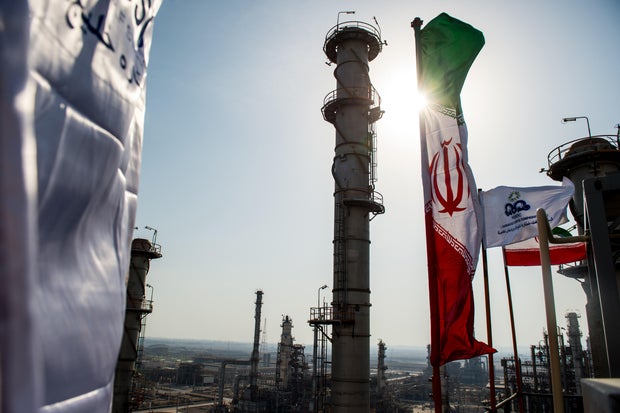
President Trump said Tuesday that the U.S. was "not finished" attacking Iran. The 11th straight night of strikes saw the U.S. target "military logistics infrastructure," according to the Pentagon, while Iranian state media reported strikes around the country.
Mr. Trump also said he would "take care of" Yemen's Iranian-backed Houthi rebels if they carry out threats to block access to Saudi Arabia's Red Sea ports via the Bab el-Mandeb strait, something which – if fully realized – could deal the global economy another blow.
"Our view is that we'll be ... in this $80-to-$90 range, depending on the news flow," Jay Hatfield at Infrastructure Capital Management told Bloomberg about oil prices. "If we actually have a closed Red Sea, that's a threat. We haven't seen that yet. That could shoot us over $100."
The Houthis have previously tried to cut off shipping through the Red Sea, leveraging the Bab al-Mandeb as a chokepoint. The strait, at the southern end of the Red Sea, is the only route in or out of the body of water apart from the Suez Canal in the north, which offers a much longer, and thus costlier route to the energy markets of Asia via the Mediterranean.
CBS/AP
Strait of Hormuz "belongs to us," says Iranian official
The Strait of Hormuz "belongs to us," an Iranian official said Wednesday, adding that those who fail to understand Iran's hold on the waterway would "end up at the bottom."
"We will not seek an alternative route to the Strait of Hormuz because this strait is the heart of Iran," Ali Zeynivand, a spokesperson for Iran's Ministry of Interior, said Wednesday in remarks carried by the official state news agency IRNA.
"The Strait of Hormuz belongs to us," he said, and anyone who fails "to properly study Iran's continuous civilization … will disappear, and only their remains may end up at the bottom of the Strait of Hormuz."
Lebanon prime minister says Beirut seeking "complete Israeli withdrawal"
Beirut is working toward a "complete Israeli withdrawal" from areas it occupies, Lebanese Prime Minister Nawaf Salam said on Wednesday during a visit to a village where Lebanon's army recently deployed.
"We will continue mobilizing our political and diplomatic efforts to secure a complete Israeli withdrawal from the south," he said in Zawtar al-Gharbiya, one of several "pilot zones" intended to demonstrate that the Lebanese army can remove and disarm Iran-backed Hezbollah as part of a Washington-sponsored deal with Israel.
Lebanon and Israel have been engaging in direct talks sponsored by the U.S.
CBS/AFP
CENTCOM wraps up another night of Iran strikes, insists Strait of Hormuz "remains open"
The U.S. military's Central Command said it completed an 11th consecutive night of strikes on Iran at about 8:15 p.m. ET on Tuesday, insisting that the Strait of Hormuz "remains open."
The latest round of strikes on Iranian assets lasted just over an hour. CENTCOM said in a social media post that it hit aircraft hangars, drone storage and operations centers "to further degrade Iran's ability to threaten commercial shipping in the Strait of Hormuz."
"Over the past three months, Iran has attacked more than 30 commercial vessels transiting the international waterway vital for regional and global trade," CENTCOM said. "The unwarranted attacks have endangered hundreds of innocent mariners and undermined freedom of navigation."
Despite those attacks, which continued Tuesday, however, CENTCOM concluded: "The Strait of Hormuz remains open for commercial vessel transit."
Pentagon names 3rd soldier believed to have been killed in Jordan
The Pentagon on Tuesday identified a third soldier who is believed to have been killed by Iranian strikes on a Jordanian air base.
Army Sgt. Angel S. Rampersad, 28, of Ozone Park, New York, had previously been listed as missing in action.
Rampersad was assigned to the 1st Battalion, 57th Air Defense Artillery Regiment, 52nd Air Defense Artillery Brigade, 10th Army Air Missile Defense Command, in Ansbach, Germany, the Pentagon said.
Pvt. Isabella Gonzales, 19, of Carrollton, Texas, and 1st Lt. Tyler James Feehan, 25, of Ewa Beach, Hawaii, were also killed in the attack on the Muwaffaq Salti Air Base over the weekend.

Eighteen American service members are believed to have been killed since the start of the Iran war, including four U.S. soldiers in recent days — three in an Iranian attack on Jordan and one during a controlled demolition of an Iranian drone in Iraq.
Iran war could cost far more than Hegseth's $37.5 billion estimate, sources say
Two Democratic sources and a third source familiar with the matter told CBS News the actual cost of the Iran war is much higher than the $37.5 billion estimate offered Tuesday by Defense Secretary Pete Hegseth.
This is in part because the current estimate does not include costs like military construction for U.S. bases that have been damaged.
Hegseth said the war has cost around $37.5 billion during questioning by Democratic Sen. Dick Durbin of Illinois in a Senate Appropriations Committee hearing. He said it reflects the expected cost of certain expenses that will be incurred through the end of the fiscal year, like troop pay.