Trump formally signs U.S.-Iran deal as questions linger about nuclear program, missiles
Follow updates on the war in the Middle East for Thursday, June 18, here. See earlier developments below.What to know about the Iran war:
What to know about the Iran war:
- The Trump administration released the 14-point memorandum of understanding on Wednesday. President Trump emphasized the U.S.-Iran agreement is not a final deal, and he warned the U.S. could resume bombing Iran "if they don't behave." A White House official later confirmed to CBS News that the U.S. and Iran had signed the memorandum remotely, and that it was now "in effect."
- Israel has continued carrying out limited strikes in Lebanon since Mr. Trump announced the agreement with Iran. Tehran has said that if Israel keeps troops in Lebanon and continues attacks in the country, it would be considered a violation of the agreement with Washington.
- Iranian tankers are crossing the U.S. naval blockade line, adding to confusion for shippers after Mr. Trump said the blockade would only lift after the memorandum of understanding with Tehran is signed on Friday. Shipping firms say clarity and security guarantees are needed before normal operations can resume.
Israel's military says 1 soldier killed in Lebanon, 7 wounded
The Israeli military announced on Thursday that one of its soldiers had been killed in fighting in southern Lebanon the day before in an incident that also wounded seven soldiers.
Master Sgt. Alexander Filin, 29, "fell in combat," the military said in a brief statement, adding that an officer, a reserve officer and a reserve soldier were moderately wounded.
A combat non-commissioned officer, two reserve soldiers and a female reserve soldier were lightly wounded, the military added.
The United States and Iran signed a memorandum of understanding on Wednesday meant to end the Middle East war, with fighting halted on all fronts, including in Lebanon.
Lebanon was drawn into the conflict when Tehran-backed Hezbollah fired rockets at Israel on March 2 in support of Iran.
Lebanon said earlier that Israel's massive campaign of airstrikes and ground invasion has so far killed more than 3,800 people.
Israel's side saw 31 soldiers and one civilian contractor killed since March 2.
Asian markets surge after U.S.-Iran deal as oil prices dip
Shares surged Thursday local time in Asia, with benchmarks in Japan and South Korea setting fresh records, after the U.S. and Iran signed their initial agreement ending the war.
The rally in Asia followed a retreat Wednesday on Wall Street driven by speculation the Federal Reserve may raise interest rates this year to curb inflation.
U.S. futures were higher early Thursday, while oil prices fell.
The news came after U.S. markets closed. In Tokyo, the Nikkei 225 kept on surging, gaining 1.9% to 71,233.35. It topped 70,000 for the first time this week and is still gaining thanks to hopes for an end to the war and buying of high-tech shares due to the artificial intelligence boom.
South Korea likewise has been setting records, gaining 0.6% to 8,917.31. Taiwan's Taiex jumped 1%.
In Hong Kong, the Hang Seng lost 1.4% to 23,968.66, while the Shanghai Composite index edged 0.1% higher.
Australia's S&P/ASX 200 slipped 0.4% to 8,930.50.
On Wednesday, the S&P 500 slumped 1.2% to 7,420.10 after the Fed released projections showing nearly half its policymakers foresee at least one increase to its main interest rate in 2026.
The Dow Jones Industrial Average dropped 1% to 51,492.55, and the Nasdaq composite sank 1.3% to 26,021.66.
Oil prices were steadier Wednesday following slides earlier in the week on optimism about the tentative U.S.-Iran deal to get the global flow of oil going again. Iran is set to take steps to reopen the Strait of Hormuz now that the deal is signed. That would allow oil tankers to deliver crude from the Persian Gulf again and hopefully take pressure off inflation.
The price for a barrel of Brent crude oil fell 1.6% to $78.31. It's still above its roughly $70 price from before the war, but it's well below its $100-plus price from a few weeks ago.
U.S. benchmark crude slipped 1.7% to $74.75 per barrel.
Pakistan says deal will take "immediate effect," with Iran opening Strait of Hormuz and U.S. dropping blockade
The U.S.-Iran memorandum of understanding will take "immediate effect" now that the presidents of both countries have signed it, said Pakistani Prime Minister Shebhaz Sharif, who helped mediate talks between the two sides.
Sharif also wrote on X that "as a first step, Islamic Republic of Iran will instantly reopen the Strait of Hormuz and the United States of America will immediately lift the naval blockade."
"The signing of this agreement at the highest level of the respective governments demonstrates the commitment of both sides to a diplomatic resolution of the conflict," he said.
President Trump and Iranian President Masoud Pezeshkian signed the memorandum of understanding on Wednesday, a U.S. official told CBS News. Mr. Trump later told reporters that he signed the deal in Versailles while taking part in a reception hosted by French President Emmanuel Macron after attending the G7 summit.
In Iran's system of government, the most powerful official is not the president, but Supreme Leader Mojtaba Khamenei.
What are the similarities and differences between the new Iran MOU and the JCPOA?
The memorandum of understanding that President Trump struck with Iran sets up a two-month sprint toward a longer-term deal over the fate of the Iranian nuclear program, eight years after Mr. Trump pulled out of an Obama-era nuclear agreement that he viewed as "disastrous" and "one-sided."
The Trump administration says its memorandum of understanding is far superior to the Obama administration's 2015 Joint Comprehensive Plan of Action (JCPOA), and will do much more to prevent Iran from having a nuclear weapon.
The memorandum is not a final agreement like the JCPOA, which numbered hundreds of pages and was packed with technical details.
Although the memorandum is merely a roadmap for further negotiations, since Trump administration officials are comparing the two, read about some of the differences and similarities here.
U.S., Iran remotely sign memorandum of understanding, White House official says
A White House official told CBS News Wednesday that the U.S. and Iran remotely signed the memorandum of understanding, which implements a 60-day ceasefire in the Iran war.
The White House official said that the memorandum is now "in effect."
A separate U.S. official told CBS News that the memorandum was signed by President Trump, who was attending the G7 summit in France, and Iranian President Masoud Pezeshkian.
On Sunday, the deal had been digitally signed by Vice President JD Vance and Iranian Parliament Speaker Mohammad-Bagher Ghalibaf, the U.S. official said.
Iranian Foreign Ministry spokesman Esmaeil Baqaei also confirmed to Iran's official IRNA news agency Wednesday that the memorandum had been signed.
Axios was first to report on Wednesday's remote signing.
It is unclear how the signing differs from the formal signing ceremony that U.S. and Iranian officials have said would take place in person Friday in Switzerland, or if that event would still go ahead as planned.
Trump says "it's okay" if Iran has some ballistic missiles
In his press conference at the G7 summit in France, the president said he doesn't mind if Iran has ballistic missiles. A reporter asked him to clarify that comment.
"No I want, I'm saying that if other countries have them, it's a little bit fair for them not to have some," he said. "A ballistic missile is not the same thing as what we're talking about when we talk nuclear. But if Saudi Arabia and Qatar and they all have some, I would say in relative proportion, I think it's okay. That's what I mean."
Trump says 60-day timeline for nuclear deal isn't a "hard" deadline
President Trump told reporters he does not view the U.S.-Iran memorandum of understanding's 60-day timeline to strike a longer-term nuclear deal as a "hard" deadline.
Speaking to reporters in France, he said reaching a deal "could take longer."
"Just as long as they're behaving, I really don't care that much," Mr. Trump said.
Earlier Wednesday, the president suggested the deadline was important, telling reporters: "If it doesn't get done in 60 days, that's all right. We go back to bombing."
Read the 14 points of the agreement between Iran and the U.S.
Senior U.S. officials on Wednesday dictated the 14 points of the memorandum of understanding between the U.S. and Iran, reading the text of the agreement to reporters on a phone call. The officials spoke on the condition of anonymity.
Key points of the deal include:
- Both sides agreed to "the immediate and permanent end to military operations on all fronts, including in Lebanon."
- Iran can begin exporting oil as soon as the MOU is signed.
- Iran "will make arrangements using its best efforts for the safe passage of commercial vessels with no charge for 60 days only from the Persian Gulf to the Sea of Oman and vice versa."
Trump touts Iran agreement in lengthy press conference wrapping up G7 summit in France
President Trump discussed everything from the Iran agreement to criticism of Benjamin Netanyahu and the upside of granite over marble in more than an hourlong press conference wrapping up his stay at the G7.
He also spent an extended period talking about the assassination of Qasem Soleimani, the head of the IRGC killed in an airstrike at the end of Mr. Trump's first administration.
Most of the questions focused on the memorandum of understanding between the Iran and the U.S., which Trump at times read updates from during the presser.
Israel has a copy of the U.S.-Iran deal, Trump says
Israel had been sent a copy of the memorandum of understanding between the U.S. and Iran, President Trump said Wednesday, the terms of which Washington and Tehran have thus far declined to confirm publicly, but he did not say when Israel saw it.
Israel's ongoing military occupation of a large portion of southern Lebanon has emerged as a possible point of contention this week, as Iranian officials have said they will consider a continuation of that presence a violation of the agreement with Washington. Israeli cabinet members said Monday that the forces would remain in Lebanon.
Mr. Trump voiced clear frustration earlier this week with Prime Minister Benjamin Netanyahu's handling of Israel's war with Hezbollah in Lebanon, calling recent Israeli strikes "too much" and complaining that "they should have been able to do the job faster. It just goes on forever, and when that happens, it throws a negative light on the big deal, and that's the deal with Iran."
Trump says if 60-day talks with Iran don't yield wider deal to end war, "We go back to bombing"
President Trump said if the U.S. and Iran cannot reach a wider deal to end the war now in its 110th day during a 60-day negotiation period set to commence with the signing of a deal between the two countries this week, "We go back to bombing."
"Just in case you have any question, we'll be giving this out, so you can read it, and you can see," he said of the memorandum of understanding with Iran, which neither side has yet shared publicly. "If it doesn't get done in 60 days, that's all right. We go back to bombing. I don't want to do that, because it's so good, but we might have to, because we're never going to let them have a nuclear weapon."
Trump says agreement with Iran could be signed Thursday or Friday
President Trump raised the possibility Wednesday of a possible earlier formal signing ceremony for the memorandum of understanding with Iran.
He said during his news conference at the conclusion of the G7 summit in France that it could still take place Friday as U.S. and Iranian officials have said, but also that it could happen on Thursday.
Trump says fellow G7 leaders were all "thrilled that we made a deal, every one of them"
President Trump said Wednesday during a news conference to wrap up the Group of Seven summit in France that the meeting had offered a "chance to discuss the details of this historic agreement" with Iran with many of the United States' closest allies, whom he said were all "thrilled that we made a deal, every one of them."
5 empty Qatari tankers head back toward Gulf ports ahead of expected U.S.-Iran deal signing
A handful of Qatari liquified natural gas (LNG) tankers appeared to be heading back for the country's export terminals in the Persian Gulf on Wednesday, an indication of hope on the part of the energy producer ahead of the expected signing of the U.S.-Iran deal on Friday.
Five LNG tankers operated or chartered to state-owned petroleum and natural gas enterprise QatarEnergy have changed course from routes in Asia and Africa since the announcement of the tentative agreement between the U.S. and Iran that's expected to formally reopen the Strait of Hormuz.
The ships were all heading Wednesday for Qatar's Ras Laffan port in the Gulf, according to data from MarineTraffic.com. Iranian strikes on Ras Laffan Industrial City in March reduced its LNG production capacity by 17%, according to Qatar's energy minister.
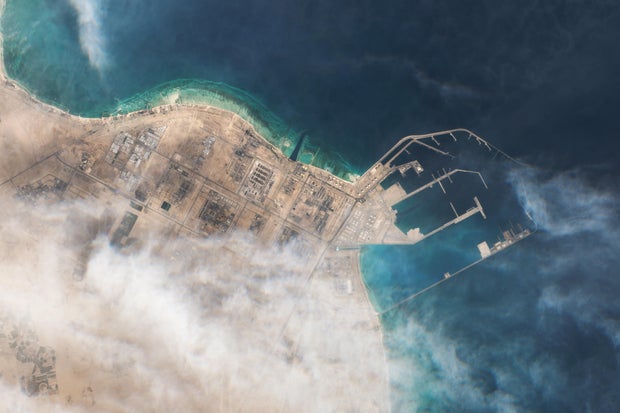
The open-source data shows the tankers are all empty, suggesting the operator now hopes to get them into port to load with product for export to markets in Asia and elsewhere.
QatarEnergy said Tuesday that the company could return to full output nationally, boosting production at other facilities, within a month, according to the Reuters news agency.
Roughly 20% of the world's crude oil and LNG supplies transited the Strait of Hormuz - the only gateway for ships in or out of the Gulf - before the U.S. and Israel launched their war with Iran on Feb. 28.
Trump says G7 leaders keen to discuss "fact that Iran will not have a Nuclear Weapon," Strait of Hormuz reopening
President Trump said in a social media post from France on Wednesday, where he's attending a G7 economic summit, that his fellow leaders mostly wished to discuss "the fact that Iran will not have a Nuclear Weapon, and that the Strait of Hormuz will immediately be opened!"
His post came hours after he cautioned that the memorandum of understanding agreed with Iran, which is set to be formally signed Friday, is not a final deal, adding that if Iran's leaders "don't behave, we'll go right back to dropping bombs right smack in the middle of their head."
In his Truth Social post, Mr. Trump again touted stock market gains and falling oil prices as the result of "the settlement" with Iran.
The terms in the memorandum of understanding have not been confirmed by the U.S. or Iranian governments, and it is unclear what concessions Iran has committed to regarding its contentious nuclear enrichment program.
Lebanese president says negotiations with Israel are independent of U.S.-Iran deal
Lebanon's president said Wednesday that the country's negotiations with Israel were independent of the U.S.-Iran deal.
"The assurances we have received, and what we insist on, is that Lebanon's path in the negotiations is independent, though we are certainly for a ceasefire and for any country that helps us, including Iran," President Joseph Aoun said, according to a statement from his office.
"The Lebanese state is sovereign in its decision-making, and for the first time, it is the one conducting the negotiations, and nobody is negotiating for us," Aoun said ahead of a fifth round of Israeli-Lebanese talks next week.
Iranian officials said earlier this week that if Israel keeps troops in Lebanon and continues attacks in the country, it would be considered a violation of the agreement.
Pope Leo praises U.S.-Iran deal
Pope Leo XIV has praised the U.S.-Iran agreement as an "encouraging result of patient work in dialogue and negotiation."
"I welcome with satisfaction the reaching of an agreement between the Islamic Republic of Iran and the United States of America," Leo, the first-ever U.S.-born leader of the Catholic Church, said in a social media post.
"I hope that the agreement may help strengthen mutual trust, security, and stability in the Middle East, promoting paths of dialogue and cooperation among peoples," he said.
Vance says text of U.S.-Iran deal will be released Friday "at the latest"
Vice President JD Vance said Wednesday on "CBS Mornings" that the text of the U.S.-Iran deal would be released Friday "at the latest," adding that the White House is pushing to release it sooner. Vance said Qatari and Pakistani negotiators, who helped mediate the agreement, "asked us not to release the full text for a little while."
"We're actually trying to push them to get it out today, because we want to tell the American people what's in this deal," Vance said.
The vice president called it "a good deal for the American people," and said he had seen it being misrepresented.
Vance said the agreement would reopen the Strait of Hormuz "immediately" and provide a framework "whereby if the Iranians give us what we need on stopping the funding of terrorism, on no longer pursuing a nuclear weapon, then they can get some benefits, be reinvited into the world economy."
"When I say benefits, I'm talking about sanctions relief on their economy," he said. "We've destroyed their nuclear program, but one of the things the president is trying to do is give them the incentive not to try to rebuild that program for the long haul."
Pressed on whether the deal includes reconstruction financing of at least $300 billion for Iran, along with the release of all of Iran's frozen financial assets, as some reports have claimed, Vance said "none of those things flow to Iran unless Iran fundamentally changes how it behaves with the world."
"What the president is really saying is, if Iran fundamentally transforms how it deals with the United States and the region, the rest of the world, then Iran can get some economic benefits," said the vice president.
On gas prices, Vance said he expects prices to come down "a lot more" over the next few weeks.
"We really do think, as the president said, this was a short-term increase in prices," he said. "We understand it caused a lot of disruption, there are a lot of American families who are struggling, but this is not a long-term change."
G7 leaders praise Trump's "strong leadership" in U.S.-Iran deal
Leaders at the G7 meeting praised the U.S.-Iran agreement as a "breakthrough" and "an historic opportunity to prevent Iran from acquiring any nuclear weapon."
"We welcome the announcement of a deal between the United States and Iran, secured under the strong leadership of President Trump, with the support of mediating countries," the statement said.
The leaders also called for an immediate ceasefire in Lebanon and the disarmament of the Iran-backed Hezbollah group.
Trump says he would resume "dropping bombs" if Iran doesn't "behave"
President Trump said on Wednesday the memorandum of understanding is not final and that he would resume fighting if Iran doesn't "behave."
Speaking to reporters in France at the G7 meeting, Mr. Trump said: "If I don't like it, we'll go back to shooting at them, dropping bombs on their head. If I don't like it, if they don't behave, we'll go right back to dropping bombs right smack in the middle of their head."
The president also said the deal does not include immediate sanctions relief for Iran, adding that he would clarify this matter at a later date.
Five Iranian ships have crossed U.S. blockade line in past 24 hours
Five sanctioned Iranian ships have crossed the U.S. naval blockade line in the Gulf of Oman over the last 24 hours.
Three crude oil tankers, one bulk carrier and a container ship departed the southern Iranian port of Chabahar and appeared to be headed east after transiting the blockade area Tuesday and Wednesday, according to open source tracking data from MarineTraffic.com.
Another sanctioned oil tanker, the Stream, turned off its location broadcasting system overnight Monday as it approached the blockade zone from the east, having left Pakistan's port of Karachi.
On Wednesday, crude oil tanker Herby and bulk carrier Aries were also tracked heading for the blockade area from Pakistan.
All of the vessels are Iranian-flagged and owned by the Islamic Republic of Iran Shipping Lines or the National Iranian Tanker Company, both of which are subject to U.S. sanctions in connection to Iran's oil trade and weapons program.
Commercial traffic through the Strait of Hormuz remains low, with the number of vessels transiting the gateway to the Persian Gulf in the single digits, compared to a historic average of around 135 vessels per day.
Price of oil continues to fall as market optimism grows over reopening of Strait of Hormuz
Oil prices stabilized after falling sharply earlier on optimism over a possible end to the war and reopening of the Strait of Hormuz, crucial for oil and gas transport worldwide.
Brent crude, the international standard, traded 1% lower at $78.19 per barrel early Wednesday after falling more than 5% on Tuesday. It was still above its roughly $70 a barrel level in late February, before the war started.
Benchmark U.S. crude was down 1.1% to $75.21 a barrel.
Mixed messaging over Strait of Hormuz
Mixed messages about the status of the U.S. naval blockade of Iran's ports and vessels around the Strait of Hormuz, and uncertainty over the terms in the U.S.-Iran agreement, have kept tanker traffic to a minimum so far.
On Sunday, President Trump announced an agreement had been reached with Iran and said in a Truth Social post that he would "authorize the immediate removal of the United States Naval blockade." He later said the strait would only reopen when the deal is signed on Friday, and a multilateral naval command, which includes the U.S., said Monday that the blockade was still in place.
On Tuesday, however, a senior Iranian diplomat said the U.S. blockade had been lifted ahead of the planned signing ceremony, and CBS News has tracked at least four sanctioned Iranian-owned vessels, crossing the U.S. blockade line since Mr. Trump's announcement on Sunday.
Major shipping companies have said they will only resume normal operations in the strait when details of the U.S.-Iran deal are clear, and they get assurances of safety in the vital shipping lanes.
"Due to lack of details and a history of overly optimistic reassurances, we believe the security situation for the shipping industry remains volatile, and we still consider it very risky for ships to commence transits at this point," Jakob Larsen, head of safety and security at BIMCO, one of the largest international shipping associations, said Monday.
Several Israeli strikes hit south Lebanon, country's news agency says
Israeli forces carried out airstrikes on several areas in south Lebanon Wednesday, Lebanon's National News Agency reported, despite a memorandum of understanding on the Middle East war that Iran insists includes Lebanon.
NNA said Israeli warplanes launched raids targeting the Nabatieh al-Fawqa area and the eastern outskirts of neighboring town Kfar Tebnit. The Israelis also launched a drone strike on the town of Ansariyeh in the Zahrani area, NNA reported.
Iran's Foreign Minister Abbas Araghchi said Tuesday that the continuing presence of Israeli forces in Lebanon would be a violation of the U.S.-Iran agreement set to be signed on Friday.
On Monday, Israeli officials said troops would remain in a wide section of southern Lebanon that they have effectively occupied over the last three and a half months, forcing tens of thousands of residents to evacuate.
"Trump's agreement does not bind us," Israel's far-right National Security Minister Itamar Ben-Gvir said.
Iranian tankers loaded with oil exit U.S. blockade zone ahead of peace talks
The first tankers carrying Iranian oil exited a U.S. blockade in the Strait of Hormuz, a tracking website said on Wednesday, two days before Washington and Tehran launch talks under terms of a memorandum of understanding between the two nations.
The negotiations on a final settlement are set to begin Friday at Switzerland's Burgenstock mountain resort after the memorandum is formally signed.
The TankerTrackers website, which monitors oil shipments and storage, marked Iran's "first crude oil exports in two months," citing digital tracking data corroborated by satellite imagery.
"At least two National Iranian Tanker Company (NITC) VLCC supertankers named DIONA (9569695) and HERO2 (9362073) have exited the U.S. Navy blockade perimeter carrying a combined total of 3.8 million barrels of Iranian crude oil between them," TankerTrackers said on X, later adding that a third tanker had exited.
The U.S. will let Iran immediately begin selling oil and fuel under the deal, the Wall Street Journal reported Tuesday, citing unnamed people familiar with the agreement.
The waiver of sanctions on oil sales will take effect immediately after the signing, the Journal said.
Graham says he's "pretty skeptical" about future Iran talks, but "it's worth a try"
Republican Sen. Lindsey Graham of South Carolina told CBS News he's "pretty skeptical" about planned U.S.-Iran talks, but is willing to "wait and see."
The two countries agreed to a memorandum of understanding to extend their ceasefire, reopen the Strait of Hormuz and launch longer-term nuclear talks over the next 60 days.
Asked if he believes that initial deal is a good or a bad idea, the GOP lawmaker and longtime Iran hawk said: "I don't know yet."
"I mean, I like the idea of opening the straits and ending the conflict," he said. "In terms of how the negotiations work long term … let's wait and see. I reserve judgment, but I don't mind jumpstarting the process."
Graham added: "When it comes to Iran, I'm pretty skeptical, but you never know till you try, so it's worth a try."
Graham spoke to reporters after he and other GOP lawmakers met with Defense Secretary Pete Hegseth to discuss Iran and the Pentagon's request for additional funding.