Live Updates: Iran claims new attack on U.S. radar system in Bahrain and says tanker hit near Strait of Hormuz
What to know about the Iran war today:
- The U.S. launched strikes on Iran's Qeshm Island in the Strait of Hormuz on Tuesday, according to an Iranian official. The strikes came hours after Iran said it targeted a U.S. radar system in Bahrain. U.S. Central Command said those attack drones were all intercepted.
- Iran also claimed Tuesday that another oil tanker was on fire near the Strait of Hormuz after striking a sea mine. Daily claims by the regime of ships hitting mines have not been confirmed, and the U.S. military says the shipping lanes in the southern strait are mine-free and safe to use.
- Vice President JD Vance told Fox News on Monday that the Trump administration won't let the Iran war become a two-year commitment, but he reiterated the White House's justification for launching the war, insisting that Iran's nuclear program remains a threat to the United States.
Iran's foreign minister refers to dirty bomb report as "RUBBISH"
Iranian Foreign Minister Abbas Araghchi slammed reports that his country was targeting Washington, D.C., with chemical weapons or building missiles under dams, blaming the reports on Israel.
"In the past 72 hours, pro-Israel media have 'reported' that Iran is supposedly plotting to use chemical weapons in DC while building missile bases under dams. RUBBISH," Araghchi wrote on X.
CNN reported that Iran could be developing plans to target administration officials with a dirty bomb or chemical weapon in Washington. According to sources cited by CNN, Tehran's planning is, for now, "an effort to give itself options rather than an indicator of an imminent attack."
Separately, The New York Times reported that Iran's network of dams might be cover for underground missile development.
In his social media post, Araghchi also invoked the misguided U.S. assertion of there being weapons of mass destruction in Iraq as cause for invading that country in 2003.
"Spare us the Iraq War-style propaganda, especially with Israeli fingerprints all over it," Araghchi said Tuesday. "Nobody is buying it."
Araghchi has been one of the most important members of negotiations between the U.S. and Iran over a lasting peace deal.
U.S. strikes Iran's Qeshm Island in Strait of Hormuz, Iranian official says
The United States on Tuesday carried out several attacks on Iran's southern Island of Qeshm, located in the Strait of Hormuz, a local Iranian official said.
"The American attack on locations on Qeshm island caused no damage to residential, commercial, or infrastructural areas," said Ahmad Nafisi, deputy provincial governor of the southern province of Hormozgan, quoted by the official IRNA news agency.
There was no immediate confirmation of an attack by the United States.
Qeshm Island has been a regular target of strikes by the U.S. throughout the war. Most of them have been categorized as "defensive" attacks targeting drone or missile launch equipment. The U.S. acknowledged Iran fired multiple one-way attack drones toward Bahrain, but said they were all shot down.
CBS/AFP
Iran-backed group warns it will fight Iraqi forces entering its stronghold
A powerful Iran-backed armed group in Iraq vowed on Tuesday to confront government forces if they try to enter its main stronghold near Baghdad, denying allegations it is smuggling oil from the area.
The standoff between Kataib Hezbollah and Iraqi authorities is shaping up to be the first major test of the new government's resolve to disarm nonstate armed groups.
Abu Taleb al-Saidi of Kataib Hezbollah made the comments a day after Iraqi Prime Minister Ali al-Zaidi said security forces would enter Jurf al-Sakhar, south of Baghdad in Babil province, later this week. Local media reported the group had until Friday to leave.
Kataib Hezbollah, one of Iraq's most powerful armed groups, wields considerable influence in Jurf al-Sakhar and has maintained an armed presence there for more than a decade.
The planned move by al-Zaidi is part of his push to disarm powerful Iran-backed groups by mid-2027. The move by the rival sides raises alarms of internal Shiite fighting that has been mostly avoided since the 2003 U.S.-led invasion that removed Saddam Hussein from power.
Iranian navy claims 3 oil tankers have hit sea mines near Strait of Hormuz today alone
Iran's navy claimed a third oil tanker struck a sea mine near the Strait of Hormuz on Tuesday after trying to use shipping lanes declared safe and open by the United States, but which Iranian authorities have repeatedly warned mariners against using.
The semi-official Fars news agency cited the Iranian Army Navy as saying the third "offending" tanker "caught fire after striking a naval mine east of the Strait of Hormuz."
"Our message is clear: the Strait of Hormuz is closed. Safe passage requires coordination with the Iranian Armed Forces, transit through designated safe zones, and having navigation systems switched on," the Fars report cited the navy as saying.
Iran has made claims of ships striking sea mines in and around the southern Strait of Hormuz for weeks, without offering evidence. Independent monitoring agencies report frequent, unexplained explosions impacting vessels in the region, but the commander of the U.S. military's Central Command declared the strait's southern shipping lanes completely de-mined and safe to navigate as recently as late October.
Iran's Houthi allies say key Bab el-Mandeb Strait shipping lanes "safer now" in their hands
Iran's Houthi allies said Tuesday that the shipping lanes of the Bab el-Mandeb Strait, the southern gateway to the Red Sea that provides access to Saudi Arabia's oil and gas export hub of Yanbu Port, are "safer now" after they seized control of Yemen's coastline on the waterway from Saudi-backed forces.
The Iran-backed rebels group has fought Yemen's Saudi-backed government forces for control of the strait for months, and the declaration by their spokesman Brig. Gen. Yahya Saree on Tuesday came a day after a government-allied group said its fighters had retreated from areas along the Yemeni coastline near the strait amid relentless Houthi attacks.
Fighting between the Saudi-led coalition that backs Yemen's government and the Houthis has escalated this year, putting control of the vital sea passage at stake as Iran and the U.S. attempt to exert control over the nearby Strait of Hormuz.
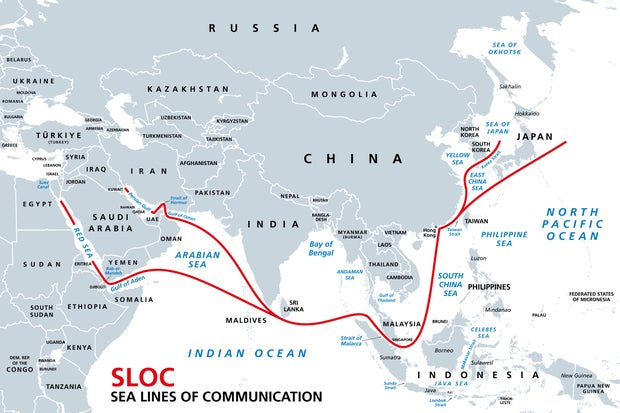
Saudi Arabia has attempted to impose a naval blockade of Houthi-held territory in Yemen, and the Houthis have responded by declaring their own blockade of Saudi ports and vessels in the Red Sea, launching several attacks on ships.
Almost a third of global oil supplies would typically transit both straits before the U.S. and Israel launched their war on Iran, and while shipments via the Strait of Hormuz have rebounded, the unresolved, interlinked conflicts have kept risks for shipping companies high, which in turn has kept global oil prices up about 40% compared to before the war.
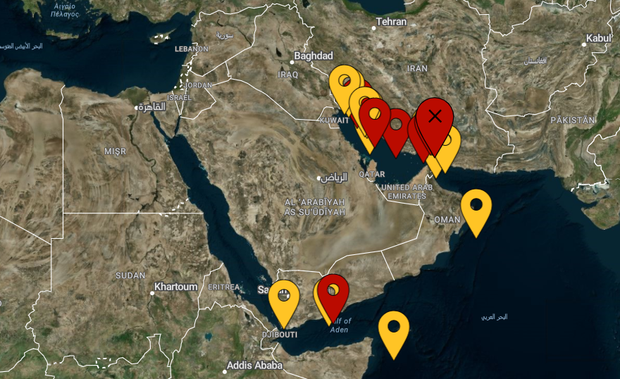
"We will continue our military operations deep into Saudi territory, responding to the blockade with a blockade and to escalation with escalation, and targeting the Saudi enemy's military buildup and its officers until the aggression ceases and the blockade against our beloved people is lifted," Saree said in his Tuesday statement, adding that the group, "also assure the world that navigation through the Bab al-Mandab Strait is safer now that the Saudi enemy has been defeated and its forces have been dispersed."
Iran dismisses CNN report on possible chemical weapon plot against Washington
Iran on Tuesday dismissed as baseless a CNN report suggesting it was preparing to launch a possible chemical "dirty bomb" attack on Washington D.C.
"Those who initiated the aggression against Iran are now seeking to lay the media groundwork for their sinister designs by manufacturing and disseminating baseless allegations, including the recent claims published by The New York Times and the fabricated media narrative surrounding an alleged 'dirty bomb' propagated by CNN," Iranian foreign ministry spokesman Esmaeil Baqaei said in a post on X.
CBS/AFP
U.S. says 3rd Iranian attack on Bahrain radar installation in less than a week was intercepted
The U.S. military's Central Command said Tuesday that Iran's third claimed attack targeting a U.S. radar installation in Bahrain was thwarted by air defense systems.
"Iran's Islamic Revolutionary Guard Corps (IRGC) claimed its drones hit a U.S. military radar system at a base in Bahrain early this morning. This is FALSE," CENTCOM said in a statement shared on social media.
It acknowledged that Iran had launched the attack on Tuesday, however, saying "multiple Iranian one-way attack drones launched by the IRGC today towards Bahrain were intercepted without any damage to U.S. equipment or injury to American personnel."
Iran issued nearly identical claims to have struck a U.S. radar site on a military base in Bahrain on Friday and Sunday, all of which were intercepted according to American and Bahraini authorities.
The incidents appear to represent an increase in attempted strikes by Iran against U.S. interests and infrastructure across the Persian Gulf region. Large-scale tit-for-tat strikes largely ended over the summer, with the war grinding into a stalemate as both Iran and the U.S. refuse to back down from their demands for a peace deal.
President Trump has suggested an agreement may not be necessary and that the status quo could be acceptable, despite ongoing threats to shipping in the Strait of Hormuz keeping global oil prices about 40% higher than they were before the war, and no agreement to renew international monitoring of Iran's opaque nuclear program.
Trump says he's taking report of possible Iranian chemical bomb plot "very seriously"
President Trump said Tuesday that he is taking "very seriously" a CNN report suggesting Iran may be plotting to attack Washington with a chemical weapon.
According to sources cited by CNN, Tehran could be developing plans to target administration officials in the U.S. capital with a so-called dirty bomb. The sources cited said the planning was not an indicator of an imminent attack, but an effort to explore options.
Arriving in the Philippines Tuesday, Mr. Trump told reporters that "if there is" such a plot, Iran "will pay a price the likes of which no country has ever paid before."
"I hope it's not," he said. "But we take it very seriously because they happen to be crazy."
Asked earlier about the report, White House spokesperson Lauren Bis said the administration remained vigilant in "monitoring any and all potential threats, but at this time there are no credible threats to the homeland."
CBS/AP
Qatar calls for restraint after Iran claims attack on U.S. radar in Bahrain
Qatar on Tuesday called for "all parties" to avoid a new escalation Tuesday after Iran's Islamic Revolutionary Guard Corps claimed for the third time in less than a week to have targeted a U.S. radar system in Bahrain.
"We call on all parties to exercise restraint during this period and to avoid any escalation that could undermine negotiation efforts," Qatari foreign ministry spokesman Majed Al Ansari said at a press briefing in Doha, warning of an "extremely serious" threat to efforts to forge an agreement to end the Mideast war.
President Trump has kept his intentions on Iran ambiguous, repeatedly insisting that the war has been won and he no longer considers it necessary to make a deal with the Islamic Republic, but also keeping the possibility of renewed U.S. attacks on the table.
CBS/AFP
Iran claims another oil tanker hit a sea mine near Strait of Hormuz
Iran's Islamic Revolutionary Guard Corps claimed Tuesday that another oil tanker had struck a sea mine and was on fire near the Strait of Hormuz, according to Iran's semi-official Tasnim news agency, which is closely linked with the IRGC.
"A short while ago, an offending oil tanker — which was navigating within a restricted zone east of the Strait of Hormuz with its navigation systems switched off and in violation of established regulations — caught fire and sustained severe damage after striking a naval mine," the report said, citing the IRGC.
Iranian forces have claimed similar incidents on a nearly-daily basis for weeks, though it has offered no evidence. Independent maritime monitors report frequent explosions, caused by unknown projectiles, impacting ships in the region.
Tehran has repeatedly warned ships not to use southern routes through the Strait of Hormuz, close to Oman's coast, that the U.S. military insists are de-mined and safe to navigate. Iran demands that all vessels seek permission to use a northern passage close to its own shores, and it has attacked ships that use the southern route with missiles and drones since the summer.
Iranian and Omani ministers discuss Strait of Hormuz options
The Iranian and Omani foreign ministers discussed "safeguarding" shipping and diplomatic options, Oman's official news agency said on Tuesday.
Iran's top diplomat, Abbas Araghchi, and his Omani counterpart Badr Albusaidi held talks in the Omani capital, Muscat, on the "diplomatic options available to contain tensions and revitalise tracks of dialogue and negotiation," according to the agency.
"These efforts aim to expand areas of mutual understanding among the concerned parties and prevent the widening of the crisis and its repercussions," it added.
Iran and Oman's coastline form the Strait of Hormuz, and the two countries were engaged in talks on the potential future management of the waterway in recent months.
CBS/AFP
Iran claims another attack on U.S. radar systems in Bahrain
Iran's Islamic Revolutionary Guard Corp said Tuesday it targeted U.S. radar systems in Bahrain for the third time since Friday.
"Combat drones belonging to the Revolutionary Guards carried out a precision operation this morning, targeting a radar system operated by US forces at the Sheikh Isa Air Base in Bahrain," the Guards' Sepah news website said, adding that the attack was in response to the "repeated violations of Iranian airspace by US military drones".
Bahrain issued an alert Tuesday morning, urging residents to seek shelter and to remain calm, before giving the all clear shortly after. Explosions were heard over the Bahraini capital of Manama on Tuesday.
CBS/AFP
White House downplays Iranian dirtybomb plot report
A White House official has downplayed a CNN report suggesting that Iran could be developing plans to target administration officials with a dirty bomb or chemical weapon in Washington.
According to sources cited by CNN, Tehran's planning is, for now, "an effort to give itself options rather than an indicator of an imminent attack."
In response to the report, White House spokesperson Lauren Bis said, "We remain vigilant monitoring any and all potential threats, but at this time there are no credible threats to the homeland."
Vance says there's "no daylight" between him and Trump on war with Iran
In an interview with Fox News that aired Monday night, Vice President JD Vance said "there's no daylight" between himself and President Trump, after he was asked about his post-election comments on the war with Iran being the reason for GOP midterm defeats.
"I think there's no daylight between the president or any other senior member of the administration," Vance told Laura Ingraham.
Vance also said that neither he nor the president want the conflict to become a forever war.
"... We have accomplished an extraordinary amount. We have destroyed the nuclear program. We have destroyed Iran's conventional military," Vance said. "... The President of the United States has a lot of options, right? He could say, 'We're done now.' He could of course, exert more military and diplomatic pressure on the Iranians. I think it's something he's thinking about doing right now, right? What are we actually going to do to finally bring this thing to a resolution?"
Vance positioned himself as a skeptic of foreign military entanglements before he became vice president, and early in the Iran war, Mr. Trump conceded that Vance was "philosophically, a little bit different than me" and "less enthusiastic about going." Still, Vance has publicly stood by the president on the Iran war, and helped lead a U.S.-Iran diplomatic push over the summer.
Another tanker hits naval mine in Strait of Hormuz, Iranian officials say
A tanker struck a naval mine in the Strait of Hormuz on Monday and caught fire, according to Iranian state media.
It is the fourth such incident in 24 hours, the Islamic Republic of Iran Navy told semi-official news agency ISNA in a statement. Officials did not identify the vessel or provide further information.
Meanwhile, a British maritime agency on Monday said it received a third-party report of an attack involving a tanker transiting the Strait of Hormuz, just north of Khasab, Oman. The incident disabled the vessel and resulted in an engine room fire, according to the United Kingdom Maritime Trade Operations.
"The crew have been reported safe. Damage assessment, and environmental impact are unknown at the time of this report," the UKMTO said.
Vance says U.S. won't let Iran war become 2-year commitment
Vice President JD Vance told Fox News that the Trump administration won't let the Iran war become a two-year commitment. He also said the Iranian nuclear program was still a threat to the U.S.
"We told the American people we would do no more forever wars. Yes, the president felt he had to destroy the nuclear program, and, yes, the Iranian nuclear program is a threat to the United States of America," Vance told Fox News' Laura Ingraham in a clip from an interview expected to air Monday night. "But we are not going to allow this to become a 10- or 15-year commitment or, frankly, even a two-year commitment."
The U.S. and Israel started the war at the end of February. Throughout the conflict, President Trump has said that Iran cannot have a nuclear weapon. The Iranian regime has maintained for years that its nuclear program is for peaceful purposes.
"Despite the fact that a lot of neoconservatives and a lot of other people want us to stay there forever, we're not going to stay there forever," Vance told Ingraham. "We promised we wouldn't, and I have full confidence the president will get us out of this thing with great results."
U.S. Central Command posts photo of newest carrier in Middle East
U.S. Central Command posted on Monday a photo of the newest aircraft carrier operating in the Middle East, the USS Theodore Roosevelt.
A U.S. military official confirmed to CBS News senior national security correspondent Charlie D'Agata on Sunday that the Roosevelt had joined the two other carriers in the region, the USS George H.W. Bush and the USS George Washington.
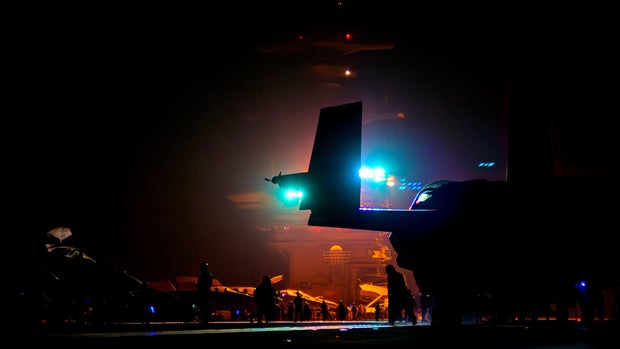
Central Command said the Roosevelt was in its area of responsibility as part of a scheduled deployment.
The three ships aren't all expected to remain in the area for long as carrier strike groups rotate through the region.
Iran's Houthi allies say 37 people killed or wounded by Saudi strikes in 24 hours
Iran's Houthi allies in Yemen said Monday that Saudi attacks had killed or wounded 37 people in the past 24 hours.
The Houthis' Saba news agency said in a post on social media that "the toll of the Saudi aggression during the past 24 hours reached 37 martyrs and wounded," citing the Houthi-run health ministry.
Houthi authorities said earlier that three Yemenis, including a child, were killed in two separate Saudi strikes in areas held by the rebels.
Health ministry spokesperson Anees al-Asbahi said a child was killed in a drone strike that hit a house in the al-Sarar quarter of the capital, Sanaa, which also wounded seven others.
Separately, two people were killed and eight more wounded in airstrikes Monday morning on a private fuel station in Harf Sufian district in Omran province, al-Asbahi said.
Saudi Arabia has not commented on the strikes.
Iran reportedly claims Strait of Hormuz shipping lanes endorsed by U.S. are "fully mined"
A Saudi news outlet closely linked to the government and ruling royal family cited Iran's Islamic Revolutionary Guard Corps as claiming Monday that southern shipping lanes through the Strait of Hormuz, which the Trump administration and U.S. military have insisted are safe and open, have been "fully mined."
There was no immediate statement from the IRGC itself echoing the report by Saudi Arabia's Asharq News, which is not technically state-run, but owned by a state-backed institution in the kingdom.
Iran has made daily claims of commercial ships hitting sea mines in and around the Strait of Hormuz for weeks, and independent monitors have confirmed multiple fires on vessels after unexplained explosions.
Iran insists the southern lanes, which skirt the Omani coast, are unsafe and that all vessels must use other routes close to Iranian shores.
U.S. Central Command chief Adm. Brad Cooper reiterated the Trump administration's claim at the end of October that "Iran's navy is all at the bottom of the sea."
"We also successfully cleared the strait's internationally recognized primary transit routes of Iranian sea mines," he said, adding that "U.S. forces remain highly vigilant and present to ensure that all primary transit routes in the Strait of Hormuz remain free and clear."
Iran's foreign minister meets Pakistan's army chief
Iranian Foreign Minister Abbas Araghchi held talks in Islamabad on Monday with Pakistan's army chief, who has served as a key mediator between the U.S. and Iran throughout the war, according to a post on his official Telegram account.
During the meeting with Gen. Asim Munir, "the two sides reviewed regional and international developments" and "exchanged views on existing challenges and threats to regional peace and security," said the statement by Araghchi.
Pakistan, along with Qatar and Turkey, has tried to mediate a peace deal between Iran and the U.S. for months.
Pakistani foreign minister says Mecca pact nations to meet in Islamabad this month
Pakistani Foreign Minister Mohammad Ishaq Dar said Monday that senior officials from Pakistan, Saudi Arabia and Turkey - the countries that signed onto the trilateral Mecca Joint Defense Agreement in the summer - would meet in the Pakistani capital later this month.
Pakistan signed the mutual defense pact with Saudi Arabia and Turkey in August. It is, like the much larger NATO alliance co-founded by the U.S. after World War II, a vow to come to each other's defense in the event of an attack on any member.
"The apex committee of this body ... will be actually meeting, hopefully, end of this month, in Islamabad," Dar said.
Saudi Arabia continues to face repeated attacks by the Iran-backed Houthi rebels in Yemen, who have targeted major commercial airports, oil facilities and shipping infrastructure since fighting in Yemen's civil war intensified in July.
Both Turkey and Pakistan have sent troops to Saudi Arabia as part of the mutual defense agreement.
CBS/AFP
2 Houthi drones intercepted over Saudi Arabia, Saudi-led military coalition says
The Saudi-led coalition fighting Yemen's Iran-backed Houthi rebels said it had intercepted two Houthi drones targeting Saudi cities on Monday.
Coalition spokesperson Turki Al-Maliki said in a brief post on X that the two drones were "intercepted and destroyed in the Mecca and Riyadh regions."
Earlier Monday, Houthi health authorities said three Yemenis, including a child, were killed in two separate Saudi strikes in areas the rebels hold in Yemen.
A group allied with Yemeni government forces said, meanwhile, that its fighters had pulled out of areas along Yemen's coastline near the Bab el-Mandeb Strait – the southern gateway to the Red Sea and thus a vital chokepoint for commercial shipping – amid relentless attacks by the Houthis.
Iraq orders army to enter stronghold of Iran-backed militia
Iraqi army forces were ordered Monday to enter a town near Baghdad considered a stronghold of the powerful Iran-backed group Kataib Hezbollah following accusations of oil smuggling.
Kataib Hezbollah, a U.S.-designated terrorist group that has launched attacks on American forces in the region, has controlled the town of Jurf al-Sakher, about 40 miles south of Baghdad, for 12 years, according to The New Arab. Previous U.S. strikes have targeted Iranian proxy groups in Iraq such as Kataib Hezbollah.
Prime Minister Ali al-Zaidi "ordered the armed forces to enter" Jurf al-Sakher, government spokesman Haidar al-Aboudi told state news agency INA, adding that "a deadline has been set for the armed faction to exit the area." A security source told the AFP news agency the deadline was Friday.
Fighting between the army and the Iran-backed militias is possible, sources told The New Arab. A senior Iraqi official said the government had deployed tanks, armored vehicles and troop carriers to the outskirts of Jurf al-Sakher, and that forces were ready to push into the town.
CBS/AFP
Oil prices continue downward trend, U.S. diesel drops below $6 a gallon
The price of oil continued its downward trend Monday morning despite ongoing tension and attacks on commercial vessels in the Persian Gulf amid the unresolved U.S.-Iran war.
Brent crude, the international standard for oil, declined 0.5% to $95.34 per barrel, still much higher than the approximately $72 a barrel in late February before the U.S. and Israel launched the war on Iran. Benchmark U.S. crude fell 0.3%, to $88.31 a barrel.
The International Energy Agency said last week that Gulf exports "recovered much faster than global oil demand."
Consumer prices for gas and diesel have seen a slight decrease in recent weeks, but they remain higher than pre-war levels.
The average price of a gallon of diesel in the U.S. fell below $6 Monday for the first time since it crossed that threshold in September.
CBS/AP
Houthi rebels claim 3 killed, including a child, in Saudi airstrike
Houthi health authorities said Monday that three Yemenis, including a child, were killed in two separate Saudi Arabian strikes in areas the Iran-backed rebels hold in Yemen.
Health Ministry spokesperson Anees al-Asbahi said a child was killed in a drone strike on a house in the al-Sarar quarter of the capital, Sanaa, which also wounded seven others.
Separate airstrikes Monday morning hit a private fuel station, killing two people and wounding eight in Harf Sufian district in Omran province, al-Asbahi said.
Al-Asbahi blamed Saudi Arabia, which made no immediate comment on the strikes.
CBS/AFP
U.S. envoy calls on Iran-backed Hezbollah to disarm
A U.S. envoy on Monday called on Iran-backed Hezbollah to voluntarily give up its weapons - which the Lebanese group has always rejected.
On a visit to Lebanon, U.S. Ambassador to the United Nations Mike Waltz called on Hezbollah to disarm and hand its weapons over to Lebanese state authorities, saying: "No country can have two armies."
"I think the message should be loud and clear, that Lebanese sovereignty must be fully restored," said Waltz, "and the mechanism to do that will be the Lebanese armed forces."
Fighting between Hezbollah and Israel has eased since the summer, but the conflict remains a hurdle to any final peace deal between the U.S. and Iran. Iran and Hezbollah have demanded the full withdrawal of Israeli forces from southern Lebanon and a total halt to fighting in the country as part of any ceasefire agreement between Washington and Tehran.
An agreement signed in June between the Israeli and Lebanese governments to end the fighting in southern Lebanon linked Israel's withdrawal from the country with Hezbollah's disarmament, and Hezbollah has refused to give up its weapons.
CBS/AFP
France expects EU to approve new sanctions against Iran after store fridges hacked
France is asking the European Union to impose new sanctions against Iran after cyberattacks, which the French and later the Belgians blamed on Iranian security forces, targeted refrigeration units at hundreds of grocery stores in October.
Foreign Minister Jean-Noel Barrot said Monday he was "confident" that measures targeting those responsible for the hack would be agreed at the next gathering of EU foreign ministers in Brussels in December.
"I have come to Brussels today to present evidence concerning those primarily responsible for this extremely serious cyberattack, and to request that European sanctions be imposed against them within one month," Barrot told reporters. "I am pleased to have secured the support of a vast majority of European Union member states."
On Oct. 11, major grocery store chains in France were struck by a cyberattack that caused "significant food spoilage" and triggered around 20 fires as temperatures in refrigeration units shot up, according to the country's prosecutor's office.
French officials believe Iran was behind those attacks, accusing a cyber unit of Iran's Islamic Revolutionary Guard Corps of carrying it out. Belgian authorities have drawn the same conclusion about a second cyberattack a couple weeks later that hit refrigeration units in stores in several European nations.
Iran has denied responsibility for the cyberattacks, which come after months of warnings from the regime that it could respond to ongoing hostilities by the U.S. and its allies with unspecified asymmetrical warfare - and a warning from British authorities that Tehran's hybrid warfare tactics are evolving to target civilian infrastructure.
CBS/AFP
Iran claims regional 10-nation bloc backs its proposed 2-day deal
Iranian Foreign Minister Abbas Araghchi said Monday that a 10-nation regional bloc had backed Tehran's proposed plan to reopen the Strait of Hormuz under an initial ceasefire with the United States.
Tehran has said it is prepared to reopen the strait within two days if Washington agrees to its seven core conditions. After initially proposing a seven-day implementation period, Iranian negotiators later reduced the proposed timeframe to two days, calling it a "sign of good will."
The Trump administration has thus far rejected Iran's demands, which include the U.S. releasing frozen Iranian financial assets, easing sanctions and lifting its naval blockade of Iranian ports, as "unacceptable."
Araghchi's comments came during a meeting of the Economic Cooperation Organization, a group of nations from Central and South Asia and the Middle East.
"The meeting responded positively and, by supporting the plan proposed by Iran, namely the two-day plan, expressed hope that this plan would lead to a definitive and comprehensive ceasefire," Araghchi told reporters in Islamabad.
Senior officials from Pakistan, Turkey, Azerbaijan, Kazakhstan, Iran, Kyrgyzstan, Tajikistan, Turkmenistan and Uzbekistan attended the meeting in the Pakistani capital, but there was no immediate confirmation from the other nations attending the meeting that they had backed the Iranian proposal. Afghanistan is also a member of the bloc.
CBS/AFP
Israeli military says it struck a Hezbollah weapons shipment
The Israeli military said Monday that it had struck a Hezbollah weapons shipment along the Syria-Lebanon border.
"The weapons were intended to strengthen Hezbollah's operational capabilities to carry out terror attacks against Israeli civilians & IDF soldiers," the Israel Defense Forces said in a post on X.
Lebanese state media also reported that Israel had struck a mountainous area in eastern Lebanon.
"Enemy aircraft launched a strike at dawn against the Al-Shaara region, in the highlands of the Anti-Lebanon mountain range, without resulting in victims or damage," Lebanon's official National News Agency (NNA) said.
Large-scale hostilities between Israel and Iran-backed Hezbollah in Lebanon have eased in recent months, but sporadic fighting continues. The conflict has complicated efforts by the Trump administration to wind down the war it launched jointly with Israel against Iran more than eight months ago, as Tehran insists any ceasefire must include all fronts in the region, including Lebanon and Gaza.
CBS/AFP
Iran, British monitoring agency report tankers hit in and near the Strait of Hormuz
A British naval monitoring agency said Monday morning it had received a report of a tanker in the Strait of Hormuz being struck.
The U.K. Maritime Trade Operations Center said the vessel was "struck by an unknown projectile whilst transiting outbound," resulting in a fire in the engine room.
It added that crew members were all accounted for and no casualties were reported.
Meanwhile, Iran's state broadcaster said a tanker east of the Strait of Hormuz had caught fire after hitting a naval mine, citing Tehran's navy.
It said the ship was traveling through a "restricted area," which "exposes offending vessels to serious risks."
Iran's armed forces regularly report similar incidents with ships Tehran deems to be transiting the Strait of Hormuz without its permission.
Iran-backed Houthis tighten control of key strait after Yemeni troops pull back
A group allied with the Saudi-backed Yemeni government said its fighters pulled out from areas along the Bab el-Mandeb Strait amid relentless attacks by the Iran-backed Houthis.
The Southern Armed Forces said they would now focus on securing Yemen's southern city of Aden, held by the internationally recognized government, as well as trying to break the Houthi siege of the crucial city of Taiz.
The move has allowed the rebels to consolidate their grip on the strait, in a setback to the Saudi-backed efforts to dislodge them from the strategic coastal territories on the Red Sea.
Local media reported that the Houthis fired two ballistic missiles on the district of Buraiqeh on Aden's western coast.
Clashes were reported between the Houthis and government forces in an area in Yemen's southwestern province of Lahj, which has key supply routes close to the Bab el-Mandeb Strait.
The strategic waterway is a key chokepoint for Saudi Arabia's oil exports, and has been the focus of fighting in the region for months.
Houthi rebels have tightened their grip on the strait in recent months, threatening to disrupt the flow of Saudi oil through the Red Sea.
CBS/AP
Iran rules out inspections of damaged nuclear sites until war ends
A senior Iranian official said Tehran would not allow inspections of nuclear sites damaged by the war with the U.S. until the war had "permanently ended."
"We will not grant the IAEA access to the facilities until Iran's conditions are met and the war has permanently ended," Deputy Foreign Minister Kazem Gharibabadi said in a televised interview late Sunday.
The remarks came after the International Atomic Energy Agency, a nuclear watchdog, urged Tehran to take steps toward resuming inspections, which have been partly suspended since last year.
IAEA inspectors visited Bushehr nuclear power plant in September but have not gained access to other sites targeted by the U.S., including Natanz, Fordow and Isfahan.
Gharibabadi said the agency's request to inspect damaged facilities was "likely aimed at assessing the effectiveness of American weaponry."
CBS/AFP
Army whistleblower alleges senior military officials ignored warnings ahead of deadly attack in Kuwait
A U.S. Army soldier who survived a deadly Iranian drone attack filed a whistleblower complaint to Congress alleging senior military officials ignored warnings and did not plan properly for anti-drone defenses ahead of the war with Iran.
The whistleblower, Army Maj. Stephen Ramsbottom, spoke exclusively with 60 Minutes' Norah O'Donnell about his complaint, which was submitted to the House and Senate Armed Services Committees on Friday and obtained by CBS News.
He alleges Army leaders dismissed concerns over thin fortifications at a U.S. command post in Kuwait where six American soldiers were killed by an Iranian drone in the first 24 hours of the conflict, the deadliest attack on U.S. troops in the war.
The complaint also claims the post — known as Port Shuaiba — "had no physician, no fixed aid station, and only one ambulance."
"I feel this is a tactical failure by the Army, our leadership, and myself - all the way down to my level," Maj. Ramsbottom told 60 Minutes. "We just did not plan this well, and this needs to be a lesson that we learn."
Ramsbottom spoke with 60 Minutes as part of an eight-month investigation into the March 1 attack at the command post, known as Port Shuaiba. The day after the attack, in a press conference, Defense Secretary Pete Hegseth insisted the troops there were well-protected.
Iran claims attack on U.S. assets in Bahrain
Iran's Islamic Revolutionary Guard Corps said its forces carried out a drone attack on a U.S. radar system at a base in Bahrain, according to a statement carried by the Iranian state broadcaster on Sunday.
"The U.S. air defense radar system at the Al-Riffa helicopter base in Bahrain was targeted by six drones belonging to the IRGC Aerospace Force," the IRGC said in a statement posted by the state broadcaster on Telegram.
Bahrain's military later said it had intercepted Iranian airstrikes before they hit their targets.
The interior ministry in an X post urged "residents to remain calm, proceed to the nearest safe location, and follow news through official channels for the protection of public safety."
There was no immediate comment from the U.S. military's Central Command about the claim on Sunday. CENTCOM on Friday rejected a similar claim from the IRGC, which said it had attacked a "U.S. early-warning radar" in Bahrain.