Live Updates: Oil prices inch back up as Iran and its Houthi allies escalate threats and attacks
What to know about the Iran war today:
- Global oil prices, which had dropped about 20% in recent weeks with the U.S.-Iran war locked in a stalemate, have risen again slightly as Tehran threatens to increase attacks on ships and fighting between its Houthi allies and Saudi Arabia escalates.
- Ship transits through the Strait of Hormuz have fallen again this month and the amount of oil and other products being shipped out of the Persian Gulf remains at just over half of pre-war levels, according to shipping intelligence firm Kpler.
- The Iran-backed Houthi group claimed an attack on the financial district of Saudi Arabia's capital on Wednesday, as well on a sprawling oil refinery in the country's east.
Body of Jordanian sailor found off UAE coast after vessel attacked in Strait of Hormuz
The body of a Jordanian sailor who was reported missing after an Iranian attack on his vessel in the Strait of Hormuz last week, was found off the coast of Ras Al Khaimah in the United Arab Emirates, Jordan's Foreign Ministry said on Thursday.
"The body of Mohamed Hossam al-Din al-Otaibi, may he rest in peace, was found on Wednesday," the ministry said.
The United Arab Emirates' state-owned ADNOC energy company reported the sailor missing last week after one of its vessels was attacked in the Strait of Hormuz. It said 11 crew members were injured in the attack.
The Jordanian ministry praised the efforts of UAE and Omani authorities for locating the sailor's body.
Iran claims 2 more tankers ablaze after hitting sea mines in Strait of Hormuz
Iran's Islamic Revolutionary Guard Corps claimed Thursday that two "non-compliant" oil tankers were on fire after striking sea mines while attempting to transit the Strait of Hormuz via southern shipping lanes the U.S. military insists are safe, but Tehran has repeatedly warned vessels to avoid.
"Since the early hours of today, two non-compliant oil tankers have exploded and caught fire after striking naval mines north of the port of Khasab," which is on the Omani coast in the center of the strait, Iranian state media quoted the IRGC as saying.
The report, which was not immediately corroborated by independent maritime agencies, said one of the ships was a supertanker laden with more than 2 million barrels of crude oil that was left burning after hitting a mine.
The statement — the latest in a series of daily claims by the Iranian regime of ships striking mines in the strait — came after IRGC Navy commander Rear Adm. Ali Azmaei reiterated Tehran's warning to shipping firms that passage through the strait would only be safe "by respecting Iran's sovereignty."
"We not only have control of this waterway, but have also placed the power to change the equations at the heart of the Strait of Hormuz," declared Azmaei, whose remarks were also carried by state media.
Ship traffic through Strait of Hormuz has dropped significantly this month, maritime intel firm says
Ship transits through the Strait of Hormuz have fallen again this month and the amount of crude oil and other products shipped outside the Persian Gulf remains at just over half of pre-war levels, according to data from shipping intelligence company Kpler.
The number of ships making the journey per week fell from 217 to 147 between Nov. 1 and Nov. 23, Kpler said in two reports this week.
Tanker crossings averaged 11 per day for the week ending Nov. 21, compared to 50 per day before the war, meanwhile, though the company noted that many crossings are "dark," or done with their AIS transmission systems turned off, usually for safety reasons.
The International Maritime Organization has recorded 141 attacks on commercial ships in and around the strait since the war began in February, including at least 15 in November. October was the worst month for attacks on vessels in the region since the war began, with at least 35 ships coming under attack according to the IMO.
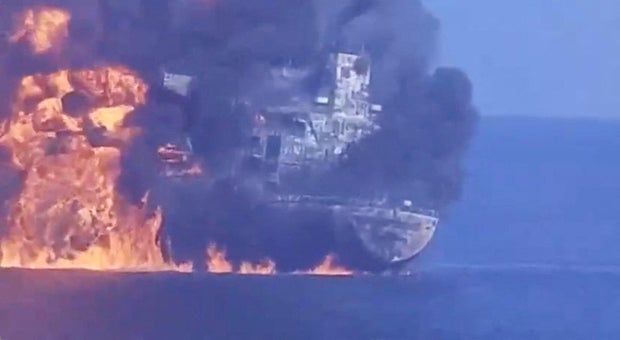
U.K. navy monitor says tanker off UAE reported nearby explosion, sustained no damage
The U.K. navy's Maritime Trade Operations agency said late Wednesday that it had received a report of an explosion near a tanker about 50 nautical miles west of Dubai, in the United Arab Emirates, west of the entrance to the Strait of Hormuz.
The tanker's master reported an explosion, which UKMTO attributed to an "unknown projectile," but the vessel was not damaged and there was no environmental impact, UKMTO said in an advisory.
Iran claimed earlier Wednesday, without offering evidence or details, that a liquified natural gas carrier had struck a sea mine in the southern part of the strait — the latest in a series of similar daily claims.
Iran insists all vessels must use northern shipping lanes through the strait, and only with authorization from its military. The regime said Wednesday that it was tightening its control over the vital waterway, which the U.S. military insists is safe and open to traffic.
Houthis claim attacks on Saudi ports
Yemen's Houthis said Wednesday they had targeted the Saudi ports of Jeddah and Jazan in response to Saudi strikes on a Yemeni port controlled by the Iran-backed group as their conflict further escalated.
The attacks came after the Saudi-led military coalition fighting the Houthis said it had struck Yemen's Red Sea port city of Hodeida, drawing threats of retaliation from the Yemeni fighters.
"Both operations resulted in damage to the targeted sites," Houthi military spokesman Yahya Saree said.
An explosion was later heard in Saudi capital Riyadh, according to an AFP journalist and residents, after authorities issued an alert warning of a "hostile aerial threat," which was lifted shortly after.
Residents in northern and eastern Riyadh confirmed hearing the blast, with one saying their house windows "shook violently."
Saudi forces said air defenses destroyed two ballistic missiles launched toward the capital by the Houthis, as well as a cruise missile in the western part of the country and a drone near Jeddah's port.
Turki al-Malki, the spokesman for the Saudi-led military coalition battling the Houthis, said no civilian injuries resulted from the debris of the intercepted drone.
In recent weeks, the Houthis has launched a barrage at Saudi targets including the financial district, airports, energy infrastructure and military sites.
The Saudi coalition has in turn been striking Houthi-held areas of Yemen in support of the internationally-recognized government, which has been battling the Houthis for territory since a civil war reignited in July.
CBS/AFP
Iran criticizes Sen. Cornyn for incorrectly citing nuclear report actually about North Korea
The Iranian Foreign Ministry has called out Republican Sen. John Cornyn for a post on X criticizing Iran's alleged pursuit of nuclear weapons, however, the quote cited by the senator was actually about North Korean nuclear ambitions.
The Texas senator cited International Atomic Energy Agency chief Rafael Grossi raising concern "about a rapidly built extension at the Yongbyon gas centrifuge uranium enrichment plant."
Cornyn wrote on X, "Doesn't sound like the Iranian regime is giving up on its nuclear weapons aspirations."
Iranian Foreign Ministry spokesman Esmaeil Baqaei correctly pointed out Grossi was speaking about Yongbyon, North Korea, and nothing to do with Iran.
Cornyn serves on the Senate Committee on Foreign Relations, one of the governing body's most important posts. Cornyn is on his way out of the Senate. He was soundly defeated by Ken Paxton in the Republican primary this spring. Paxton would eventually lose earlier this month to Democrat James Talarico.
The post on X remains live 24 hours after the senator shared it.
Israel trying to deceive U.S. into war with chemical weapons claim, Iran says
Iranian Foreign Minister Abbas Araghchi said Wednesday that Israel was trying to drag the United States into another war after an Israeli minister alleged Tehran is building chemical weapons.
"This warmonger shamelessly accuses Iran ... of developing and concealing such heinous weapons in pharmaceutical factories. The objective is audacious: to deceive the US into fighting yet another war on its behalf," he wrote in a statement posted on X.
Israel has for years accused Iran of trying to acquire nuclear weapons, but Israeli Defense Minister Israel Katz on Tuesday alleged Tehran is building chemical weapons and vowed to stop the Islamic republic from obtaining them.
"Iran is in the process of developing chemical weapons but has not yet reached the capability to attack Israel with them," said Katz in a statement published by his Likud party on Telegram. He also left open the possibility of preemptive strikes against Iran.
"We must not allow this to proceed," he said.
President Trump mentioned the same thing to Fox News earlier this month on his Asia trip, saying, "Well, there is indication that Iran is looking at gases, looking at bio, because we've shut them out with the nuclear. ... Nuclear is much harder, and they're looking at gas and they're looking at the bio, the biological weapons."
CBS/AFP
Houthi projectile hits Saudi Arabia's Jazan port, causing minor damage
A projectile fired by the Houthi militia struck Jazan port in southwestern Saudi Arabia, causing minor damage but no civilian casualties, the Saudi-led coalition said on Wednesday.
It said efforts were underway to determine the type of projectile.
The Iran-backed Houthis reiterated earlier on Wednesday their threat to target Jeddah and all Saudi Arabian ports on the Red Sea if Saudi Arabia followed through on its threat to target Yemen's Hodeidah port, which is held by the rebels.
Hodeidah is the main entry point for food and other essential supplies into Houthi-held northern Yemen.
Shortly after the Houthis' warning, the Houthi-affiliated Al-Masirah TV network reported a Saudi attack on the port of Hodeidah.
Iran claims natural gas tanker struck sea mine in Strait of Hormuz, causing an explosion
Iran's Islamic Revolutionary Guard Corps claimed Wednesday that a liquified natural gas carrier exploded after striking a sea mine while transiting what it calls an unauthorized route through the southern Strait of Hormuz — shipping lanes the U.S. military insists are free of mines and safe for travel.
The IRGC statement, carried Wednesday by state television network IRIB and other Iranian media, did not provide any further information about the ship purportedly impacted, and there was no immediate report from independent monitoring agencies of a vessel being hit Wednesday.
Iran has repeatedly warned vessels not to ignore its restrictions on the Strait of Hormuz, saying ships must only use northern shipping lanes through the waterway, close to its shores, and only with authorization from Iranian authorities.
The IRGC said Wednesday that ships being "deceived by the plundering U.S. military" were at risk of striking naval mines.
Iranian army spokesperson Brig. Gen. Mohammad Akraminia said Wednesday that Iran's forces had tightened their control over and monitoring of the Strait of Hormuz.
U.S. Treasury chief calls Iranian regime a sinking ship
U.S. Treasury Secretary Scott Bessent said Wednesday that the Iranian regime was a "sinking ship."
In a brief social media post, Bessent said Iran had failed to load a single oil tanker since the Treasury launched Operation Economic Outcast in August, which he called at the time an "unprecedented campaign against the Islamic Republic of Iran and its enablers."
The initiative is aimed at using economic tools - including secondary sanctions against countries and entities that do business with Iran - to force the regime to halt its threats to shipping in the Strait of Hormuz and to end the war.
While neither of those objectives has been met, Bessent said in his post on Wednesday that "Iran doesn't have a drop of oil on the water left to sell."
Iran dismisses U.S. naval blockade, claims boost in exports via "northern and other non-southern borders"
Iran's First Vice President Mohammad Reza Aref said Wednesday that Tehran is not concerned about the U.S.-imposed naval blockade of Iranian ports, claiming an increase in exports and the clearance of goods via other routes, according to state news agency IRNA.
Aref was quoted as saying increased commerce across Iran's "northern and other non-southern borders" demonstrated the Islamic Republic's ability to maintain supplies despite maritime restrictions.
The U.S. military announced earlier this month an expansion of its naval blockade, as Central Command heralded a new task force aimed at disrupting the illegal shipment of prohibited items such as military technology or illegal revenue streams over ground transportation routes into and out of Iran.
"The establishment of Task Force Iron Gate reinforces the success of our ironclad blockade against Iran at sea," U.S. Central Command chief Adm. Brad Cooper said in Nov. 7 a statement. "Strengthening CENTCOM's collaboration with U.S. interagency partners will further constrain Iran's ability to finance terrorism, rebuild weapons factories, and replenish their military."
Iranian Foreign Minister Abbas Araqchi said Monday that a land blockade of Iran would be "almost impossible" given the country's vast territory, numerous provinces and extensive ties with neighboring countries.
U.K. reportedly taking extra precautions to protect warplanes on bases due to drone threat
Britain's air force is moving planes into hangars and hardened shelters overnight to protect them from drone threats, The Times and Sky News reported Wednesday. The two U.K. media outlets also said the Royal Air Force (RAF) is planning to install anti-drone nets around warplanes that remain exposed.
The Ministry of Defense did not immediately confirm the reports, but British authorities have issued warnings recently about the rising threats posed by Russia and Iran, and the government has urged citizens to be prepared for various contingencies that could make access to fresh food, water and other essentials difficult for days.
In October, the head of Britain's domestic spy agency MI5 warned that Iran had made a "major shift" in its efforts to attack the U.K., including going after harder targets such as military bases,
He spoke weeks after authorities thwarted an alleged Iran-backed plot targeting the U.K. air base RAF Fairford. That incident, for which two men have since been charged with serious national security offenses, led the U.S. to withdraw all of its bomber aircraft, which had been used in strikes on Iran, from the base.
CBS/AFP
Houthis renew threat to target Saudi Arabia's Red Sea ports
The Iran-backed Houthis reiterated on Wednesday their threat to target Jeddah and all Saudi Arabian ports on the Red Sea if the Saudis follow through on their threat to target Yemen's Hodeidah port, which is held by the rebels.
Hodeidah is the main entry point for food and other essential supplies into Houthi-held northern Yemen.
In a statement posted online, Houthi military spokesman Yahya Saree called on "employees and workers at these ports, as well as those present in their vicinity, to evacuate them immediately and move away."
Shortly after Saree issued the warning, the Houthi-affiliated Al-Masirah TV network reported a Saudi attack on the port of Hodeidah.
The rebel group said earlier Wednesday that it had carried out two operations targeting the Ras Tanura refinery in Saudi Arabia's Eastern Province, as well as the financial center in Riyadh.
Saudi Arabia's Civil Defense agency said Tuesday that a skyscraper in the financial district had been targeted by a Houthi attack, injuring 11 people.
U.N. humanitarian chief: Half of Yemen's population needs aid as "renewed fighting" drives displacement
United Nations humanitarian relief chief Tom Fletcher said Wednesday that half of Yemen's population is in need of aid, as he arrived in the war-torn nation that has become the most active front in the intertwined Middle East conflicts.
Fletcher warned in a statement shared online that "renewed fighting has forced over 364,000 people from their homes since August, including tens of thousands this past week alone."
He repeated his demand for Yemen's Iran-backed Houthi rebels to "immediately and unconditionally release our detained UN colleagues" and other humanitarian workers and said the U.N.-led relief efforts in the country were overstretched, underfunded and under attack.
"Yemen is where we are furthest off track on our ambition to reach 87 million people with lifesaving support this year," Fletcher said. "We will not allow the people of Yemen to slip off the world's radar."
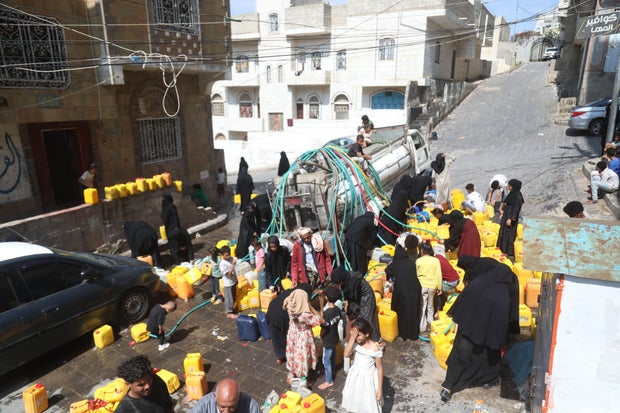
Iran claims it has tightened its control over Strait of Hormuz
Iranian army spokesperson Brig. Gen. Mohammad Akraminia said the military had tightened its control and monitoring of the Strait of Hormuz on the orders of the army's commander-in-chief.
Ships attempting to transit the waterway without coordinating with Iran's armed forces have faced greater risks in recent weeks, including sea mines, Akraminia was quoted as saying Wednesday by the semi-official Tasnim news agency.
President Trump has dismissed Iran's claims attacks on ships and sea mines being laid in the strait as lies intended to inflate global energy prices, and the U.S. military declared international shipping lanes through the waterway free of mines at the end of October.
Without offering any evidence, however, Akraminia claimed Iranian forces had upgraded their monitoring capabilities by introducing new systems, improving existing ones and strengthening their combat abilities, and he said the measures would continue.
Iran's Persian Gulf Strait Authority (PGSA) said Tuesday that 26 tugboats had been added to the country's "Non-Compliance List," for providing services to non-compliant vessels, indicating they could be targeted.
Iran issues daily claims of commercial vessels striking mines in and near the strait, few of which are ever corroborated, but independent monitors do report frequent incidents involving "unknown projectiles" striking ships in the region.
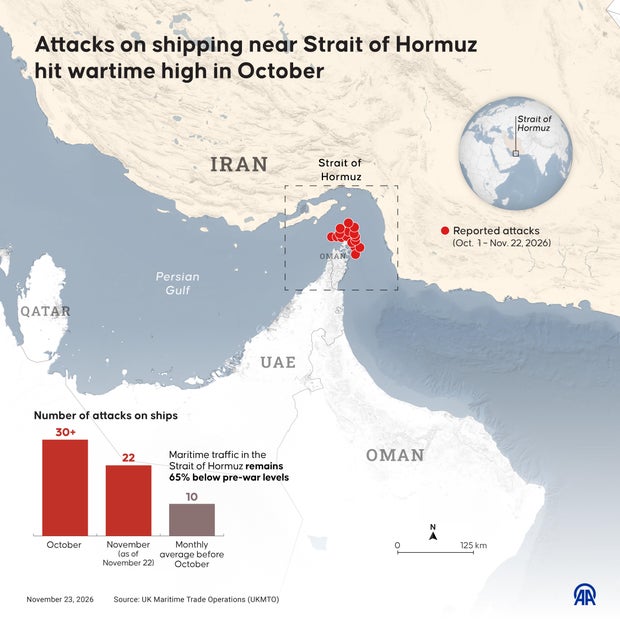
Iran criticizes U.S. for using artificial intelligence for deadly attacks
Iran has denounced the U.S. military's use of artificial intelligence to plan and carry out attacks.
Speaking at a U.N. Security Council meeting Tuesday, Iranian Ambassador Gholamhossein Darzi said the weaponization of AI "raises serious concerns."
Darzi claimed U.S. forces used the technology to deploy more than 2,000 munitions to hit 2,000 distinct targets within 96 hours. He said Palantir's Maven and Anthropic's Claude system were used to analyze intelligence, identify and prioritize targets and provide strike coordinates.
"Neither advanced technology nor the involvement of private companies can shield the United States or the Israeli regime from accountability for flagrant violations of their obligations under international law," Darzi told the council meeting.
"Those responsible for the commission of atrocious crimes against Iranian people, including deliberate attacks against civilians and civilian objects, must face individual criminal accountability," he added.
In March 2026, the Commander of U.S. Central Command Adm. Brad Cooper confirmed American forces had used a "variety of advanced AI tools" in order to "cut through the noise and make smarter decisions faster than the enemy can react."
While the Pentagon has not said exactly how AI tools are being deployed, CBS News spoke in March with several experts with knowledge of military operations who described the likely scenarios.
"The military is now processing roughly a thousand potential targets a day and striking the majority of them, with turnaround time for the next strike potentially under four hours," said retired Navy Admiral Mark Montgomery, senior director of the Foundation for Defense of Democracy's Center on Cyber and Technology Innovation. "A human is still in the loop, but AI is doing the work that used to take days of analysis — and doing it at a scale no previous campaign has matched."
Iran-backed Houthis and Saudi forces intensify attacks
Yemen's Iran-backed Houthis on Wednesday claimed attacks targeting the financial district in the Saudi capital and the sprawling Ras Tanura refinery in the kingdom's oil-rich east, in retaliation for strikes on their territory.
Houthi military spokesman Yahya Saree described the attack targeting the refinery as "accurate and direct", saying it "caused fires to break out at the facility". He said the attack on Riyadh was "carried out in three phases, with strikes hitting their targets accurately".
In separate attacks, Saudi's forces said they had struck the city of Hodeida on Wednesday, after the Houthis said they would retaliate if that attack took place.
The Houthis have been locked in grueling, more than decade-long civil war against Yemen's government forces, who are backed by Saudi Arabia. Recent Houthi gains have consolidated the group's control of the Bab el-Mandeb Strait, which the group has tried to use to disrupt Saudi oil exports.
CBS/AFP
Iran developing chemical weapons, Israeli defense minister says, warns of possible preemptive strike
Israeli Defense Minister Israel Katz said on Tuesday that Iran is developing chemical weapons, and vowed to stop Tehran from obtaining them.
"Iran is in the process of developing chemical weapons," Katz said in a briefing to Israeli reporters, according to public broadcaster KAN and other national outlets. "The state of Israel will not allow them to reach that capability."
In his briefing on Tuesday, Katz floated the possibility of a preemptive strike against Tehran, if necessary.
"If we recognize that the Iranians intend to attack Israel, can't we tell the army to attack earlier and thwart the threat?" he said, according to a transcript from Israel's Channel 12. "If the Iranians attack us first, it will be a failure."
Katz's comments came at the same time as Iranian Foreign Minister Abbas Araghchi criticized the U.S. government for not funding the Organisation for the Prohibition of Chemical Weapons, the international body that monitors and combats chemical weapons use at The Hague. The organization is facing a budget crisis because the U.S. has pulled funding, according to a Reuters report.
"The U.S. is so concerned about chemical arms that it's crippling the world's chemical weapons watchdog," Araghchi wrote Tuesday on X. "OPCW may be forced to suspend work and scale back vital programs. By obstructing its mandate, the U.S. is deliberately putting global peace and security at risk. Shameful."
The OPCW won the Nobel Peace Prize in 2013 for its work in Syria.
CBS/AFP
Jury convicts Chinese tech giant Huawei over business with Iran, other conspiracy charges
A U.S. jury convicted Chinese tech giant Huawei Technologies on Tuesday of conspiring to steal trade secrets and doing business in countries subject to U.S. sanctions, including Iran.
In all, Huawei was convicted on 10 of 12 counts. The case in Brooklyn federal court involved no human defendants, but the company could be made to pay billions of dollars in penalties when it is sentenced next September.
The Department of Justice said Huawei and its subsidiaries assisted an Iranian intelligence apparatus called Zaeim in monitoring and censoring internet access. The company also provided surveillance cameras that helped Tehran monitor protest activity, according to the DOJ.
"Huawei repeatedly lied about the nature of its business in Iran, falsely telling banks, journalists, and the U.S. government that it did not assist Iran's government, military, or intelligence community; that it began restricting its business in Iran in 2011; that Skycom was a business partner, rather than a wholly-owned subsidiary; and that Huawei complied with all applicable sanctions," the DOJ said. "Huawei knew that all of those statements were materially false and misleading."
CBS/AP