Live Updates: Iran dismisses Trump's "economic D-Day" threat, says it "will only bring further defeat"
What to know about the Iran war today:
- Iran's foreign minister on Thursday dismissed President Trump's threat to wield "Economic Warfare and Isolation on an unprecedented scale" as a diversion from the burgeoning U.S. national debt and a "doubling down on failed policies." Mr. Trump threatened Iran on Wednesday with "an economic D-Day."
- The president said earlier Wednesday the U.S. could return to talks with Iran "at some point," but he believes the current "situation is so good" he didn't need to now, despite a stalemate in the nearly six-month war.
- The Pentagon said the USS George Washington aircraft carrier arrived Wednesday in the Middle East. The ship will replace the USS Abraham Lincoln, about which family members have voiced concern over deteriorating mental health conditions for the crew after a nearly nine-month deployment.
Vance says war is in "new phase" using economic pressure
Vice President JD Vance on Thursday said the war with Iran has entered a "new phase where the most effective tool that we have is the economic pressure that we can apply to them."
In an interview on "The Clay Travis & Buck Sexton Show," Vance noted the "delicate dance" involved.
"We apply economic pressure to them, they're going to try to apply economic pressure to us," the vice president said. "But what has been true over the last couple of weeks is they felt a lot more pressure than we have. We're going to keep that going because we think that's the best way to ultimately accomplish the final objective here."
U.S. increases sanctions on network smuggling millions in cash to Hezbollah
Ten people smuggling millions of dollars in cash to the Iran-backed Hezbollah militia in Lebanon have been sanctioned by the U.S. Treasury Department.
The network was previously led by Iranian Gen. Behnam Shahriyari, however, he was killed in an Israeli airstrike in western Iran in June. The same network is now being targeted with sanctions, including against the person who manages the network of couriers, Turkish businessman Yunus Alper Yilmazs, according to the Treasury Department.
Yilmaz is accused of abusing Turkey-based exchange houses as fronts for business dealings with Iran's Islamic Revolutionary Guard Corps, or IRGC. The other nine people included in the sanctions are the actual couriers who would collect the money from the exchange houses and deliver it to Hezbollah.
The sanctions release also notes the information on the couriers as evidence of the IRGC's involvement in coordinating attacks by Hezbollah, which is currently fighting a war with Israel in Lebanon and "deep involvement in directing Hizballah's political decision-making."
U.S. blockade on Strait of Hormuz redirects 2 more ships, military says
The blockade on commercial ships entering and exiting Iranian ports via the Strait of Hormuz was up to 67 through Thursday, after two more ships were stopped in the last day, according to U.S. Central Command.
The blockade was reinstated on July 14 after a brief period when a larger number of ships were able to get through following the signing of the U.S.-Iran memorandum of understanding. The Trump administration has shown no inclination to call off the blockade anytime soon, with Treasury Secretary Scott Bessent touting it on Thursday.
"It is a one-two punch," Bessent told CNBC. "We have the blockade, and we are going to have the toughest sanctions in history."
The USS George Washington and its strike group has now arrived in the region, CENTCOM said on Thursday, and will begin taking part in the blockade. The aircraft carrier will replace the USS Abraham Lincoln, which has been on a record-long deployment.
Safe passage through Strait of Hormuz can only be guaranteed with lasting regional peace, Oman says
Security for vessels passing through the Strait of Hormuz is only possible once lasting peace is reached in the Middle East, Omani's foreign minister said Thursday.
"Achieving sustainable security in the Strait of Hormuz requires establishing lasting peace in the region, through restraint, diplomacy and continuous engagement to address the underlying causes of instability, including policies of exclusion and failure to comply with international law," Omani Foreign Minister Badr Albusaidi said, according to the state-owned Oman News Agency.
Albusaidi's comments came in a joint press conference with Japanese Foreign Minister Toshimitsu Motegi. Japan is currently negotiating a trade agreement with the Gulf Cooperation Council.
The talks between Oman and Iran over a route of passage through the Strait of Hormuz have broken down. However, Albusaidi said Oman has an "aspiration to conduct more constructive talks to reduce escalation as soon as possible, ensure freedom of navigation in the Straits of Hormuz and Bab al-Mandab, and strengthen coordination between the two countries in this regard."
President Trump has repeatedly said the U.S. controls the strait, and touted secretive efforts to get millions of barrels out per day, but the number of commercial ships exiting the Strait of Hormuz has often dwindled to single digits lately.
U.S. plans to sell refueling planes to Qatar
The United States on Thursday approved a potential $4.5 billion sale of refueling aircraft to Qatar, which has acted as a mediator in Washington's war with Iran, the State Department announced.
Qatar had asked to purchase up to four KC-46A aircraft, equipped with missile-warning sensors, the department said in a statement.
The sale, which was sent to Congress for its approval, will help support U.S. national security by "helping to improve the security of a strategic regional partner," it said.
The deal will "increase Qatar's capability to meet current and future threats by enhancing its defense capabilities and interoperability with U.S. and allied forces," it added.
Bessent tells China to "get with the program" when asked about countries helping Iran
The U.S. is not excluding China from its warnings to get on board with President Trump's new campaign to isolate the Iranian economy and "collapse" the government in Tehran.
Treasury Secretary Scott Bessent underlined in an interview with CNBC that Washington expects both allies and rivals to join the ramped-up campaign on Iran.
"This is going to be the greatest coordinated economic isolation in the history of the world. And we are going to them and saying you are either with us or against us," he added in a message to allies.
Asked whether the United States would pressure China, Bessent said "many conversations are best to have in private," but called on Beijing to "get with the program."
Chinese President Xi Jinping is due to visit the White House on Sept. 24 when the topic of Iran is sure to come up, as it did when Mr. Trump traveled to Beijing for a summit in May.
CBS/AFP
Bessent says pressure on Iran makes "large-scale" war less likely, and he's "not sure why oil has popped up"
Treasury Secretary Scott Bessent said Thursday the new U.S. policy of "maximum economic pressure" on Iran makes a "large scale" war less likely. He told CNBC that global oil markets, on which prices have been rising for several weeks, were wrongly interpreting the new policy.
President Trump threatened Iran with "economic D-Day" on Wednesday, vowing to wield "Economic Warfare and Isolation on an unprecedented scale."
Iran quickly dismissed the threat as a distraction and said it would backfire.
As the price of a barrel of Brent crude, the global benchmark, hovered around a three-week high of $93 on Thursday, Bessent said, "I think oil markets are misinterpreting what this economic pressure means."
"We have asymmetric information, and I'm not sure why oil has popped up on this," he said. "If we are doing the maximum economic pressure, then that means that likely there will not be a large-scale kinetic restart."
Yemeni government forces say 81 operations against Houthis carried out in 24 hours
The armed forces of Yemen's Saudi and Western-backed government have carried out 81 military operations against the Iran-allied Houthi forces in a 24-hour period, Col. Majed al-Nazili, spokesman for the Yemeni Armed Forces, said Thursday.
In a statement posted on X, al-Nazili said the operations "across all fronts" resulted in "the neutralization of leaders and fighters, as well as the destruction of equipment and vehicles."
He said the operations were a response to what he called repeated Houthi attacks on civilian infrastructure and a "siege" on Yemen's civilian population. He cited the targeting of Al-Dhabba port and the forced halt of oil exports, the destruction of Sanaa airport and Yemenia aircraft, and attacks on the ports of Hodeidah, Salif and Ras Isa.
Al-Nazili also accused the Houthis of continuing to target Mokha port, Al-Ardi anchorage, food-carrying vessels and displacement camps in Marib, saying the attacks demonstrated an effort by the Iranian proxy group to "starve the Yemeni people."
In 2015, Saudi Arabia led an international coalition to intervene on the side of the Yemeni government in its civil war against the Houthis, who control a vast swath of western Yemen, including the capital Sanaa.
A fragile ceasefire signed in 2022 had held until last month, when the Iranian-backed rebels attacked Saudi vessels in the Red Sea and attempted to blockade Saudi ports, wading overtly for the first time into the regional conflict sparked by the joint U.S.-Israeli attack on Iran.
Oil prices continue rising amid uncertainty over Iran war
A rise in oil prices on Thursday sent worries about inflation and yields in the bond market higher, erasing some of the relief the U.S. Treasury Department created the day before. A drop for Walmart following its latest profit report helped drag the U.S. stock market lower.
The S&P 500 slipped 0.4% and is on track for a fourth loss in the five days since setting its all-time high last week. The Dow Jones Industrial Average was down 430 points, or 0.8%, as of 10:15 a.m. Eastern time, and the Nasdaq composite was 0.7% lower.
The bond market remains the center of action after yields charged higher through the summer on worries about high inflation, gargantuan government debts and other factors. Treasury Secretary Scott Bessent made a move Wednesday that jolted financial markets to at least double the size of his department's planned purchases of longer-term Treasurys from Sept. 9 through Nov. 4, but more signals arrived quickly to push worries higher.
The U.S. government's debt topped $40 trillion Wednesday, a staggering record that arrived just months after the national debt first blew past the $39 trillion mark in April, because Washington continues to spend far more money than it brings in.
The price for a barrel of Brent crude, considered the international benchmark, climbed almost 2% Thursday to $93.90 per barrel. U.S. staple West Texas Intermediate crude was also up about 2%, trading at about $86.
Oil prices have been rising steadily since the beginning of August amid growing uncertainty about when the war with Iran will allow oil tankers to freely exit the Persian Gulf again.
CBS/AP
Vatican says it has "serious concerns" over Israel-Lebanon deal implementation
The Vatican expressed "serious concerns" Thursday about problems with the implementation of a U.S.-brokered ceasefire agreement between Israel and Lebanon, following a meeting between Pope Leo XIV and Lebanese President Joseph Aoun.
During a private, 30-minute meeting at the Vatican, Aoun urged the pontiff to support Beirut's push to secure the withdrawal of Israeli forces from south Lebanon envisaged under the agreement, the Lebanese presidency said in a statement posted on X.
"The Holy See, whilst welcoming the signing of the document, has expressed serious concerns about the difficulties being encountered in implementing it, and has pledged its support for efforts to that end," the Vatican said in a statement, according to the AFP news agency.
Lebanon and Israel engaged in U.S.-sponsored talks after the Iranian-backed militant group Hezbollah drew Lebanon into the war in March by attacking Israel. Israel responded with massive airstrikes and a subsequent, ongoing ground invasion.
The framework agreement reached in June calls for the disarmament of Hezbollah, a gradual withdrawal of Israeli forces and the deployment of the Lebanese army to the currently-Israeli-occupied region of southern Lebanon, starting in "pilot zones."
Despite a weeks-long lull in fighting, Israel has kept up intermittent strikes and heavy demolition operations in the south. Israel forces are operating in a strip of territory that stretches about six miles inside the Lebanese border.
Aoun called on the head of the Catholic Church to "support Lebanon's efforts to achieve a full Israeli withdrawal from the occupied Lebanese territories, paving the way for the reconstruction of what Israel has destroyed," according to the Lebanese presidency's statement.
CBS/AFP
Iranian official says Trump's "economic D-Day" tactic is result of U.S. military failures
An Iranian official said Thursday that President Trump's newly asserted plan to wage "economic warfare" on Iran is the result of American failures on the battlefield.
"They claim Iran is on the verge of defeat and hanging by a thread, but they beg all their allies to help them!" Deputy Foreign Minister Kazem Gharibabadi wrote in a post on X. "The problem is the miscalculations that, each time, force them to create an even greater defeat for themselves to cover it up. The military war did not work, so now they have called the next defeat an 'economic war.'"
His comments came after President Trump threatened Wednesday to wield "Economic Warfare and Isolation on an unprecedented scale" on Iran.
He said it would be a "crushing economic operation" and an "economic D-Day" for Iran.
Houthis claim to have targeted Saudi airport and state-run Aramco oil facility with drones
Yemen's Houthi rebels carried out two drone operations targeting Saudi Arabia's Najran International Airport and a facility belonging to the Saudi state-owned energy giant Aramco in the same city, Brig. Gen. Yahya Saree, a senior spokesman for the group, said Thursday.
Saree said the first drone targeted what he called a "sensitive" target at Najran airport, while the second targeted premises belonging to Aramco.
"Both operations achieved their objectives successfully," he claimed in his post on X.
Saree called the attacks the Houthis' response to Saudi drone violations of the airspace over Yemen's Saada province.
He said the Iranian-backed rebels would continue to protect Yemen's sovereignty and he vowed the group would maintain the existing "equation" in response to such incursions.
Last month, the Houthis opened up a new front in the broader, interlinked Middle East conflict by attacking Saudi vessels in the Red Sea and blockading Saudi ports.
Iran had threatened for months to have its Houthi proxies attack Red Sea shipping if the U.S. continued with the major military strikes launched jointly with Israel on February 28.
The Houthis have attacked several ships since announcing their blockade of Saudi's Red Sea ports, but there has not been violence at a level significant enough to shut down all shipping through the Bab el-Mandeb Strait, which is the southern gateway to the sea, and another key chokepoint for global energy supplies along with the Strait of Hormuz.
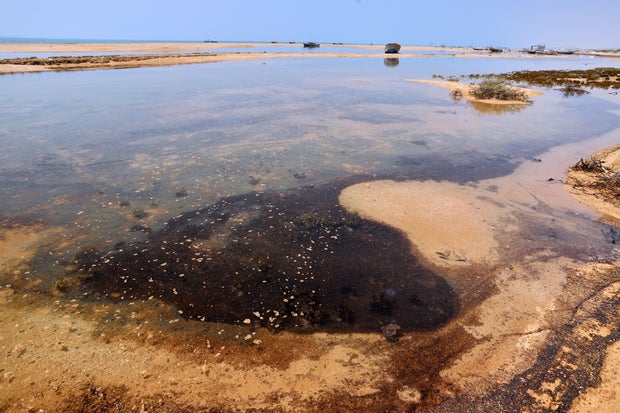
Iran says effort to clean oil spill on Strait of Hormuz island boosted as more reaches shores
Iran has bolstered efforts to clean up an oil spill along the shores of Qeshm Island in the Strait of Hormuz, according to environmental authorities cited by the country's semi-official ISNA news agency.
Ahmad Reza Lahijan-Zadeh, deputy head of the Department of Environment for Marine and Wetland Affairs, said authorities had mobilized additional resources for the clean-up. He said while much of the oil had been dealt with in recent days, a new wave of the slick was just reaching the island's shores.
Last week, the head of the environment agency, Shina Ansari, appeared to demand compensation for the oil spill, saying a foreign bulk carrier was likely the source. In a post on X, Ansari said the slick was "just one example of the widespread pollution that has destroyed the region's marine ecosystem over the past few decades."
"Who is responsible for compensating for the damages inflicted — is it the energy-consuming countries that import from our region, or the aggressor parties that have turned this area into a playground for military operations?" she asked.
Iran executes Afghan national over 2026 protests, says rights group
Iran on Thursday executed an Afghan national convicted of the killing of police officers during anti-government demonstrations, the 30th in a wave of hangings since the start of the Iran war, a rights group said.
Ghaem Hosseini was executed after being convicted of involvement in the deaths of four police officers, according to the state-linked outlet Nour News.
Hosseini was listed only as a foreign national, but the Norway-based Iran Human Rights (IHR) group said the 21-year-old was from Afghanistan and was hanged at Isfahan central prison.
The Mizan Online news website, linked with Iran's opaque judiciary authorities, said Hosseini was convicted "of drawing a weapon and causing fear and terror, creating widespread insecurity, acting against people's physical integrity and national security in a manner that seriously disrupted public order," according to the AFP news agency.
According to IHR, however, Hosseini was accused of kicking one of the policemen, and "authorities have presented no evidence proving that his actions led to the death of any of the policemen."
The case "is a stark example of collective punishment and the arbitrary use of the death penalty by the Islamic Republic," said IHR director Mahmood Amiry-Moghaddam.
He is the fifth person to be hanged over the case involving the death in Isfahan of four police
officers during nationwide anti-government protests that peaked in January.
At least 12 defendants in the case have been sentenced to death, said IHR, adding that since wartime executions resumed on March 19, at least 30 protesters have been executed.
According to Amnesty International, Iran executed at least 2,159 people in 2025.
CBS/AFP
Islamic Revolutionary Guard says it will use "more precise, more destructive" weapons if war reignites
Iran's powerful Islamic Revolutionary Guard Corps said Wednesday that if fighting with the United States reignites, it will use more precise and destructive weapons in its arsenal.
IRGC spokesman Brig. Gen. Hossein Mohebi told Iranian state broadcaster IRIB that Iran is continuously improving its military systems, including missile warheads, accuracy and range.
"If another war begins, our weapons will certainly be different from the past," Mohebi said, adding that changes could include new generations of warheads, greater accuracy and longer-range missiles, with out providing any details.
Mohebi also claimed Iran had continued developing its military capabilities without interruption during the war, and that it was making weapons "more precise, more destructive and more technologically advanced."
On Tuesday, the UAE said it was cutting all ties with Tehran after being targeted by Iranian missile fire for the first time in weeks, but the major tit-for-tat strikes by the U.S. and Iran seem to have largely paused. The U.S. hasn't announced any strikes on Iran since late July.
USS George Washington aircraft carrier arrives in Mideast to replace USS Lincoln
The USS George Washington aircraft carrier arrived in the Middle East Wednesday, according to U.S. Central Command.
CBS News previously reported that the USS Washington was headed to the region to replace the USS Abraham Lincoln, about which family members have voiced concern over deteriorating mental health conditions for crew members after a nearly nine-month deployment.
In a brief statement posted on X, CENTCOM said the vessel was "operating in Middle East during a scheduled deployment after arriving in the CENTCOM theater yesterday."
There have been complaints about sanitary conditions and food supplies during the deployment, which has already been significantly longer than the typical deployment of six months at sea.
CENTCOM commander Adm. Brad Cooper tried to assuage concerns about the sailors and Marines aboard the Lincoln after visiting the aircraft carrier over the weekend, saying that among the 11 U.S. aircraft carriers in service, the ship "has among the lowest number of cases related to mental health."
Islamic Revolutionary Guard Corps says Saudi Arabia will not be able to contain Yemen's Houthis
Iran's paramilitary Islamic Revolutionary Guard Corps warned on Thursday that Saudi Arabia will not be able to contain the Tehran-backed Houthis in Yemen as the rebels ramp up attacks on the kingdom.
"Saudi Arabia will certainly be unable to contain Yemen and Ansarullah or remain safe from their attacks," Guards spokesman Hossein Mohebi told Defa Press, using another name for the Houthis. "As we have seen in recent days, the more Saudi Arabia attacks, the more it is hit in return."
Yemen last month became the latest front to open in the ongoing war. After tit-for-tat strikes in early July following the arrival of an Iranian plane in the Yemeni capital, Sanaa, the Houthis attacked Saudi vessels and attempted to blockade Saudi Arabia's Red Sea ports.
Yemen has been embroiled in more than a decade of war – the latest fighting has upended a 2022 truce with the Saudi-backed internationally-recognized government.
This week, a Yemeni minister told the AFP news agency that the Houthi rebels were plotting to seize land along the Bab al-Mandab Strait, which would allow them to further threaten the vital shipping artery.
Three Houthi military sources and a spokesman for the Yemeni government forces battling them near the waterway also told AFP the rebels are planning to advance south from their current territory.
CBS/AFP
Iranian foreign minister speaks to army chief of mediator Pakistan
Iranian Foreign Minister Seyed Abbas Araghchi held a telephone conversation on Wednesday with the army chief of Pakistan, one of the countries that has been mediating between Iran and the U.S.
During Araghchi's call with Field Marshal Asim Munir, both men reviewed the latest regional developments and various aspects of the current situation, according to the Iranian foreign ministry.
The pair also exchanged views on recent diplomatic efforts aimed at advancing political and diplomatic solutions, the statement read, without going into further details.
ICE, Iran quietly worked together on deporting Iranians to Iran, emails show
Los Angeles — U.S. immigration officials worked with Iran to deport Iranians in late 2025 and early 2026, newly released emails show, revealing a working relationship between the U.S. and Iranian governments despite tensions mounting between them.
Hundreds of emails exchanged between U.S. immigration officials, which were obtained by the National Iranian American Council and made public Tuesday, offer the most transparent play-by-play yet of how the two countries worked together to arrange for more than 100 Iranians to be flown back to Iran on three separate immigration flights in September and December 2025 and January 2026.
The emails show that Iranian officials had some influence over which Iranian immigrants in the U.S. were sent back to their home country, and U.S. Immigration and Customs Enforcement officials apparently heeded some last-minute changes to deportation lists that Iran requested.
"Per request from the Iran Embassy I added a few cases," one unnamed ICE official wrote in late August, a month before the first deportation flight in September. Just over a week later, someone with the same job title moved to make another, unspecified change to the deportation list after they said they met with the "Director at the Iranian Embassy."
"Iran has requested that I amend the previous manifest and expedite the removal process," the official wrote.
CBS/AP
Iran says Trump's "economic terrorism" will backfire
Iran's Foreign Minister Abbas Araghchi predicted Thursday that the impact of what President Trump called new "economic warfare" against Tehran will be the opposite of what the president intends.
In a post on his Truth Social platform Wednesday, Mr. Trump announced a "crushing economic operation" against Iran that he said will consist of "Economic Warfare and Isolation on an unprecedented scale."
But Araghchi said in a social media post that "the so-called 'Economic D-Day' is a diversion from America's own crisis: unprecedented debt & surging interest costs. Doubling down on failed policies will only bring further defeat — and enmity of Iranians. US economic terrorism threatens global economy and sovereignty worldwide."
Araghchi shared a New York Times article beneath his statement, about the U.S. national debt crossing the unprecedented $40 trillion threshold.
Trump announces "crushing economic operation" against Iran
President Trump announced a "crushing economic operation" against Iran that he said would consist of "Economic Warfare and Isolation on an unprecedented scale." He called it "an economic D-Day."
"No one has given the Islamic Republic of Iran a greater opportunity to make a Deal than me. TRAGICALLY, for them, they have failed to take it," the president wrote on Truth Social.
He also said any country that provides "any type of lifeline to Iran" would face repercussions.
"ANY country that allows its financial institutions, businesses, airports, or government entities to provide any type of lifeline to Iran will itself face TREMENDOUS Economic Consequences. Oil smuggling, swap lines, cash transfers, exchange houses, ship registries, front companies — It all needs to stop NOW. You know who you are," Mr. Trump said.
The president said Iran is "on the ropes, and these HISTORIC MEASURES will cripple them and their ability to project terror worldwide," reiterating that "IRAN WILL NEVER HAVE A NUCLEAR WEAPON."
Trump says Strait of Hormuz blockade has been "extremely effective," more sanctions against Iran possible
Speaking to reporters on Wednesday, President Trump said new sanctions against Iran are possible but the U.S. Navy's blockade in the Strait of Hormuz has so far been "extremely effective."
Asked about Treasury Secretary Scott Bessent's threat last week on unprecedented sanctions against Iran, Mr. Trump said: "We have things that we could sanction … We have very draconian sanctions."
"It will either be extremely good and oil prices are gonna drop like a rock, or we'll continue exactly what we're doing," the president said.
As the war with Iran continues and both sides seek to control the strait, through which 25% of the world's oil trade transited before the war began in February, oil prices have reached their highest level since July.
Mr. Trump said Wednesday the Strait of Hormuz won't be "as important as it was in the past," adding that a record number of oil pipelines are being built.
At least seven major pipeline projects are under construction, in the planning stage or being discussed as possibilities, according to government officials, oil companies and analysts. However, it could be years before that oil could bypass the strait.
U.S. might return to negotiations "at some point," but "situation is so good," Trump says
President Trump, who said Tuesday the U.S. had no negotiations scheduled with Iran, volunteered that the U.S. might return to the bargaining table eventually, but appeared unconcerned with talks being on hold.
"Maybe at some point," Mr. Trump said, in response to a question about whether the U.S. would return to talks. "But right now, I think the situation is so good. Maybe at some point."
He pivoted to his continued insistence that Iran not pursue nuclear weapons, a condition of successful negotiations since the beginning of the war.
"Look, it's very simple," the president said. "They have to get rid of completely — no nuclear weapons. Iran cannot have a nuclear weapon. Do you know why? Because they'd use it. And we're not gonna let them use it. So Iran cannot have a nuclear weapon, and they won't."