Military archbishop says "it's hard" to see Iran war "as something that would be sponsored by the Lord"
Washington — The leader of all U.S. military Catholic chaplains questioned the veracity of America's war in Iran, saying that while there "was a threat with nuclear arms, it's compensating for a threat before the threat is actually realized."
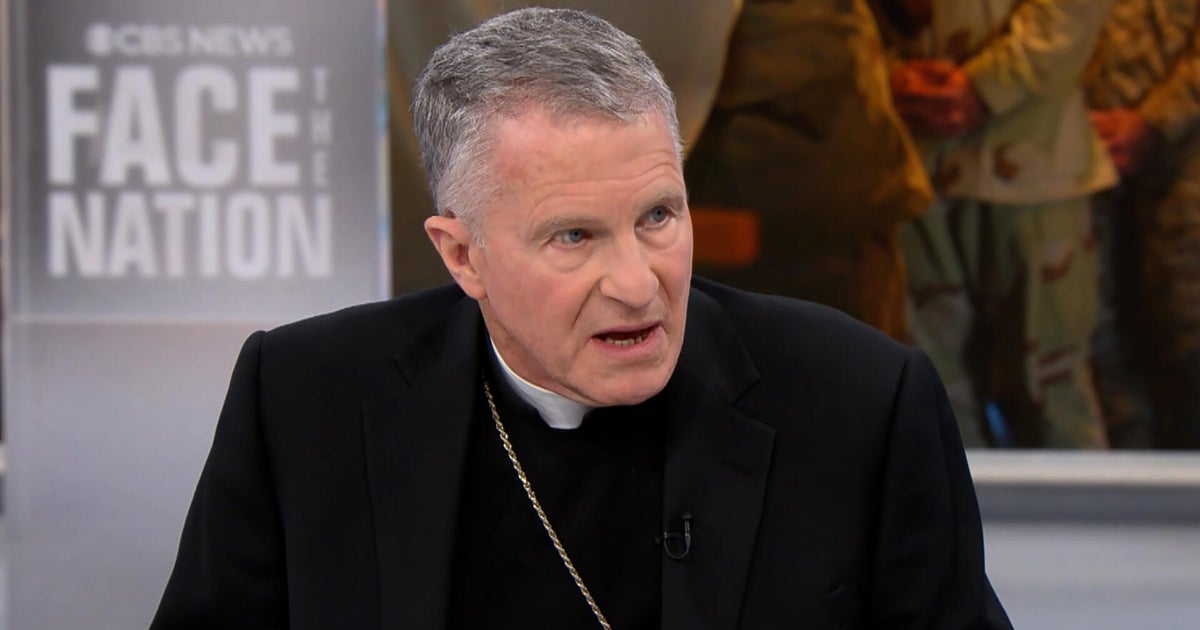
Archbishop Timothy Broglio, who heads the Catholic Archdiocese for the Military Services USA, told CBS News' Ed O'Keefe in an interview that will broadcast Sunday on "Face the Nation with Margaret Brennan" that the war is likely not justified under the Just War Theory.
One of the tenets of Just War Theory, as articulated by St. Augustine, is that war should only be a last resort "in order that peace may be obtained" and not preemptive.
"The Lord Jesus certainly brought a message of peace and also, I think war is always a last resort," Broglio said. He added that the Trump administration "may have information that led them to think that that was the only choice they had. I'm not making a judgment about that, because I really don't know. But I do think that it's hard to cast this war, you know, as something that would be sponsored by the Lord."
Asked by O'Keefe about rhetoric from Defense Secretary Pete Hegseth, who has invoked Jesus' name and called for prayers for service members in relation to the war with Iran, Broglio said casting the war as something that Jesus would justify is "a little bit problematic."
"I would line myself up with Pope Leo, who has been urging for negotiation," Broglio said.
Pope Leo XIV, the first American pope, has urged President Trump and other leaders to find ways to reduce the violence in the Middle East and find an "off-ramp" in the war with Iran.
At the individual level, Broglio counseled Catholic service members to "do as little harm as you can, and to try and preserve innocent lives."
Broglio said that because of the way conscientious objection is set up in the U.S. military, "you cannot object to a specific war or a specific action, you can only object to, 'I'm opposed to war.'" He said how a service member conducts themselves "depends on where you are in the chain of command."
"The question might be, would, you know, would generals or admirals have space to perhaps, say, 'can we look at this a different way?'" Broglio said. "But having spoken to some of them too, they're also in the same dilemma."
Broglio said he and his fellow chaplains are spending more time working on questions of "moral injury," or concerns among service members that they may need to seek forgiveness for the violence they carry out.
"Even if you obey a legitimate command, but you have to kill someone, that's going to leave some traces in, you know, in your heart or on your soul," he said. "We've tried to provide structures and help to people in that situation, to try and help them heal from those situations."