Colorado researchers get a better idea of the possible health problems caused by wildfire smoke
Colorado is breathing in the results of another season of wildfires. More smoke, and more frustration.
"I've been on the inhaler," said Haleigh Spitzbarth, who was at Red Rocks Amphitheatre Tuesday running the stairs with Mitchell Khuri.
"Definitely the hardest -- this -- of the three times we've been out," said Khuri about their recent efforts to exercise at Red Rocks.

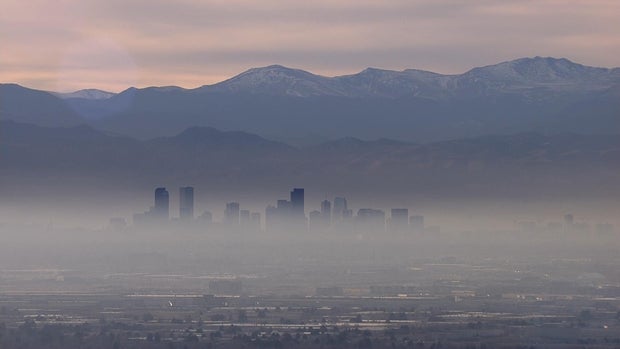
"It's crazy, I work over in Lone Tree and I can't even see the Rockies or the foothills anymore," Spitzbarth noted.
The smoke that has laid over Colorado from recent fires near Pueblo and Leadville as well as the Western Slope has made breathing a problem and has people talking about what's become a common phenomenon.
"We increasingly see evidence in epidemiological studies that fine particulate matter is associated with impacts on multiple organ systems," said Colleen Reid, a Ph.D in environmental health sciences with the University of Colorado Boulder's Geography Department.
The airborne solid and liquid small particulates common in wildfires have their own insidious effects.
"Our bodies have these defense mechanisms for large particles. They get caught in the hair in our noses and cause a mucus response that causes us to get that back out of our bodies," explained Reid. "But the really small ones can get past those defenses and get into deep into the lungs where they cause inflammation and oxidative stress."
That can move those particles into the bloodstream and other organs.
"They've been found in the brains of cadavers, they've been found in placenta, they've been found in all sorts of parts of the body," said Reid. "We also see it affecting the cardiovascular system. We see it affecting the development of the fetus. It affects the health of pregnant people."
Reid has looked at its effect on pregnant mothers, including low birth weight babies.
The small particles are also being identified in the brain.
"There's been evidence that it affects cognition and some role in cognitive decline in older adults through the accumulation of these particles in the brain and the inflammation there."
Only in recent years have scientists begun to widely study wildfire smoke. In the West in recent years, it more often has contained the by-products of the burning of more structures that are laden with oils and plastics.
"When human structures burn, the smoke is much more toxic because we're burning things with metals, we're burning plastics that create a lot of chemicals that are really harmful," said Reid.
Researchers are getting a better idea of the ills caused by wildfire smoke as the West becomes the location of larger and more severe fires.
"In general, what we find is that there's no sort of healthy level of exposure to these particles, and so it's best to just decrease your exposure as much as possible."
They have found that gains made after the passage of the Clean Air Act have been reduced in many places by the increase in wildfire smoke. Along the Front Range studies show those gains in the reduction of particulate pollution have stagnated.
Reid is part of a study looking at indoor pollution. Generally, researchers see there is less pollution indoors. Newer homes, which are tighter, generally have less of the wildfire smoke pollution, but there are variables. Homes with air conditioning, which has filters, have less smoke pollution than those with swamp coolers.
People can act to improve the air at home by obtaining and frequently changing filters on air filtering devices.
"You can put a box fan in your window to try and bring in the outdoor air," said Reid. "You can fit a filter that you would get for your furnace," she explained. "Just use duct tape to attach it, so that as it's pulling in that air to cool off the indoor space, the particles are getting collected on that filter."
Outdoors, some people, especially those with medical issues, may want to wear masks when smoke is heavy.
"So N95, KN95, the KF94, those are all respirator type masks that protect you from what's around you."


