Is Chicago crime out of control, as Trump claims? The data says no

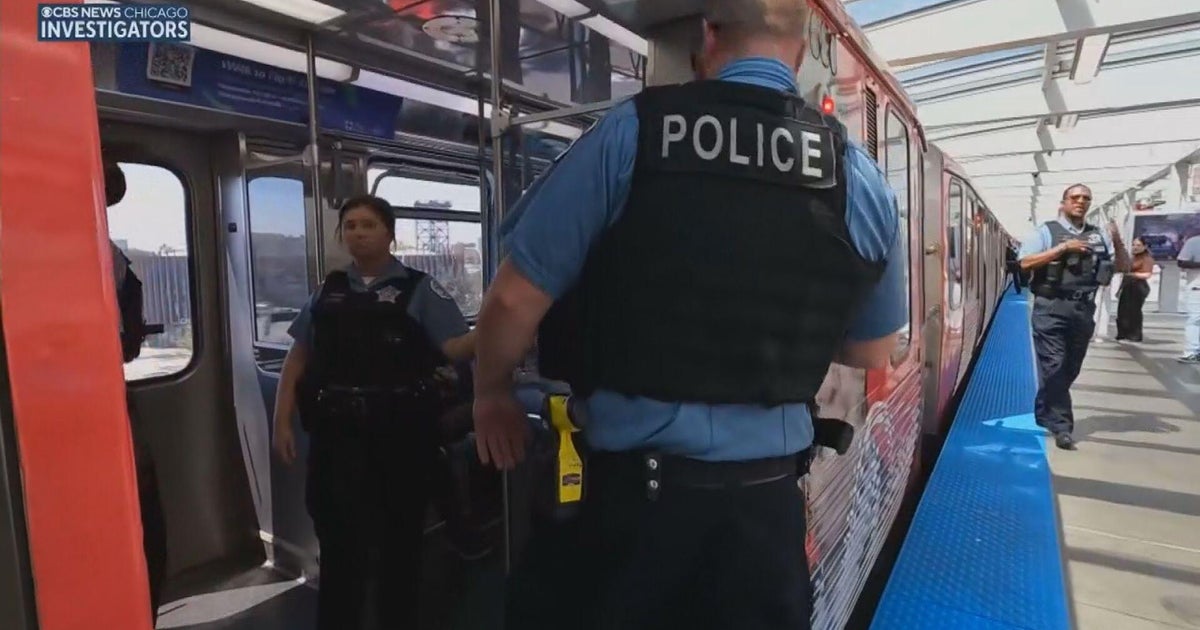
President Donald Trump is threatening to send the military to Chicago, calling the city a "killing field" and claiming violent crime is out of control. But data from the Chicago Police Department and the FBI doesn't support his claims.
Chicago has long had a national reputation for violent crime, particularly for gun violence and homicide. Like all other major American cities, Chicago crime has fluctuated over the years. Rises and drops can happen for many reasons, and a notable recent spike in crime came from the COVID-19 pandemic.
But a CBS News analysis of FBI and CPD data from 2024 found that Chicago is not the most crime-ridden city in the United States. It's not even in the top 50 cities for violent crime.
In fact, data shows that among American cities with populations of 100,000 or more, Chicago ranks 80th overall for violent crime per capita.
Where does Chicago rank for violent crime?
Violent crime falls into several categories as tracked by CPD and the FBI: murder and non-negligent manslaughter, rape, robbery and aggravated assault and/or battery.
There have been some discrepancies in FBI and CPD data since the reporting system changed in 2021; at that time, the FBI tracked certain violent crimes using a definition different than CPD. As a result, the FBI recorded significantly less aggravated assault/battery crimes in 2021 than CPD did. Because of that, CBS News Chicago and the CBS News data team are using a combination of FBI and CPD data to provide the fullest picture with the most accuracy.
In 2024, data shows there were 18,327 instances of violent crime recorded in Chicago. With a population just shy of 2.7 million people, the city recorded 695 instances of violent crime per 100,000 people.
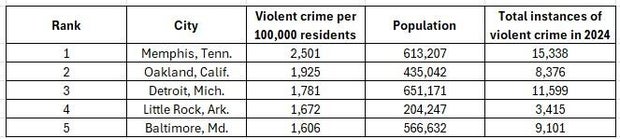
By contrast Memphis, Tennessee ranks first for per capita violent crime of all U.S. cities with 2,501 instances of violent crime per 100,000 people.
The top five cities for violent crime nationwide are Memphis, Tennessee; Oakland, California; Detroit, Michigan; Little Rock, Arkansas; and Baltimore, Maryland.
In fact, per capita Chicago doesn't even rank as the most violent city in Illinois. It comes in fourth, behind Peoria (1,345 instances of violent crime per 100,000 people), Rockford (1,080 instances of violent crime per 100,000 people) and Springfield (901 instances of violent crime per 100,000 people).
Why does per capita violence data matter?
Analyzing crime data through a per capita lens is important because a larger population will produce a higher raw number of overall crimes. The more people you have, the more opportunities there are for any of them to commit a crime, violent or otherwise
The data on raw crime numbers bears this out. New York City, the most populous city in America with 8.29 million people, saw a total of 55,690 violent crimes in 2024. Los Angeles, which is the second most populous city in the country with 3.8 million people, recorded 27,656 total violent crimes in 2024.
Chicago bucks the trend even through this lens: it is the third largest city by population, with 2.64 million people, but fourth-place Houston, with a population of 2.32 million, recorded more total violent crimes in 2024 — 26,628 compared to 18,327 in Chicago.
While the raw numbers may look enormous, they're small when put in the context of population.
If every single violent crime reported in New York City last year was committed by a different person, that's only 0.67% of the city's population. Meanwhile, Memphis recorded 15,338 total violent crimes in 2024 in a city populated by only 613,207 people. If every single violent crime was committed by a different person, that's 2.5% of the city's population.
Are Trump's claims Chicago crime is "out of control" true?
Crime is also falling in Chicago. When compared with national data released by the FBI showing an estimated 4.5% decrease in crime in 2024 compared to 2023, Chicago's crime statistics show changes in the same direction.
Speaking about Trump's reported plans, Illinois Governor JB Pritzker said on Aug. 25 that murders this year in Chicago are down 32% compared to 2024 and nearly cut in half since 2021; shootings are down 37% compared to 2024 and down 57% from 2021; and that robberies have declined 34%, burglaries declined 21% and vehicle thefts are down 26% compared to last year.
CBS News analysis shows those figures are accurate. While complete data will not be out until after the end of the year, the Chicago Police Department announced in August that homicides were down 35%, shootings were down 26% and the number of shooting victims are also down 26% in July 2025 compared to July 2024. Chicago police said violent crime in the city overall so far in 2025 is down 23% compared to 2024, while property crime has dropped 11%, vehicle thefts dropped 27%, carjackings dropped 49% and burglaries are down 21%.
According to the mayor's office, Chicago reported 123 homicides in the summer of 2025, the fewest in June, July and August since 1965. As of August 31, 2025, the city has recorded 278 total homicides, according to Chicago police data cited by the mayor's office.
What is the city doing to address crime?
Chicago still struggles with crime. In 2024, Chicago recorded significantly more murders than other cities over 100,000 people: 573 to rank first in the nation compared to 325 in second-place New York City.
City and state officials continue to work to address crime in Chicago. Mayor Brandon Johnson says he has focused much of his efforts on programs to address violence through community investment, violence intervention, youth employment and other social policies. Johnson and other advocates say these programs address the roots of violent crime in the community and produce long-term reduction in daily violence instead of simply increasing arrests.
Not all residents, especially those who live in neighborhoods with higher rates of violent crime, agree with Mayor Johnson's approach. They want to see more police officers on the streets in their neighborhood; some even welcome Trump's plan of sending the National Guard as long as they are deployed to where they are needed.
"If they put it where it's needed it wouldn't be Michigan Avenue," said Helen Land, who lives on the city's West Side and lost her son to gun violence in 2018. "The violence goes downtown when the people go downtown, but the violence hasn't left the community."
Mayor Johnson recently took President Trump to task, demanding he release $800 million in violence prevention funding. The Trump administration terminated 365 grants funding anti-gun violence programs nationwide in April 2025, including $158 million in funding for the city of Chicago.
Both Johnson and Pritzker have called on the president to restore that funding and to maintain consent decrees overseeing police reforms in departments nationwide.
Chicago and Illinois leaders have called President Trump's characterization of violence in Chicago a "manufactured crisis." The data available shows that, at least, the reality of violent crime in the city is not consistent with Mr. Trump's statements.