Cape Cod residents call for federal support to stabilize coastline after winter storms: "We need help"

After the snow has melted, the impact of the brutal winter is still visible along the Cape Cod shoreline, where powerful storms have accelerated long-standing erosion concerns at local beaches.
At Town Neck Beach in Sandwich, the February blizzard dramatically reshaped the coastline, pushing back the sand dune, leaving behind a steep drop to the entrance of the beach and tearing down the public access staircase.
Residents who have watched the coastline change over decades say the latest winter storms caused some of the most dramatic damage yet and want a more permanent solution.
"It's really bad," said Bill Boles, who has lived in Sandwich for more than two decades. "What you're looking at, especially to the left, was a 25-foot-high dune. And now, as you can see, it's a sandbar, which at high tide is completely covered with water," he added pointing near the salt marsh area.
Boles says erosion has worsened over the years, pointing in part to the federal government's extension of a jetty on the Cape Cod Canal.
$10 million restoration effort wiped out
The Blizzard of '26 also wiped out much of a recent restoration effort. A $10 million U.S. Army Corps of Engineers project that brought more than 300,000 cubic feet of sand back to the beach there last year had already begun eroding before the latest storms struck.
"By November, half of that had gone away already, and these last two storms were devastating," Boles said.
Damage can also be seen nearby Springhill Beach, where residents are scrambling to deal with toppled stairs, decks and shifting sand.
"You see that post hanging down used to be a support beam," said Laura Wing.
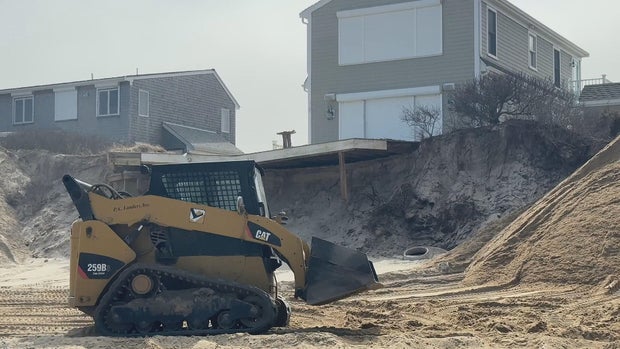
In some areas, she says the face of the dunes has lost significant ground.
"That dune face has lost, in some cases, 10 to 15 feet," Wing said.
Both residents are part of the nonprofit Trustees of Sandwich Beaches, a group calling for continued state and federal support to help stabilize the coastline, to protect properties and the beaches tourists flock to in the summer.
"We need help," Boles added.
Local officials say stronger renourishment policies from the state could help communities maintain beaches that serve both residents and visitors.
"It just goes to show you that, you know, Mother Nature is stronger than all of us," said Assistant Town Manager Heather Harper. "We certainly would really love to see the state have a much more robust coastal beach nourishment policy, which is not as strong as it is in other places, and has just so having that in place would be helpful for us."
Sand dredged from Cape Cod Canal
Harper said securing additional federal funding would likely require another erosion study, but as part of an existing permit, sand dredged from the canal could help fill gaps in the interim.
"The federal government accepted responsibility for some of the damage that's been done to those beaches over time, so that we're hopeful that we've been very fortunate to have included in the Army Corps' ongoing permit that any time that the canal is dredged, that the spoils from that dredging then can be placed on our beaches," said Harper. "That's probably the best bet that we have, is to look forward to the next dredging of the canal, which won't produce the same volume of sand that we saw this most recent time, but enough to hopefully keep the sand in place and available."
Town leaders say they are also exploring short-term solutions to ensure Town Neck Beach can get back open and remain accessible ahead of the summer tourism season.
"In the long term, the community invested an awful lot of resources and will continue to do so as best we can," Harper added.