Battle over $850,000 Quincy saint statues comes before Massachusetts Supreme Judicial Court
The Massachusetts Supreme Judicial Court is weighing whether two statues of Catholic saints can be installed at the entrance to a new public safety building in Quincy.
Quincy officials say the 10-foot-tall statues of St. Michael and St. Florian are important to police officers and firefighters. The high court heard arguments Wednesday morning about the long-running dispute between the city and some residents of different religious faiths who say their presence in a government building would violate the Massachusetts Constitution.
Some have objected to the statues' cost, which is about $850,000. But the court is focused on the religious symbolism of the statues, with the American Civil Liberties Union and others arguing that they don't belong on public property.
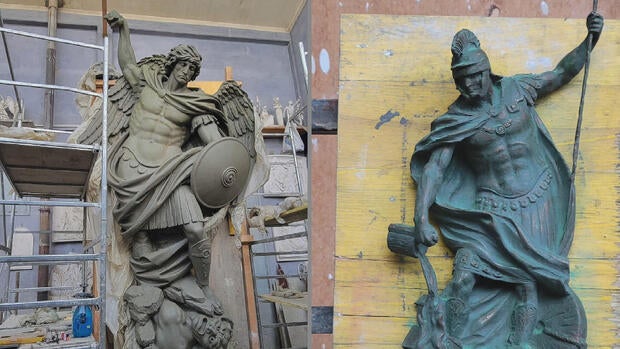
Justice Gabrielle Wolohojian asked how common the statues are, saying, "I take it that there's not another fire department or police department in the commonwealth of Massachusetts that has these statues on the front of a building."
Joseph Davis, an attorney for the city of Quincy, pointed to similar displays at police and fire departments in Los Angeles, New York City and Bristol, Connecticut.
"So none in Massachusetts, and you've come up with three out of the probably hundreds of thousands of police and fire department buildings in the country," Wolohojian replied.
Quincy has argued that as the patron saints of police and fire departments, the statues are important symbols to first responders.
"They've come to represent firefighters and police officers, whatever their beliefs or backgrounds," Davis said.
The court also had tough questions for the side opposed to the statues. Justice Scott Kafker said he's trying to figure out why the proposed statues cross the line.
"The Supreme Court's cautioning us ... there's not a hermetically sealed separation between church and state," Kafker said. "Some of it's allowed."
The ACLU's Jessie Rossman said Quincy is sending the wrong message to followers of other religions, as well as non-religious people.
"It's the government using its platform to elevate a religious belief over the beliefs of others," she said.
A Norfolk Superior Court judge in October temporarily blocked installation of the statues. It's not known when the justices will issue their decision.


