How WBZ-TV's Lisa Hughes helped rescue a duckling found abandoned in her yard

The movement in the grass caught my eye. It was a small creature moving excitedly—almost frantically—through the patchy green. "Is that a duckling?" I asked my husband and son who calmly looked outside and agreed that yes, it was a duckling. I scanned for a mother duck or other lost ducklings but there was none to be seen. This tiny bird was alone and agitated. In the yard, particularly under a pine tree or a shrub, it was safe. My fear was that, if it wandered into the adjacent conservation land, it would quickly become a meal. I walked outside to see the duckling up close and to shoot some video.
It was under a small tree when I sat down to observe it. We were on opposite sides of the pine. I positioned my phone to shoot video and started talking to the duckling. At first, it waddle-bounced out of view. Seconds later, it moved toward me… and kept coming. It was walking right up to the camera lens on my phone. I sat very still. What was I supposed to do? Before I could come up with an answer, the duckling crawled on my bent leg and made itself at home at the top of my sock. I called New England Wildlife Center and left a message. "I found a duckling in my yard and now it's sitting on my leg," I babbled.
As I spoke, the tiny bird started slipping on the sock fabric. I held my hand under its body. Was it okay to do this? It crawled into my hand. "Now it's in my hand. I'm not sure what to do." At this point, my 14-year-old son had positioned himself next to me. "I'm going to get a box with a towel in it," he said. That sounded like as good an idea as any. But I also didn't want to put down the duckling. It was calmer, still chirping but clearly more relaxed. How is this baby trusting me right now? It felt simultaneously inconceivable and understandable. It was vulnerable, alone, and needed protection.
A return text came quickly asking if I had photos or video of the duckling. Markings would help the experts at the New England Wildlife Center identify the species. After sending a few shots, I received a second message. "That's a wood duck! There's only one person in eastern Mass that rehabs wood ducks—Sue Cowan in Carver." The message included Sue's number. Bingo! I called Sue immediately. She explained that wood ducks hatch in trees. When they've all hatched, the mama duck calls to them from the bottom of the tree. The babies leap from heights of up to 50 feet or more, using their feet to "catch air" on the way down to control the fall. Once on the ground, they follow their mother to the closest water source. But if a predator or an obstacle separates the ducklings from their mother, she doesn't stick around. This duckling in my yard was not going to be reunited with its mother.
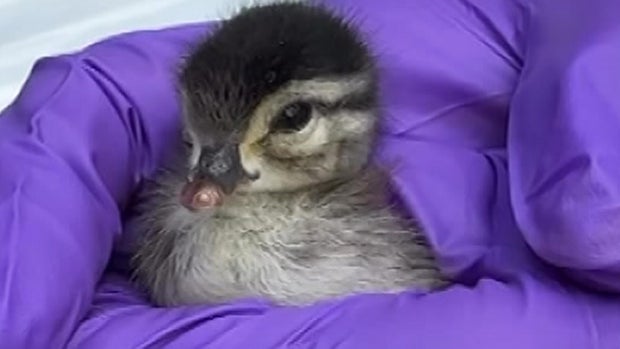
Sue explained that, of greatest immediate concern, was the duckling's stress level. Wood ducklings can get so stressed that they die. Sue told me to close the top of the box and keep the duckling's environment as dark, warm, and comfortable as possible. If I could drive the duckling to Carver, she would take it. While I quickly got ready to leave, my son watched the duckling. At one point, he set it carefully on the deck. It turned and walked back to him where it rested in his hand. My husband called it Pebbles for its markings.
Within minutes of talking with Sue, taped box in the backseat, I set out for Carver. None of this was in my Sunday plan. But this was life—full of surprises. I made it exactly a half-mile before I was stopped by a parade on Route 16 in Wellesley. There was no way to get to Route 9 or any other road until the parade ended. I left the car running, ran across the street (dodging parade participants in small trains) and asked a kindly man in a golf cart how much parade was left. I explained my predicament, and he assured me that, with seven "acts" to go, it wouldn't be long. I positioned my car at a parking lot exit while describing the hold-up to the box and the duckling. I realize this explanation was for my benefit, the equivalent of a deep breath. But I desperately wanted this sweet creature to know that I would do everything in my power to help it survive. After all, its will to live was so strong that it had trusted a giant (relatively speaking) stranger with its life.
After an eternal 10 minutes, Pebbles and I were on the road for Carver. I listened for rustling and chirping from the box—hopeful signs that the duckling was okay. Almost every sound was reassuring, with one exception. Within 10 miles of our destination, it started jumping. That kind of anxious movement, I now knew wasn't good for the bird. I couldn't bear the idea that it might expire with mere miles of Cowan Critters. I reached back and put my hand against the box. I'm pretty sure it did nothing for the duckling. But it helped me calm down. Hang in there little baby. We are almost to your new home.
We arrived at 3:30. Sue opened the box and said sweetly, "It's a little baby wood duck!" She scooped him up in a gloved hand and looked over the duckling. She showed me the little barbed claws on its webbed feet which allowed it to grip the bark in the tree where it hatched. She guessed it was two days old. Next, she brought the baby inside to a 95-degree incubator, opening the door of the enclosure where it joined, roughly, a dozen other ducklings. She explained that they would snuggle and bond.
Sue and her husband Dave run Cowan Critters—largely at their own expense. Right now, they are caring for 300 ducks and ducklings. Hours after I dropped off the duckling, Sue sent me a photo of him (or her) with its new "flock." The duckling was just fine. Better than fine. Mission accomplished.