Likely origins of Cape Cod Bay meteorite revealed in new report
Remember that meteorite that landed in Cape Cod Bay back in the spring? Well, a group of researchers have been hard at work trying to piece together exactly what happened in the skies over Massachusetts back on May 30.
It is indeed a rare event to have a "superbolide" (a very bright fireball/meteor that typically explodes in the atmosphere) literally explode right over our heads and then actually make landfall.
Some local residents actually caught a glimpse of the fireball while thousands of others heard the sonic boom.
You could say the scientists got lucky with this one, occurring in a densely populated area. It was captured by a wide array of sensors, dashcam and security video, four weather radars and, most importantly, the MIT Haystack Observatory specular radar located in Westford.
Researchers were able to combine all these measurements to reconstruct the path of the meteor, the energy release and finally, the "landing field."
What they discovered was truly fascinating.
Composition: Evidence is consistent with a "dense, mechanically strong meteoroid, possibly iron-rich."
Origin: The belief is that the meteor originated as a "main-belt asteroidal fragment" (from the asteroid belt between Mars and Jupiter).
However, more recently, it likely was part of the "Jupiter-family-comet-like orbits." In other words, it came from a much more distant place in our solar system, as shown in this diagram.
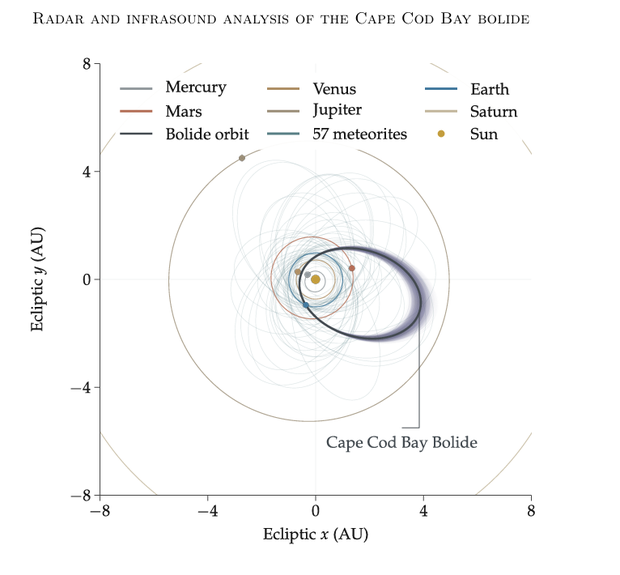
They also concluded that there was no "parent body or meteor shower association," meaning it was a lone wolf.
Sonic boom: Researchers estimate that the meteorite exploded about 21 miles above our heads with a force somewhere near 500 tons of TNT.
Landing zone: Finally, the researchers verified that the landing zone was somewhere in Cape Cod Bay and likely in several small fragments.
Comparison: They say that this meteorite's impact energy was comparable to the 2008 impact over Sudan and about one quarter of the 2012 meteor explosion that occurred over California and Nevada, otherwise known as "The Sutter's Mill meteor."
Finally, they added only three recorded events in all of 2025 had impact energies that exceeded the Cape Cod meteorite.


